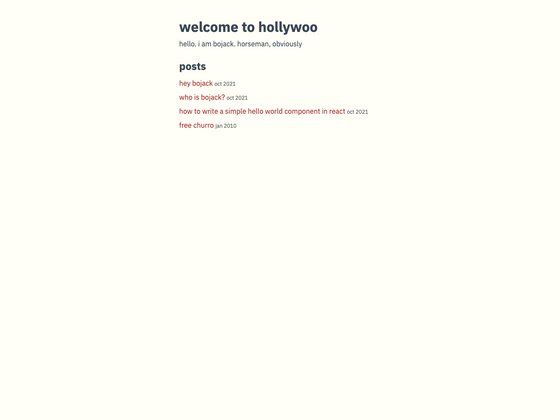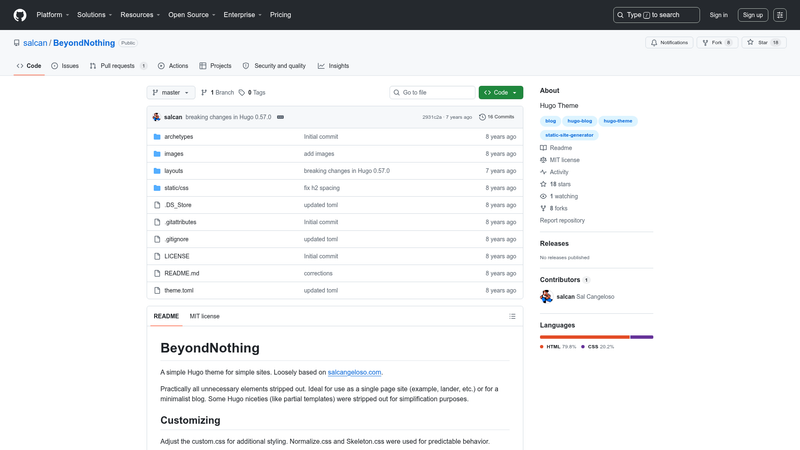
BeyondNothing is a minimal Hugo theme for static sites that strips away all unnecessary elements, making it ideal for single-page landers and minimalist blogs. It is built on the Hugo static site generator, takes Markdown content as input, and produces a clean HTML output with minimal styling dependencies.
What is BeyondNothing?
BeyondNothing is a Hugo theme that emphasizes extreme minimalism. It was created for the personal site salcangeloso.com and is released under the MIT license. The theme intentionally removes practically all unnecessary elements, including Hugo partial templates, to keep the codebase tiny and easy to understand. Users customize the theme by editing a custom.css file, and the theme relies on Normalize.css and Skeleton.css for consistent base styles.
Key Features
- Extreme Minimalism — Practically all unnecessary elements are removed, and even Hugo partial templates are omitted to simplify the theme structure.
- Skeleton.css Integration — The theme bundles Skeleton.css for responsive grid and base styling, paired with Normalize.css for cross-browser consistency.
- Custom CSS Override — Users adjust the look and feel by editing custom.css, without modifying the theme's core files.
- Two Target Layouts — The theme is ideal for a single-page site (such as a lander) or a minimalist blog.
- Simple Installation — Install by running
git clone https://github.com/salcan/BeyondNothing.git themes/beyondnothingand then start Hugo withhugo server --theme=BeyondNothing --buildDrafts --watch. - MIT License — Free to use, modify, and distribute with no restrictions.
Who is it for?
- Developers with personal sites — Set up a clean landing page without extra boilerplate or complex component systems.
- Bloggers who value focus — Publish a minimalist blog where content is front and center, with no distractions from heavy theming.
- Hugo beginners — Explore a minimal, readable Hugo theme structure, though note that partial templates are intentionally absent.
Use cases
- Freelancers: create a one-page portfolio or service lander quickly, relying on the built-in Skeleton.css grid.
- Writers: start a no-frills blog and keep the focus on text, using Normalize.css for predictable typography.
- Developers: use BeyondNothing as a starting point to build a custom Hugo theme from a clean, minimal base.
How does it work?
After cloning the theme into your project's themes directory, you run the Hugo development server with the theme enabled. The theme reads your content files and renders them as static HTML pages. Styling adjustments are made by editing custom.css, which overrides the base styles provided by Skeleton.css and Normalize.css.
FAQ
Is BeyondNothing free?
Yes, the theme is open source and distributed under the MIT license, so you can use it for personal and commercial projects without cost.
Does BeyondNothing support Hugo partials?
No, partial templates were intentionally stripped out to keep the theme as simple as possible, as stated in the project's description.
What CSS does BeyondNothing use?
It uses Skeleton.css for the grid and base styles, along with Normalize.css to ensure consistent rendering across browsers.
How do I install BeyondNothing?
From your Hugo project root, run git clone https://github.com/salcan/BeyondNothing.git themes/beyondnothing, then start the server with hugo server --theme=BeyondNothing --buildDrafts --watch.