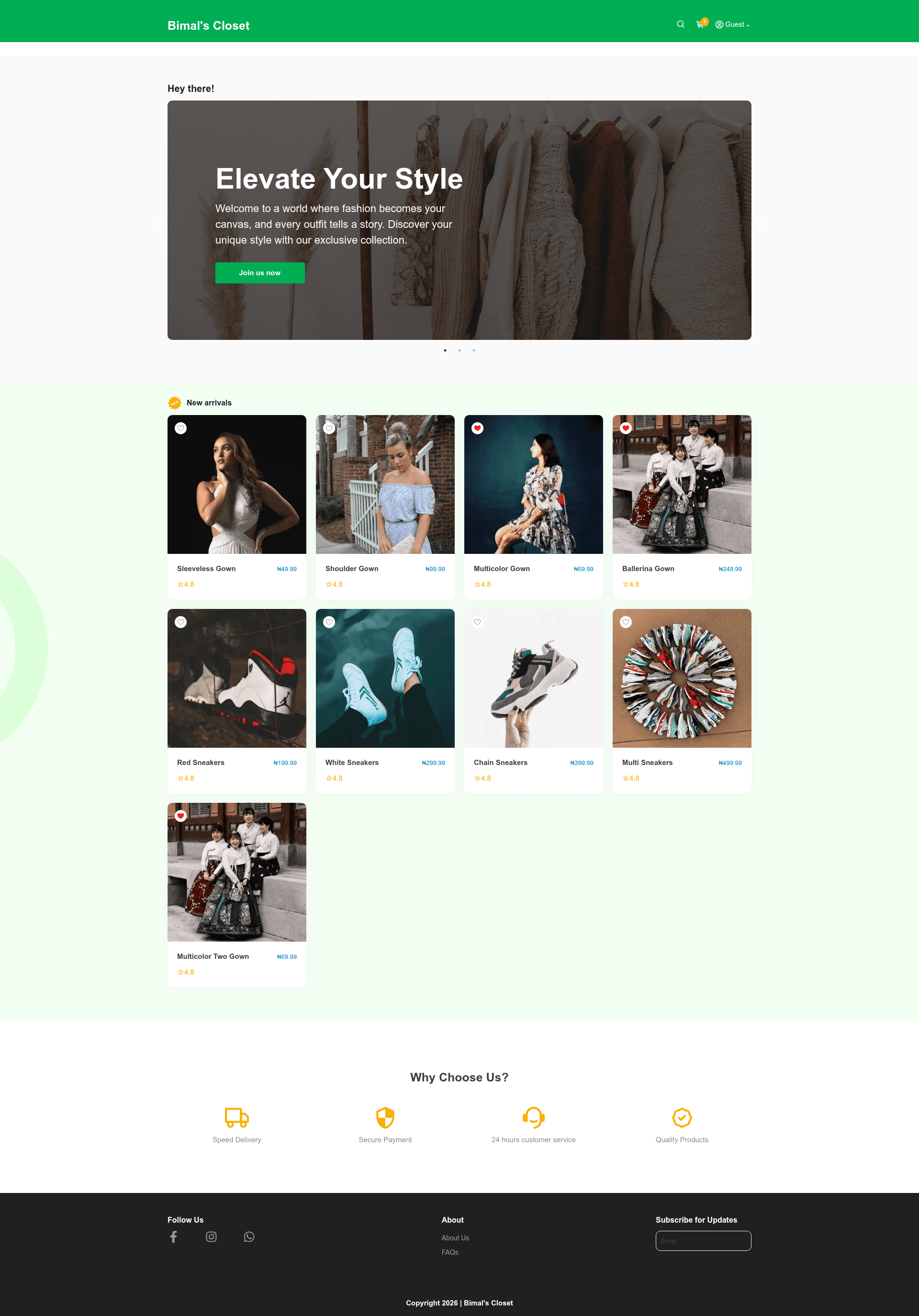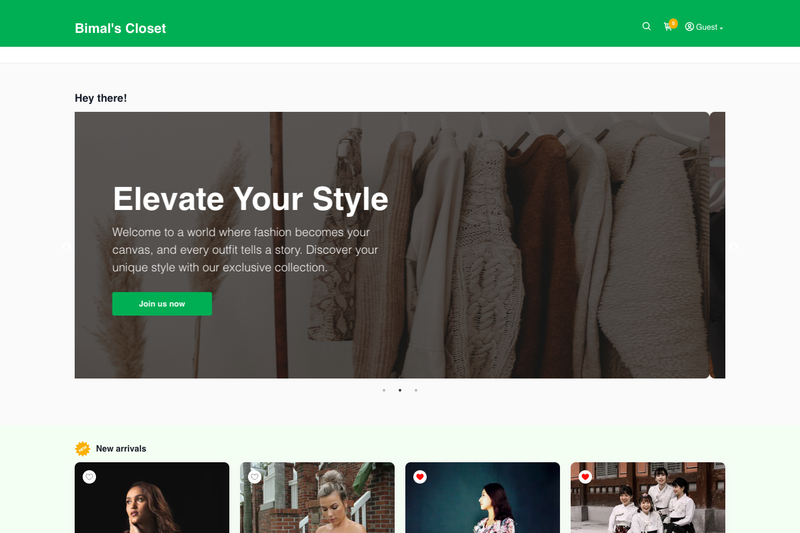
Bimal's Closet is an e-commerce web app template built with Next.js that delivers a functional storefront with authentication, cart, wishlist, order placement, and checkout via Paystack. This frontend repository pairs with a separate backend (bimals-closet-API) and is live at https://bimals-closet.vercel.app.
What is Bimal's Closet?
Bimal's Closet is a frontend-only e-commerce project written in TypeScript and JavaScript on the Next.js framework (Next.js 13 per repository topics). It implements the storefront layer of a clothing store, taking product data and user actions from an API and rendering a shopping experience with a Chakra-UI component library. The template outputs a responsive web application for browsing products, managing a cart and wishlist, placing orders, and paying through the Paystack payment gateway. It is maintained by Bimal's Closet (the author is not named beyond the project name), was last updated in 2023, and has 24 GitHub stars.
Key Features
- Authentication — User sign-in/sign-up flow is implemented, allowing customers to create accounts and log in before ordering.
- Cart implementation — A client-side cart stores selected items, with state managed through Zustand.
- Wishlist — Users can save products to a dedicated wishlist for future purchase.
- Order placing — The app supports submitting an order once the cart is finalized.
- Checkout with Paystack — Payment processing is integrated with Paystack, the Nigerian payment gateway, to handle transactions.
- React Query data fetching — Server-state management uses React Query for API calls, caching, and synchronization.
- Chakra-UI styling — The UI is built with Chakra-UI's component system, giving a consistent set of styled buttons, forms, and layout primitives.
Who is it for?
- Next.js developers looking for a working e-commerce starter that demonstrates routing, API integration, and state management.
- Clothing retailers wanting a ready-made storefront to pair with a custom backend; the frontend already handles cart, wishlist, and checkout.
- Learners of modern React who want a real-world example combining Zustand, React Query, and Chakra-UI in a TypeScript project.
What can you do with Bimal's Closet?
- Launch a storefront — Deploy the frontend to Vercel (live demo) and connect it to your own backend API to start selling clothing.
- Study a full-featured codebase — Trace how auth, cart, wishlist, and orders are wired together in the Next.js app.
- Extend the missing features — The repo notes that SMS verification, order tracking, and order cancellation are planned, so developers can fork and add these modules.
FAQ
Is Bimal's Closet free to use?
The repository is publicly viewable on GitHub and accepts pull requests, but the license reads "Copyright © 2023 | Bimal's Closet. All rights reserved." That means standard open-source reuse is not granted, so you should contact the author for permission before using the code in your own project.
What payment gateway does Bimal's Closet use?
Checkout is integrated with Paystack, a payment gateway popular in Nigeria and across Africa. Paystack is the only payment provider mentioned in the README; the implementation handles the payment step of the order flow, though the exact transaction flow is part of the frontend codebase.
What features are not yet implemented?
The README checklist shows three unchecked items: SMS verification, order tracking, and order cancellation. These are marked as future enhancements, so a forked or deployed version currently lacks them. The checked items are Authentication, Cart Implementation, Order Placing, Wishlist, and Checkout (using Paystack).
Which backend does Bimal's Closet work with?
The frontend requires a companion API. The README links to the backend repository (github.com/Sproff/bimals-closet-API), which supplies the product, authentication, and order data. No sample API server is included inside this frontend repo.
What is the tech stack?
Next.js is the framework, Chakra-UI provides the UI components, Zustand manages client state, and React Query handles server-state data fetching. The project uses TypeScript and JavaScript in its codebase.