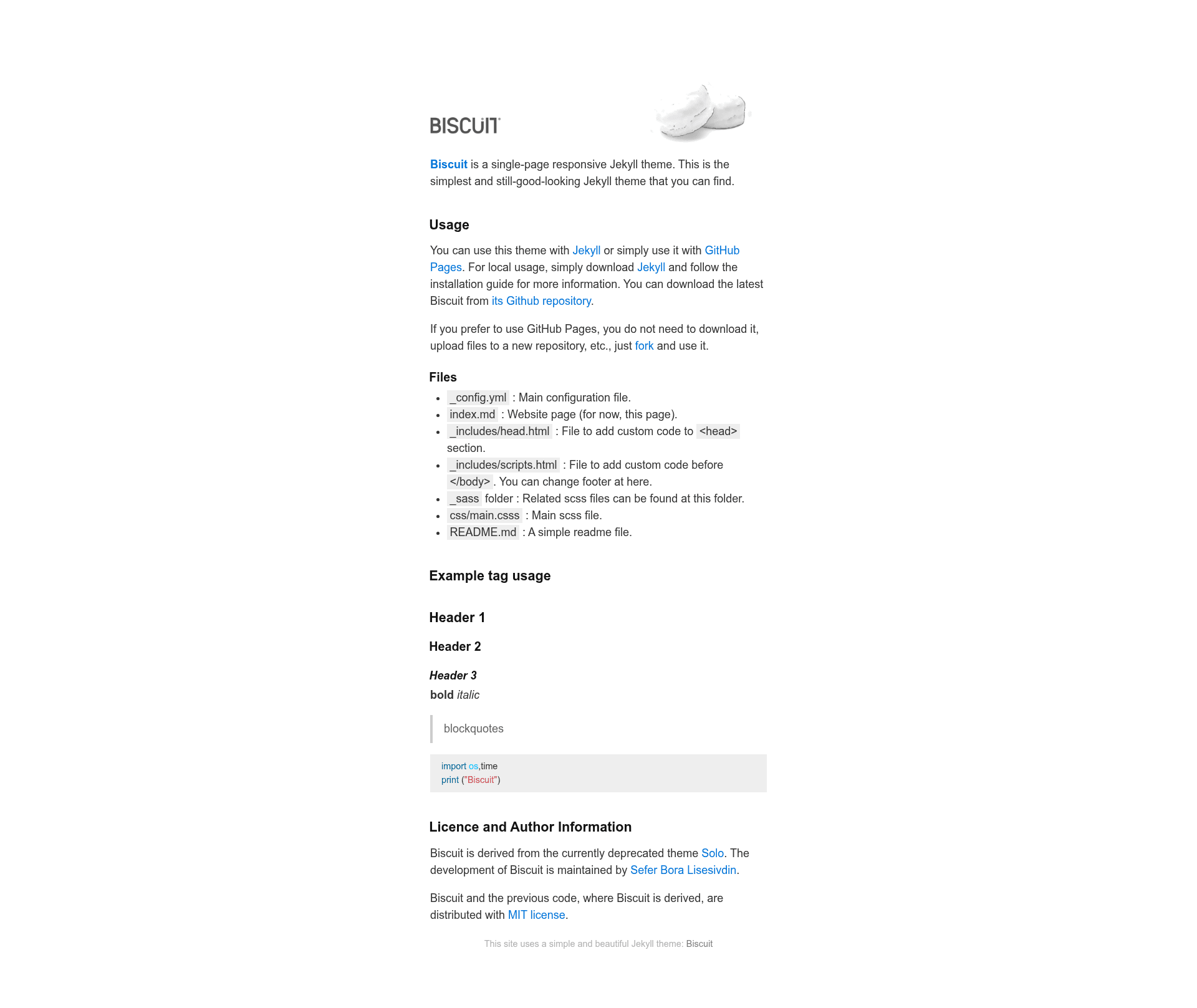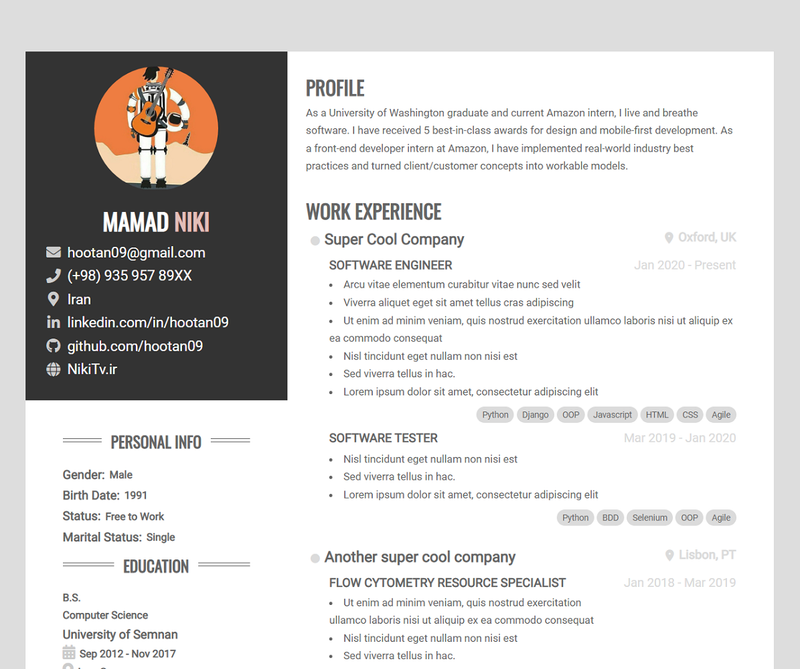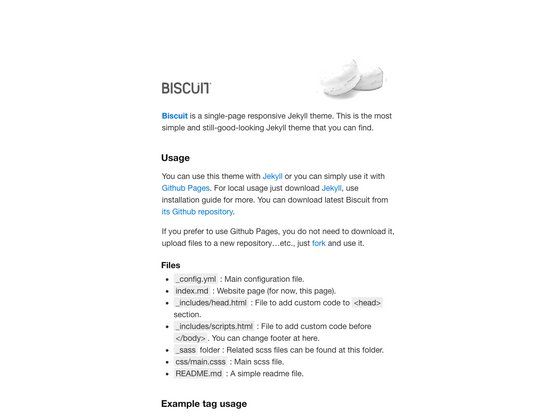
Biscuit is a single-page responsive Jekyll theme that builds a minimal static website from Markdown content, deployable locally or directly on GitHub Pages.
What is Biscuit?
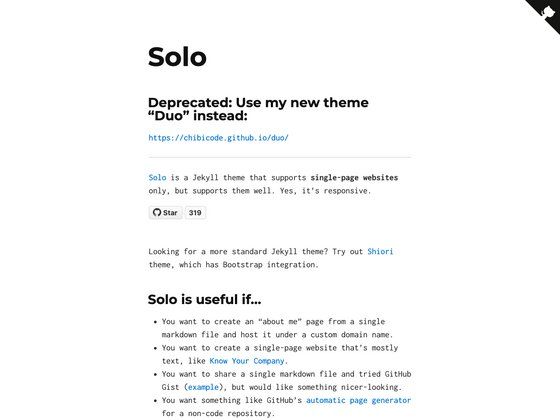
Biscuit is a Jekyll theme that renders the whole site as one responsive page. It takes standard Jekyll content files as input and outputs a static HTML page. The theme is maintained by Sefer Bora Lisesivdin and is derived from the now-deprecated Solo theme. The source code lives in the GitHub repository at https://github.com/sblisesivdin/biscuit, and the project has 37 stars. It is distributed under the MIT license, as is the Solo code it is based on.
Key Features
Biscuit is designed around simplicity, offering a short list of core capabilities.
- Single-page layout — The entire site is presented on one page, ideal for compact personal pages.
- Responsive design — The layout adapts to phones, tablets, and desktops without extra configuration.
- Jekyll integration — Works with Jekyll's standard file structure and Markdown as its content format.
- GitHub Pages compatibility — Fork the repository and enable Pages to publish without a local Jekyll install.
- MIT license — Permissive terms allow copying, modification, and commercial use.
- Solo derivation — Inherits the design of the discontinued Solo theme but is independently maintained.
- Focus on content — The theme uses minimal markup so text remains the center of attention.
Who is it for?
This theme is for people who want a simple single-page website without a complex setup.
- Jekyll newcomers — Get a working static page by copying a small theme and editing
index.md. - GitHub Pages users — Deploy a personal page by forking the repository, no installation needed.
- Hobbyists and students — Use the theme as a learning example for how Jekyll themes are structured.
- Portfolio owners — Present a short bio and links in a clean, responsive layout.
What can you do with Biscuit?
Biscuit supports a few practical uses, all built around its single-page layout.
- Personal landing page — Create a one-page site that introduces yourself and links to your social profiles.
- Project page — Showcase a single project with minimal distraction, hosted for free on GitHub Pages.
- Theme exploration — Study the code of a small MIT-licensed Jekyll theme to learn how layouts and includes work.
How does Biscuit work?
Biscuit works like any standard Jekyll theme: place content in Jekyll's conventional directories, and the theme renders it into a static site. To run it locally, download Jekyll and clone the repository. For GitHub Pages, no download is needed — fork the repository, edit the site configuration, and publish.
FAQ
Is Biscuit free?
Yes, Biscuit is released under the MIT license, so you can use, modify, and distribute it for free, including in commercial projects.
Can I use Biscuit with GitHub Pages?
Yes, you can fork the Biscuit repository on GitHub and enable GitHub Pages to publish your site without installing Jekyll locally.
Is Biscuit responsive?
Yes, Biscuit is designed as a responsive theme, meaning the single-page layout adapts to different screen sizes.
What is Biscuit based on?
Biscuit is derived from the Solo Jekyll theme, which is now deprecated. Biscuit continues Solo's minimal approach and is maintained separately.
License
Biscuit is released under the MIT license, which permits free use, modification, and distribution, including for commercial purposes. The license file is included in the GitHub repository.