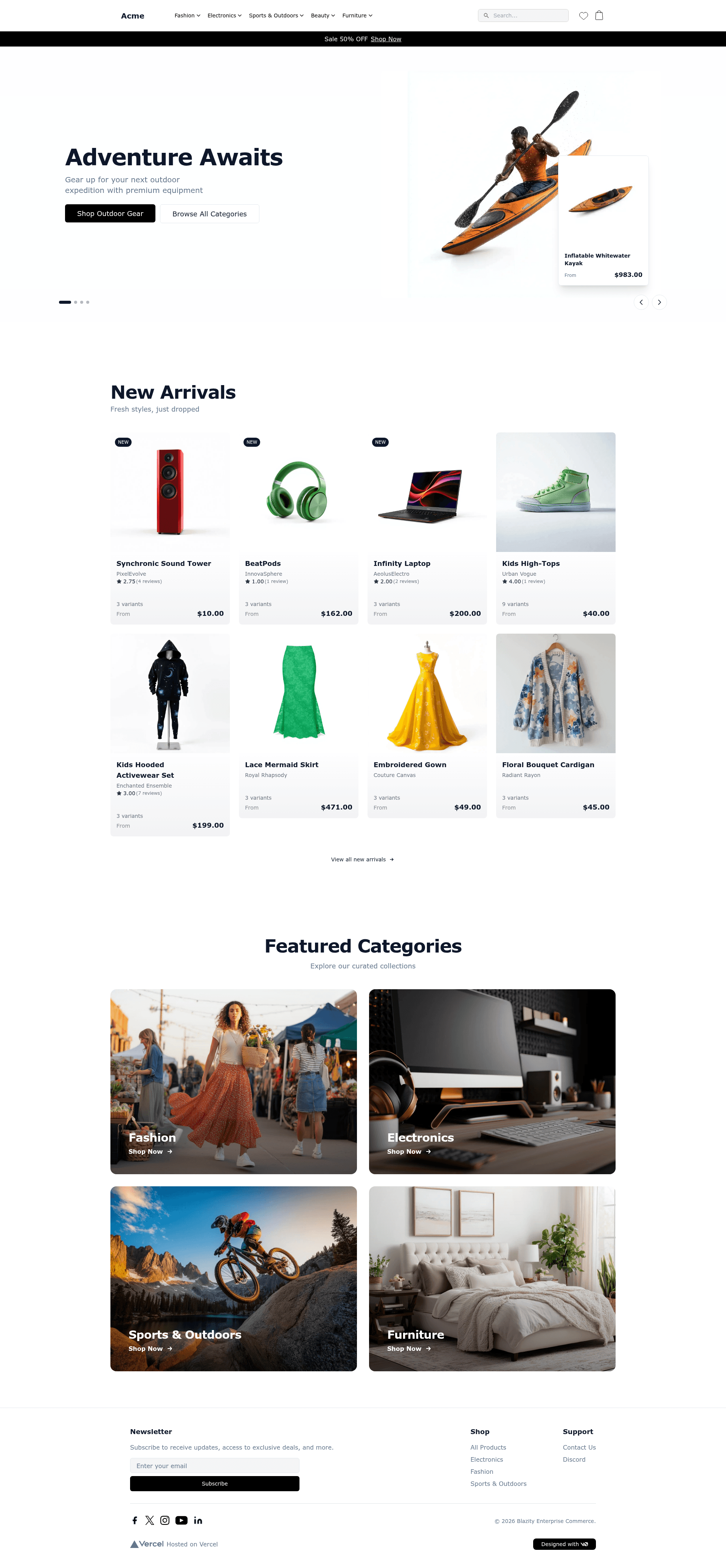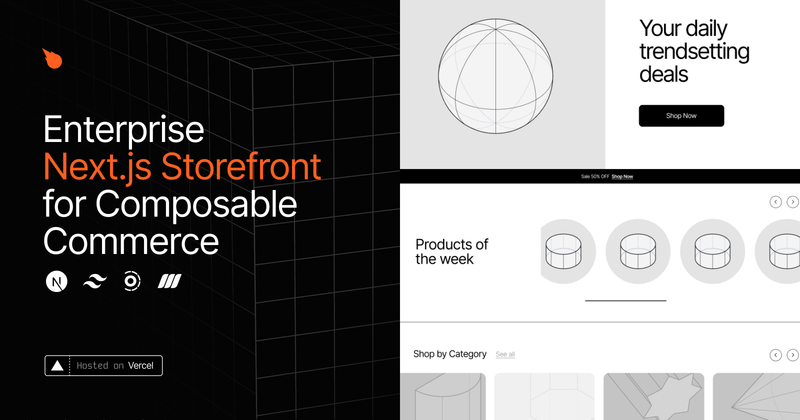
Enterprise Commerce by Blazity is an open-source, enterprise-grade Next.js storefront template that pairs a Shopify backend with an Algolia middle layer to deliver instant search, faceting, and sub-second browsing for large product catalogs.
What is Enterprise Commerce?
Enterprise Commerce is an open-source Next.js project built by Blazity using the App Router, with Shopify providing product data and categories and Algolia handling data fetching, search, faceting, and recommendations. The template outputs a full storefront including Home Page, Category Landing Pages, Product Listing Pages, Search Results Pages, and Product Details Pages, each with its own rendering strategy. It is designed to be deployed to Vercel with one-click cloning.
What makes Enterprise Commerce stand out?
- Shopify + Algolia architecture — Shopify acts as the e-commerce backend while Algolia is the middle layer for instant search, faceting, filtering, typo tolerance, and word similarity across thousands or millions of products.
- Enterprise-grade redirects — Tens of thousands of redirects are handled without latency overhead using Bloom Filters.
- Fast builds — The build process is optimized to stay fast regardless of e-commerce data volume, avoiding the typical slowdown from large product catalogs.
- Rendering strategy matrix — Different page types (HP, CLP, PLP, SRP, PDP) use combinations of ISR, SSG, PPR, CSR, and SSR to balance SEO, speed, and personalization.
- SEO with crawling budget optimization — Critical pages render content without requiring JavaScript execution, and the template supports ISR MegaNav updates with client-side hot-reload via SWR.
- Analytics and A/B testing — Built-in support for Vercel Analytics or Google Analytics with easy provider switching, plus an A/B testing setup implemented in middleware.
- Product Details Page features — Multiple variant combinations, an image carousel that auto-changes based on selected variant, headless CMS FAQ sections, product reviews panel with a 'View all reviews' subpage, and recommended products.
- Headless CMS driven content — Category Landing Pages use an optimized headless CMS for cover images and descriptions, and PDP FAQ sections are also CMS-driven.
Who is it for?
- Enterprise e-commerce teams that need a storefront capable of handling large catalogs with fast search and browsing experiences beyond what monolithic platforms can deliver.
- Developers building Shopify storefronts who want a ready-made Next.js App Router implementation with best practices for SEO and performance, including pre-configured ISR/SSG/PPR strategies.
- Growing e-commerce businesses that expect to scale to thousands or millions of products and need faceting, typo-tolerant search, and efficient redirect handling without custom infrastructure.
- Teams running A/B tests on storefronts, since the template includes middleware-based A/B testing and integrates with Vercel Analytics.
What can you do with Enterprise Commerce?
- E-commerce founders: launch a production-ready storefront connected to their Shopify catalog, with instant Algolia-powered search and filters that keep browsing fast at scale.
- Frontend engineers: customize rendering strategies per page type and switch analytics providers easily, using the documented architecture decisions on docs.blazity.com.
- SEO specialists: get above-the-fold content that renders without JavaScript and a crawling-budget-aware sitemap structure, so crucial pages are indexed efficiently.
How does it work?
Setup involves cloning the repository, configuring Shopify and Algolia credentials, and following the 'Setup & Configuration' guide at docs.blazity.com/enterprise-commerce. You can also deploy the project directly to Vercel with one click from the repository page. The template then uses Algolia as a fast lookup layer for search and faceting, with Next.js rendering strategies chosen per page type to keep responses quick.
Pricing
The project is licensed under the MIT License, so the template itself is free to use and modify. Running the storefront requires accounts for Shopify, Algolia, and Vercel, which have their own pricing.
FAQ
Is Enterprise Commerce free?
Yes, the template is open source under the MIT License, so you can use and modify it without license fees. You will need to pay for Shopify, Algolia, and Vercel services to run the storefront.
What tech stack does it use?
The template uses Next.js with the App Router, TypeScript, Shopify as the backend, Algolia for search and faceting, and is designed to be hosted on Vercel. It also integrates with Vercel Analytics or Google Analytics and was designed using v0.
Can it handle thousands of products?
Yes. The combination of Algolia for search and faceting plus optimized builds means it is designed to handle thousands of products, and the authors say it will most likely work with millions.
Does it support A/B testing?
Yes. The template includes an A/B testing setup implemented in middleware, with support for ISR variants above the fold and CSR below the fold, or PPR.
What page types are included?
It includes the Home Page, Category Landing Pages, Product Listing Pages, Search Results Pages, and Product Details Pages, each with documented rendering strategies such as SSG, ISR, PPR, CSR, and SSR.