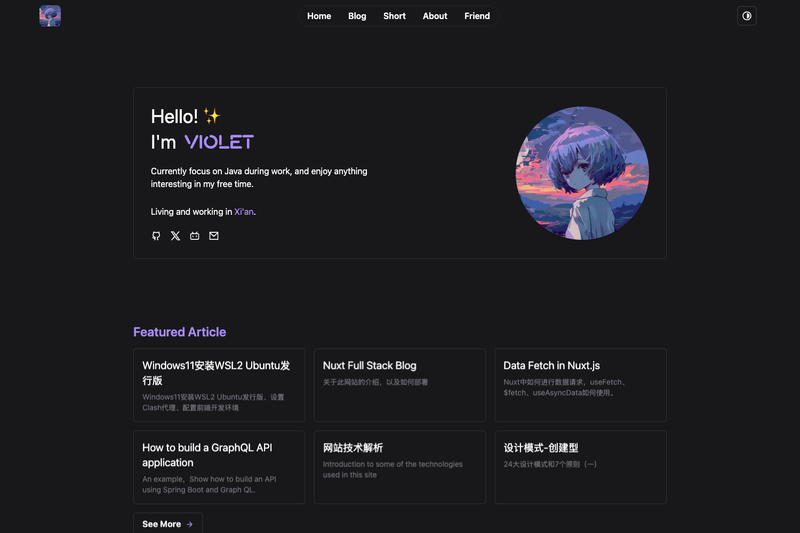
Blog Next View is an open-source Nuxt full-stack blog template with MongoDB storage, Cloudflare R2 image hosting, and a built-in admin and editor. It combines the frontend and API routes into a single Nuxt application, eliminating the need for a separate backend service. Created by developer lnbiuc and available on GitHub with roughly 75 stars, the template is designed for personal blogging with an integrated admin panel, full-text search, and Giscus comments.
What is Blog Next View?
Blog Next View is a full-stack blog template built on Nuxt (Vue.js) that merges the frontend and server routes into one application. It stores content in MongoDB via nuxt-mongoose, hosts images on Cloudflare R2 using Amazon S3-compatible uploads, and includes an admin panel plus a WYSIWYG Markdown editor for managing posts. The project originated as a Vue + SpringBoot site, but the author rewrote it as a Nuxt full-stack app to reduce the number of containers deployed on Zeabur and cut hosting costs.
What makes Blog Next View stand out?
- Full-stack Nuxt architecture — The entire blog runs as one Nuxt app, so deployment on Zeabur requires fewer containers than the previous Vue + SpringBoot setup, lowering monthly server costs.
- MongoDB data storage — Content models are defined with nuxt-mongoose, using MongoDB as the primary database instead of the MySQL used in the first generation.
- Cloudflare R2 image hosting — Images are uploaded to Cloudflare R2 buckets via the Amazon S3 API, configured through environment variables like R2_UPLOAD_ENDPOINT and R2_BUCKET_NAME.
- Integrated admin and editor — The template ships with admin and editor pages; editing uses vditor, a Markdown WYSIWYG editor, allowing posts to be written directly in the browser.
- Full-text search — Site-wide search is included, letting readers find posts by keywords.
- Giscus comments — Article comments are powered by Giscus, which stores discussions in GitHub Discussions.
- Modern styling and SEO — Uses unocss for atomic CSS, @nuxtseo/module for meta tags and SEO, shikiji for code highlighting, and @nuxtjs/color-mode for light/dark themes.
- Extra utilities — Copy-selected-text on double-click, friend-link screenshot generation via a ScreenShot service, scheduled tasks with nuxt-scheduler, and Pinia for frontend state.
Who should use Blog Next View?
- Personal bloggers — who want a modern blog with an admin dashboard and the ability to write posts from the browser, without building a backend.
- Nuxt developers — who need a complete sample of a Nuxt full-stack project with MongoDB, file uploads, authentication, and server routes.
- Budget-conscious site owners — who prefer a single-container deployment on Zeabur to keep hosting costs predictable.
What can you do with Blog Next View?
- Publish content: Write and edit articles, short posts, and project pages through the built-in WYSIWYG editor, then manage them from the admin panel.
- Customize the site: Use the About, Friend, and Project pages to build a personal hub, and configure the header with vue-use-fixed-header.
- Deploy cheaply: Run the site on Zeabur by forking the zeabur-mongo branch, setting environment variables, and connecting a MongoDB instance.
How does Blog Next View work?
Fork the zeabur-mongo branch of the repository, clone it locally, and create an .env.local file with values for MONGODB_URI, IMAGE_PREVIEW_URI, SCREEN_URL, R2_UPLOAD_ENDPOINT, AWS_ACCESS_KEY_ID, AWS_SECRET_ACCESS_KEY, and R2_BUCKET_NAME. Then run pnpm i and pnpm dev to start the development server. For production, create a project on Zeabur, add a MongoDB instance, deploy the forked repo as a service, set the environment variables, assign a domain, and point a CDN at that domain with a 2-hour cache.
Pros and cons
- Pro: Combining frontend and API into one Nuxt app reduces the number of deployed containers on Zeabur, saving on per-GB-minute costs.
- Pro: The admin and editor are included, so the site is self-managed without an external CMS.
- Con: Setup requires creating a Cloudflare R2 bucket and configuring multiple environment variables before the site runs.
- Con: Deployment instructions are written specifically for Zeabur, so adapting to another PaaS may require extra work.
FAQ
Is Blog Next View free?
The template is open source on GitHub, so you can fork and use it without payment. You will need your own MongoDB database, Cloudflare R2 bucket, and a hosting platform like Zeabur; those external services have their own pricing.
Does Blog Next View support comments?
Yes. Comments are implemented with Giscus, which connects to GitHub Discussions, so readers can comment on your articles using GitHub authentication. No separate comment database is needed.
What database does Blog Next View use?
It uses MongoDB, accessed through the nuxt-mongoose module. The README notes that MySQL was used in the first generation, but this second version switched to MongoDB.
How do I deploy Blog Next View?
Fork the zeabur-mongo branch, then deploy to Zeabur by creating a project, adding a MongoDB service, connecting your Git repository, setting environment variables, and configuring a domain. A CDN can be added with the domain as origin and a 2-hour cache.
What features does the editor include?
The editor uses vditor, a Markdown WYSIWYG editor, letting you write posts with live preview. The README shows the editor page in the admin section and describes it as a "WYSIWYG online editor."