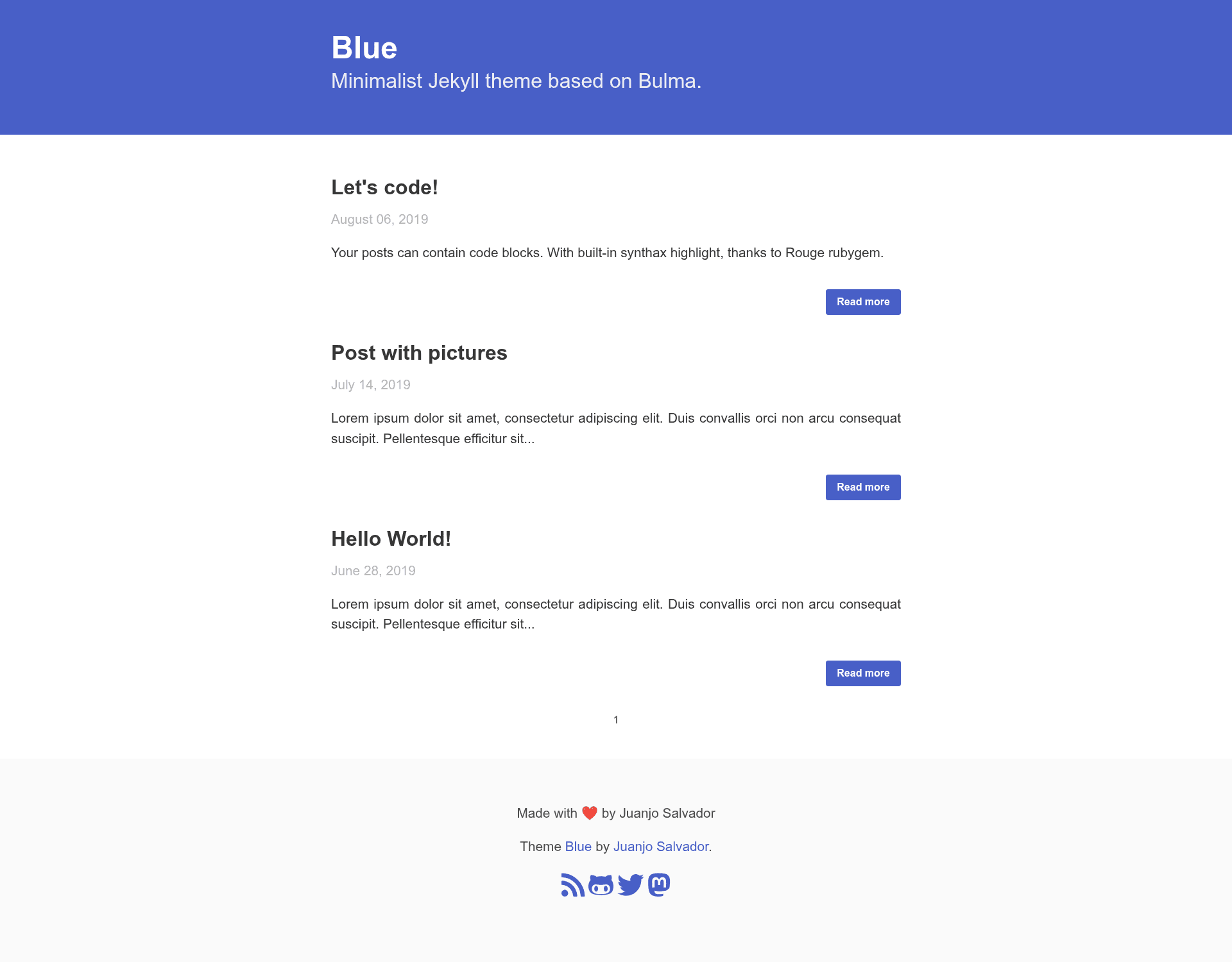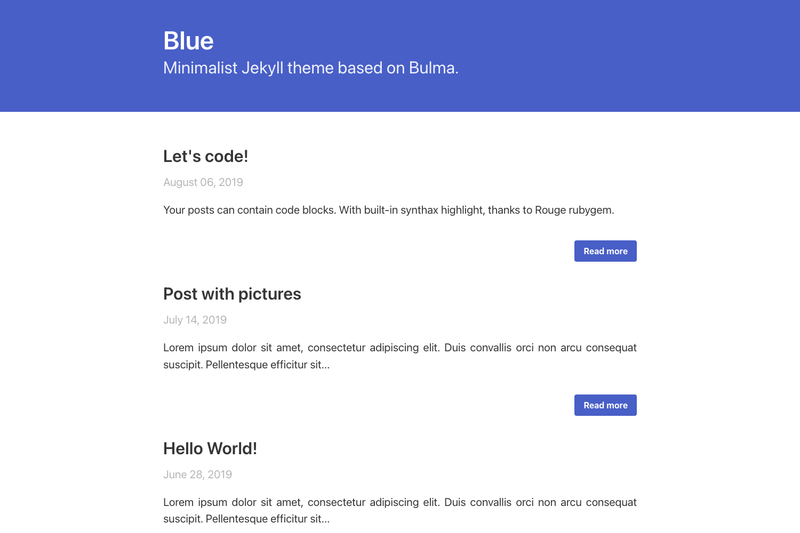
Blue is a minimalist Jekyll blog theme built on the Bulma CSS framework, designed for developers who want a clean, dependency-light site that runs on GitHub Pages.
What is Blue?
Blue is a Jekyll theme that uses Bulma as its CSS framework to build static blogs. It accepts Markdown posts via Kramdown and outputs a complete site with built-in MathJax for LaTeX math, Rouge syntax highlighting, pagination, SEO metadata, and an RSS feed. The theme is distributed both as a RubyGem (blue-jekyll-theme) and as a GitHub repository for direct forking, and it is released under the MIT License.
Key Features
- Bulma CSS — Uses the Bulma CSS framework for layout and styling; the header color can be switched among Bulma's default colors (
primary,info,warning,danger,dark,light) via thecolorconfig variable. - Kramdown markdown — Uses Kramdown as the Markdown engine with GFM input, so posts support tables, footnotes, and other extended syntax.
- MathJax — Includes MathJax for rendering LaTeX math expressions inside posts.
- Syntax highlighting — Built-in syntax highlighting via Rouge, configured with
highlighter: rougein_config.yml. - Pagination — Integrates
jekyll-paginatewith a default of 5 posts per page and apaginate_pathof/page:num/. - SEO — Includes
jekyll-seo-tagto generate meta tags and rich snippets automatically. - RSS feed — Includes
jekyll-feedto provide an RSS feed by default. - Author configuration — Supports author fields for name, URL, email, GitHub, Twitter, and Mastodon in the config file.
Who is Blue for?
- Jekyll developers — People who want a minimal, no-JavaScript theme with a clean Bulma design and don't want to build their own layout.
- GitHub Pages users — Anyone who wants to launch a personal blog by forking the repository and renaming it to their GitHub Pages domain.
- Technical writers — Those who publish math-heavy or code-heavy content and need MathJax and Rouge support out of the box.
Use cases
- Personal blogs: Fork Blue, set your title and author in
_config.yml, and start writing posts in_posts/as Markdown files. - Documentation sites: Use the Kramdown GFM input and MathJax to author technical documentation with equations and code samples.
- Portfolio or minimal site: Replace the default content and use the theme's minimal design to showcase your work without extra dependencies.
How does Blue work?
Blue's README lists two installation paths: for GitHub Pages, fork the repository, rename it to your GitHub Pages username, edit _config.yml, and replace the posts. For RubyGems, add blue-jekyll-theme to your Gemfile, run bundle update, then set the theme and plugins (jekyll-paginate, jekyll-seo-tag, jekyll-feed) in _config.yml. Both paths rely on Jekyll's standard build process to generate the static site.
Pricing
Blue is free and open source under the MIT License. There are no paid tiers or licenses to purchase for personal or commercial use.
FAQ
Is Blue free?
Yes, Blue is released under the MIT License, so you can freely use, modify, and distribute it, including in commercial projects.
How do I install Blue on GitHub Pages?
Fork the Blue repository, rename it to your-username.github.io, edit the variables in _config.yml, and replace the content of _posts/ with your own posts.
Does Blue support LaTeX math?
Yes, Blue includes MathJax, allowing you to write LaTeX math expressions directly in your Markdown posts and have them rendered on the page.
Can I change the accent color?
Yes, set the color variable in _config.yml to one of Bulma's default colors such as primary, info, warning, danger, dark, or light to change the header color.
What plugins does Blue require?
Blue uses the jekyll-paginate, jekyll-seo-tag, and jekyll-feed plugins. When installing via RubyGems, you must add these to your _config.yml plugins list.