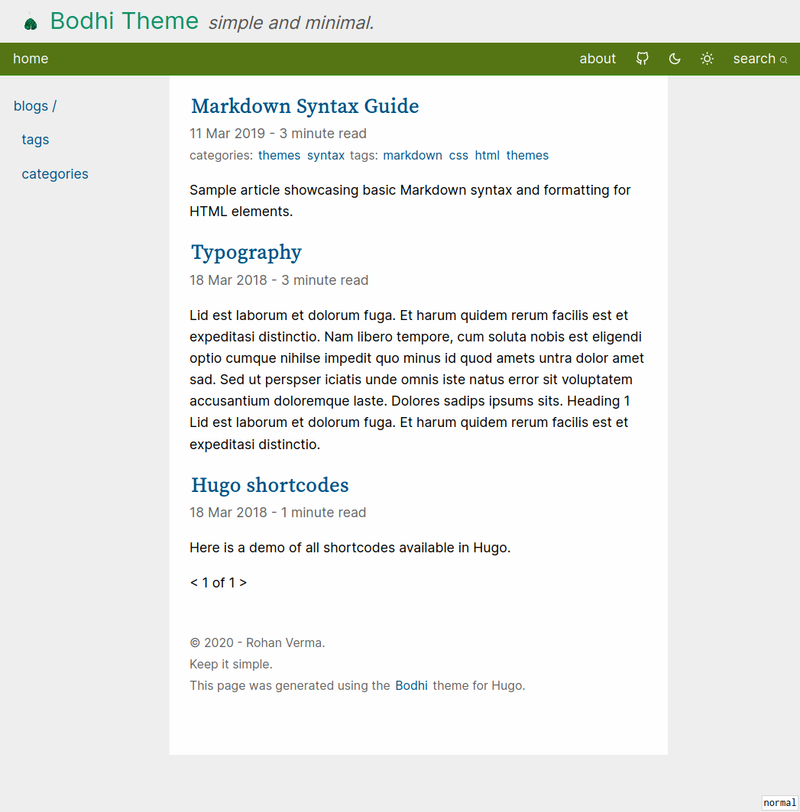
Bodhi is a minimal, two-column Hugo theme for personal websites, built by Rohan Verma, that uses a suckless-inspired tree navigation layout to keep content organization simple and familiar.
What is Bodhi?
Bodhi is a free and open-source Hugo theme created by Rohan Verma for personal blogs and portfolio sites. It takes a Hugo site's markdown content and renders it into a clean two-column layout: a left sidebar with a hierarchical tree of navigation links and a main content area. The theme is installed as a Git submodule, so adding it to an existing Hugo site takes a single clone command, and it is configured entirely through the site's config.toml file.
Key Features
- Two-column tree navigation — The left sidebar shows navigation as a parent-child tree, inspired by suckless.org's mini-sitemap design, so visitors can see the entire site structure at a glance.
- Dark mode — Built-in dark mode that follows the user's system color scheme, with previews available for both light and dark appearances.
- Analytics integrations — Supports both Google Analytics and Fathom Analytics; the Fathom block accepts a siteID and a self-hosted serverURL.
- Commenting systems — Works with both Disqus and Commento; Commento is configured by setting a commentoSrc script URL in the params.
- Search support — Inbuilt search works with the JSON output that Hugo generates for the home page.
- Syntax highlighting — Uses Hugo's Goldmark renderer with options for code fences, guessSyntax, line numbers, and tab width.
- Social metadata — Includes Twitter Cards and Open Graph tags so shared links display rich previews.
- RSS and pagination — Generates RSS feeds for the home output and includes simple pagination with page indicators.
Who should use Bodhi?
- Personal bloggers — Publish posts with reading-time metadata, tag and category pages, and an archive page, all organized via the tree menu.
- Developers and designers — Maintain a minimal portfolio site with a project listing and a configurable navigation tree, using Hugo's static site generation workflow.
- Minimalists — Anyone who wants a fast, text-first website without JavaScript-heavy UI or unnecessary decoration.
Use cases
- Developers building a personal site: Set up a blog and portfolio with a tree menu that groups projects, posts, and archives into clear sections.
- Self-hosted analytics enthusiasts: Configure Fathom Analytics by setting the siteID and serverURL in the params block, keeping tracking data on their own server.
- Open-source project documentation: Use the hierarchical nav menu to document multiple projects and sub-pages, as shown in the demo where Bodhi appears under Projects.
How does Bodhi work?
Install the theme by running git submodule add https://github.com/rhnvrm/bodhi themes/bodhi in your Hugo site directory. Then define the menus in config.toml using the main, main_right, and nav sections; the theme builds the top bar and sidebar tree from those definitions. Content is written as standard markdown, and the home page outputs HTML, RSS, and JSON.
FAQ
Does Bodhi support dark mode?
Yes, Bodhi includes built-in dark mode that automatically switches based on the user's system color scheme. The theme repository shows previews for both light and dark looks.
What analytics services can I use with Bodhi?
The theme supports Google Analytics and Fathom Analytics. For Fathom, you provide a siteID and a serverURL (useful for self-hosted instances) in the params section of config.toml.
Which comment systems work with Bodhi?
Bodhi supports both Disqus and Commento. To use Commento, set the commentoSrc parameter to the JavaScript URL of your Commento instance.
How do I install Bodhi?
Run git submodule add https://github.com/rhnvrm/bodhi themes/bodhi in your Hugo project, then set theme = "bodhi" in config.toml and configure the menus and params.
Is Bodhi free?
Bodhi is an open-source Hugo theme hosted on GitHub, so it is free to download and use. The repository does not mention a separate pricing page.