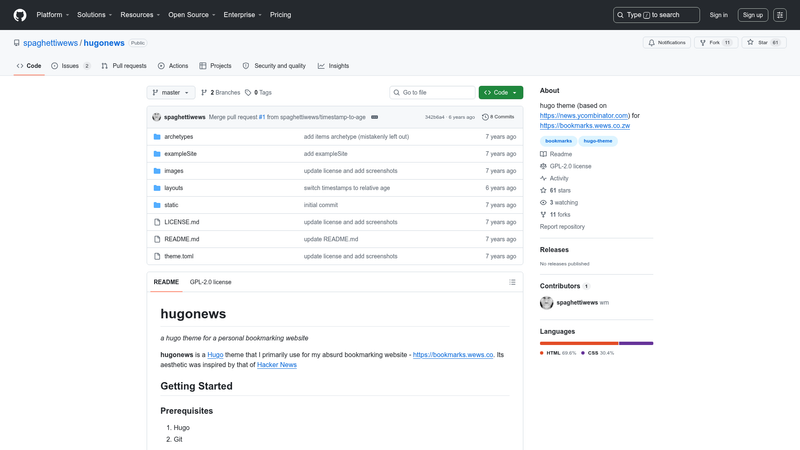
hugonews is a Hugo theme for building a personal bookmarking website whose visual style is modeled on Hacker News. Created by the maintainer of bookmarks.wews.co, it turns a folder of Markdown files into a browsable, static link archive without a database or server-side processing.
What is hugonews?
hugonews is a theme for the Hugo static site generator that produces a bookmarking website from Markdown content files. Each bookmark is stored as a Markdown file with front-matter fields including itemurl (the destination URL), sites (the domain name), and tags, and the theme renders these into a Hacker News–inspired link list. It runs on Hugo, which means the only runtime prerequisites are Hugo and Git; the build output is a static HTML site that can be deployed to any web host. The theme is authored by spaghettiwews and used on the bookmarks.wews.co website.
Key Features
- Hacker News aesthetic — The interface takes its look from Hacker News, with a dense, orange-accented listing optimized for scanning many links quickly.
- Markdown bookmarks — Content lives in Markdown files under content/items, with a YAML front-matter block that stores title, date, itemurl, sites, tags, and draft status.
- Hugo theme with Git submodule install — Add the theme from https://github.com/spaghettiwews/hugonews.git as a submodule into a Hugo site's themes directory, then set theme = "hugonews" in config.toml.
- Tagged organization — Each bookmark can carry multiple tags in its front matter, letting the theme group related links (the README's example tags include frontend, css, and dark mode).
- Static output — Running hugo generates a public folder ready to deploy via GitHub Pages, Netlify, or any other hosting service listed in Hugo's Hosting & Deployment docs.
- Git-powered workflow — Because all bookmarks are plain files, the entire archive is versioned, reversible, and easy to sync across machines with standard Git commands.
Who is it for?
- Personal bookmark hoarders — Anyone who wants an independent, self-hosted archive of links and enjoys the minimalist Hacker News reading experience.
- Hugo users — Developers already comfortable with Hugo who want a purpose-built theme for a link collection rather than a full blog theme.
- Self-hosters — People who prefer owning their data and publishing content through plain-text files and Git rather than a hosted bookmarking service.
Use cases
- Individual link collector: Run hugo new items/some-slug.md, fill in the itemurl and sites fields, and publish a new bookmark to the site with a single build.
- Hugo experimenter: Use the documented five-step setup (new site, Git init, submodule add, theme setting, first item) as a hands-on introduction to Hugo submodules and content archetypes.
- Git-flow website maintainer: Manage the bookmark archive entirely in Git, allowing edits, rollbacks, and collaboration through standard pull requests.
How does hugonews work?
The README describes a straightforward workflow: create a new Hugo site, initialize a Git repository, add hugonews as a Git submodule, and set theme = "hugonews" in config.toml. After that, run hugo new items/name.md from the site root to scaffold a new bookmark, edit the generated file to add title, date, itemurl, sites, and tags, then build with hugo and deploy the public folder.
FAQ
How do I add a new bookmark?
Run hugo new items/your-slug.md from the site root, then edit the generated Markdown file in content/items. Set the title, date, itemurl (the link), sites (the domain), and any tags, then set draft to false to publish it on the next hugo build.
What front-matter fields does a bookmark require?
A bookmark file needs title, date, itemurl, sites, and tags, plus draft. The README's example uses itemurl for the full URL, sites for the domain string, and tags as a YAML list, so the theme can group and display those fields.
Does hugonews require a database?
No. hugonews stores every bookmark as a Markdown file and delivers a static HTML site generated by Hugo, so there is no database, no server-side code, and no runtime application required on the host.
Can I deploy hugonews to any static host?
Yes, because the build produces a public folder of plain static files. The README points to Hugo's official Hosting & Deployment documentation, which covers services like GitHub Pages, Netlify, and others.