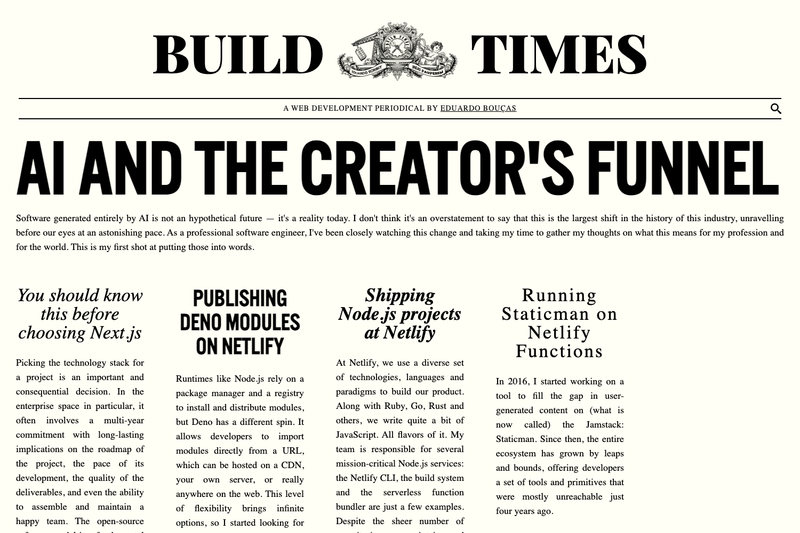
eduardoboucas.com is the open-source source code for Eduardo Bouças's fully static personal website and blog, built with the Eleventy (11ty) static site generator and deployed on Netlify directly from a GitHub repository. The site publishes musings on building and breaking websites, with an emphasis on typography and web development, and the repository provides a complete, installable setup that anyone can fork and adapt.
What is eduardoboucas.com?
This repository contains the complete source code for the personal website at eduardoboucas.com. It is a fully static site generated with Eleventy, meaning it outputs plain HTML with no server-side runtime, and it is hosted on Netlify and served straight from this GitHub repository. The site's content focuses on writing about building and breaking websites, including typography, and the README documents how to install, run, and build the site locally.
Key Features
- Eleventy static generation — The site uses the 11ty static site generator, which produces plain HTML files with no backend dependency.
- Netlify hosting — The site is hosted on Netlify and served directly from this repository, so any push to the repo can trigger a new deployment.
- Simple local development — Cloning the repo, running npm install, and then npm start launches a local server at http://localhost:8080 with automatic watch mode for changes.
- CSS and JavaScript build — A separate npm run build command compiles the site's CSS and JavaScript files for production.
- Version history — The previous iteration of the site is preserved in a separate linked repository, allowing you to compare the old and new implementations.
Who is it for?
- Personal bloggers — Writers who want a minimalist static blog focused on web development topics can fork this repo and replace the content with their own posts.
- Eleventy learners — Developers curious about how a production 11ty site is organized, including how local development, build scripts, and Netlify deployment are wired together.
- Open-source tinkerers — Anyone who likes to inspect or adapt existing personal-site codebases to bootstrap their own online presence.
What can you do with it?
- Start a personal blog — Fork the repository, customize the content, and publish your own static site using the same 11ty and Netlify setup.
- Study a real 11ty project — Read the source to see how a live personal site handles local server setup, watching files, and building static assets.
- Compare site versions — Use the linked old repository to see how the author's site evolved from an earlier static-site generator approach to the current 11ty-based one.
How does it work?
The README outlines a four-step workflow: clone the repository, install dependencies with npm install, run npm start to generate the site and watch for changes, and open http://localhost:8080 in a browser. For production, npm run build compiles the CSS and JavaScript files. Because the site is fully static, the output from Eleventy is ready to copy to any static host, but this project specifically uses Netlify.
Alternatives
- Jekyll — A long-established static site generator that is the default for GitHub Pages, and the old version of this site may have used a similar approach.
- Hugo — A fast static site generator written in Go, popular for blogs and documentation sites.
- Gatsby — A React-based static site framework that can pull data from multiple sources during the build process.
FAQ
Is eduardoboucas.com free to use?
The repository is public on GitHub, so anyone can view and fork the source code for their own personal site. No license file is shown in the README, so you should check the repository for explicit terms if you plan to reuse it commercially.
What static site generator does this site use?
The current version uses Eleventy (11ty), as stated in the README. The old version of the site is kept in a separate repository.
How do I run the site locally?
Clone the repository, run npm install, then run npm start. This starts a local server at http://localhost:8080 and watches for changes.
Does this site use Jekyll?
The repository metadata lists Jekyll as a topic, but the README explicitly says the site is powered by 11ty. The previous iteration may have used Jekyll, and that code is available in a separate repository.
Where can I find the old version?
The README links to the old version's source code at https://github.com/eduardoboucas/v1.