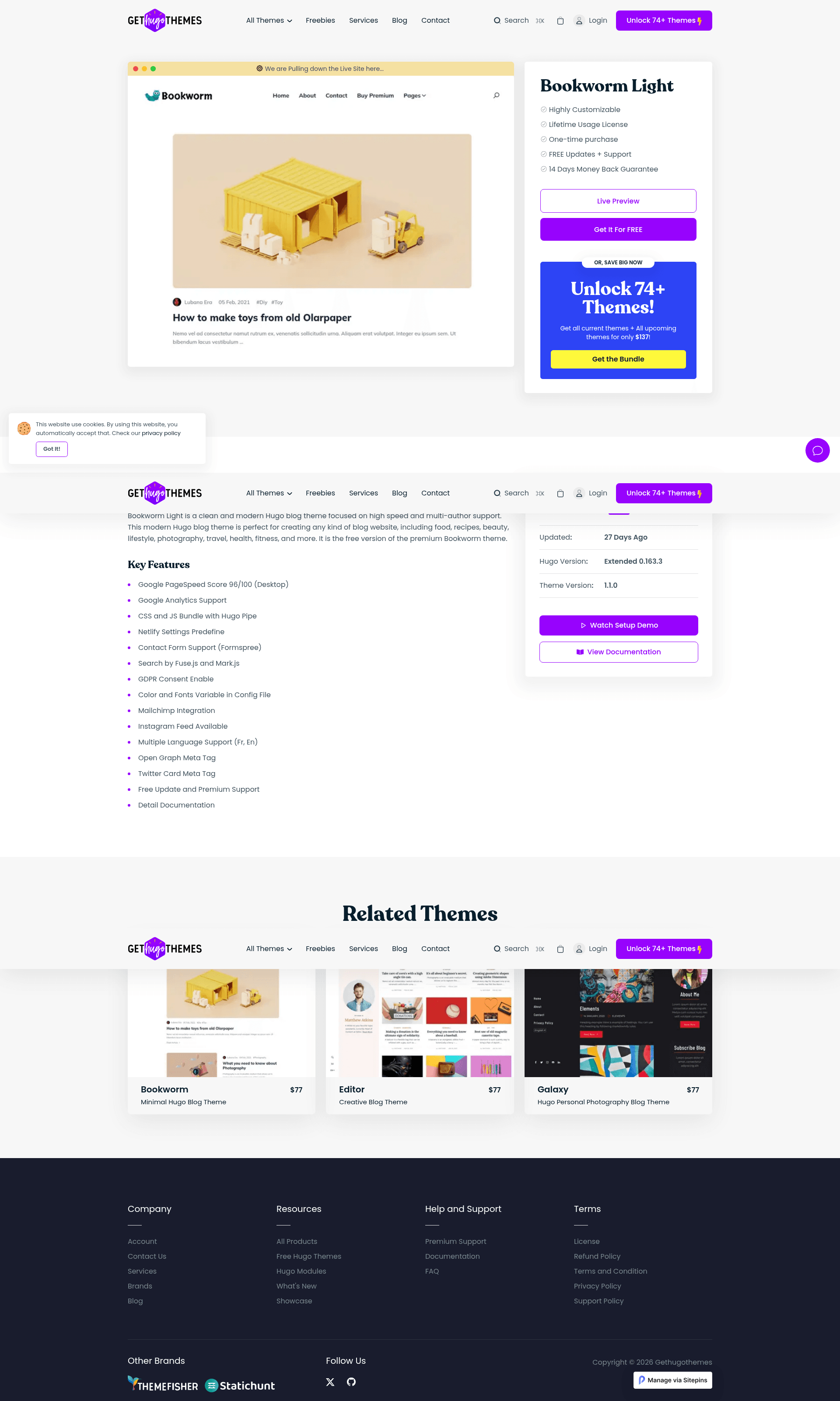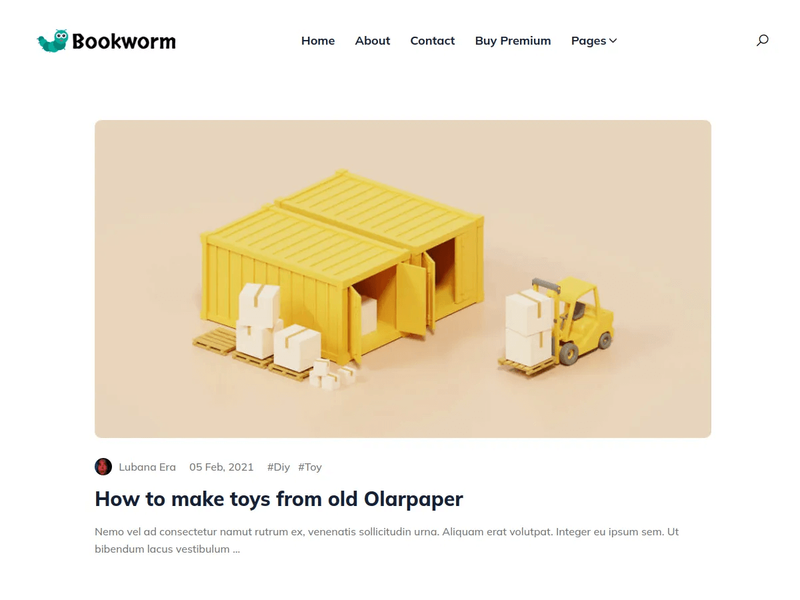
Bookworm Light is a free Hugo blog theme from Gethugothemes and Themefisher, built to create fast, clean blog websites for niches like food, travel, lifestyle, and photography, with support for multiple authors.
What is Bookworm Light?
Bookworm Light is an open-source Hugo theme released under the MIT license, designed specifically for blog websites. It takes Markdown content and Hugo configuration as input and generates a static HTML site with built-in SEO meta tags, search, and contact form support. The theme is developed by Gethugothemes and designed by Themefisher, and it requires a minimum Hugo version of 0.163.3. It comes with a live demo on Vercel and reports a Google PageSpeed score of 96% for desktop.
Key Features
- Hugo Pipe asset bundling — CSS and JavaScript are bundled and minified using Hugo Pipes, reducing the number of requests and improving load speed.
- Search with Fuse.js and mark.js — Client-side search is included, allowing visitors to search posts without a server-side search index.
- Google Analytics support — Add your tracking ID in the config file to enable analytics.
- Netlify settings preconfigured — The repository includes a
netlify.tomlwith predefined build settings, so deploying to Netlify works with minimal setup. - Contact form via Formspree — A working contact form template is included and wired to Formspree for handling submissions.
- GDPR consent banner — A built-in cookie/GDPR consent mechanism is enabled by default.
- Mailchimp integration — The theme includes a newsletter signup form that connects to Mailchimp.
- Open Graph and Twitter Card meta tags — Social sharing metadata is generated from each post's front matter.
- Sitepins headless CMS integration — The template is pre-configured with Sitepins, a Git-based headless CMS, letting you edit text, images, and config visually without touching code.
Who is it for?
- Bloggers and content creators — Publish a personal or niche blog on food, recipes, beauty, lifestyle, photography, travel, health, or fitness using a ready-made layout and typography.
- Multi-author publications — The theme supports multiple authors, making it suitable for team blogs and online magazines that need author pages and attribution.
- Developers and agencies — Build a client blog quickly by cloning the repository, running
npm install, and starting the dev server withnpm run dev:example; Hugo's static output makes hosting cheap and fast. - Small business owners — Launch a company news or updates blog with SEO basics (Open Graph, Twitter Cards, sitemap-friendly structure) already in place.
Use cases
- Food and travel bloggers: create category-based recipe and destination posts with search and social sharing meta tags built in.
- Indie writers: publish a minimalist personal blog with GDPR consent and newsletter signup (Mailchimp) to grow an email list.
- Agencies: spin up a lightweight multi-author blog for clients using the bundled Netlify settings and Sitepins CMS for non-technical editing.
- Self-hosted sites: use the theme as a static site generator alternative to WordPress, since it outputs plain HTML that can be deployed to any static host.
How does Bookworm Light work?
The workflow is based on Hugo's standard content pipeline. Clone the repository, install dependencies with npm install, then run npm run dev:example to start the local server. Content is authored in Markdown inside the content directory, and the theme automatically generates pages for posts, authors, categories, and tags. For visual editing, you can click the "Edit with Sitepins" button to clone the repository into Sitepins and edit content through a GUI.
Pricing
Bookworm Light is free and released under the MIT license. A paid upgrade called Bookworm Premium adds multiple language support (French and English), left/right/center menu alignment, grid or list post layouts, sidebar placement options, four or more premium pages, and priority support.
Alternatives
- Logbook — another Hugo theme from Gethugothemes, listed on the same page as a premium product.
- Parsa — a premium Hugo theme from Gethugothemes showcased alongside Bookworm Light.
FAQ
Is Bookworm Light free?
Yes, Bookworm Light is free to download and use under the MIT license. The source code is available on GitHub, and you can also clone and customize it. The vendor offers a paid premium version with additional layout and language features.
Does Bookworm Light support multiple authors?
Yes, the theme supports multiple authors out of the box. Each post can define an author, and the theme handles author attribution, which makes it suitable for team and magazine-style blogs.
What Hugo version do I need?
Bookworm Light requires a minimum Hugo version of 0.163.3. The README badge specifies this version, and the project uses Hugo Pipes, which depends on recent Hugo releases.
Can I edit Bookworm Light with a CMS?
Yes, the template is pre-configured with Sitepins, a Git-based headless CMS. You can click the "Edit with Sitepins" button to clone the repository and edit text, images, and configuration visually without writing code.
What is the difference between Bookworm Light and Bookworm Premium?
Bookworm Premium adds features not in the free version: multiple language support (French and English), customizable menu alignment (left, right, or center), multiple post layouts (grid or list), sidebar options (left, right, or disabled), and four or more premium pages, plus priority support.