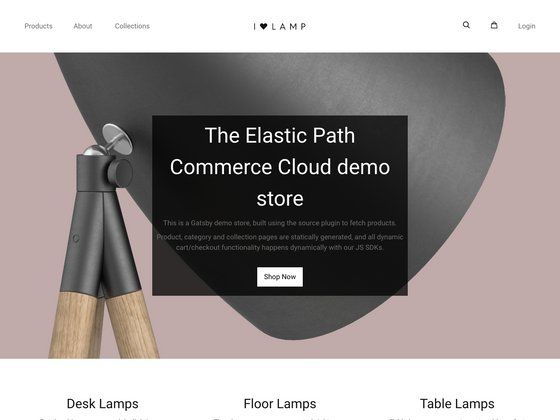
Elastic Path Commerce Cloud Gatsby Starter is an open-source Gatsby ecommerce starter that demonstrates how to build a storefront on Elastic Path Commerce Cloud, the headless commerce API formerly known as Moltin. The repository, published by Elastic Path, powers a live demo store and includes Algolia search and Algolia Places integration.
What is the Elastic Path Commerce Cloud Gatsby Starter?
The Elastic Path Commerce Cloud Gatsby Starter is a demo storefront built with the Gatsby static site generator, connecting to Elastic Path Commerce Cloud as its ecommerce backend. It takes product and transaction data from Elastic Path's API and renders it as a static React site, with Algolia providing search and Algolia Places handling address autocomplete. The project is maintained by Elastic Path, the company behind Elastic Path Commerce Cloud, and is released under the MIT License.
Key Features
- Gatsby framework — The storefront is built with Gatsby, the React-based static site generator, which outputs fast prerendered pages.
- Elastic Path Commerce Cloud integration — Ecommerce operations (products, cart, checkout) are handled by Elastic Path Commerce Cloud, a headless commerce API (formerly Moltin).
- Algolia search — Product search uses Algolia, as indicated by the repository topics.
- Algolia Places — Address autocomplete for forms is included through Algolia Places.
- Live demo site — A working instance is deployed at demo.elasticpath.com, with the Netlify deploy status badge shown in the repository.
- MIT License — The starter is free to use, modify, and distribute under the MIT open-source license.
- Open to contributions — The repository is marked as a work in progress and includes a contribution guide for those who want to help improve it.
Who is it for?
Developers who want a reference implementation for building Gatsby storefronts with a headless commerce backend can use this starter as a learning resource. Teams evaluating Elastic Path Commerce Cloud can test its features through the live demo store rather than building from scratch. Front-end engineers looking for a starting point for ecommerce projects can fork this MIT-licensed starter and replace the sample data with their own Elastic Path setup.
What can you do with the Elastic Path Commerce Cloud Gatsby Starter?
- Ecommerce developers: Study the codebase to see how Gatsby components consume Elastic Path Commerce Cloud APIs and how Algolia search is wired in.
- Evaluation teams: Click through the demo store to assess Elastic Path Commerce Cloud's storefront behavior and integration requirements.
- Open-source contributors: Fix issues, add features, and submit pull requests to the starter, which explicitly welcomes contributions.
FAQ
Is the Elastic Path Commerce Cloud Gatsby Starter free?
Yes, the starter is licensed under the MIT License, so you can use, modify, and distribute it freely, including for commercial projects.
What does the Gatsby starter do?
It provides a working Gatsby storefront for Elastic Path Commerce Cloud, demonstrating how to build an ecommerce front end on top of headless commerce APIs with integrated Algolia search.
Does the starter require Elastic Path Commerce Cloud?
Yes, the storefront is designed to work with Elastic Path Commerce Cloud, so you'll need an Elastic Path account (or sandbox) to fully run the store with real product and checkout data. The repository links to Elastic Path documentation for setup.
Is the template production-ready?
The repository labels itself as a work in progress and encourages contributions, so it's best considered a reference implementation rather than a battle-tested production store. Use it as a starting point and adapt it for your requirements.