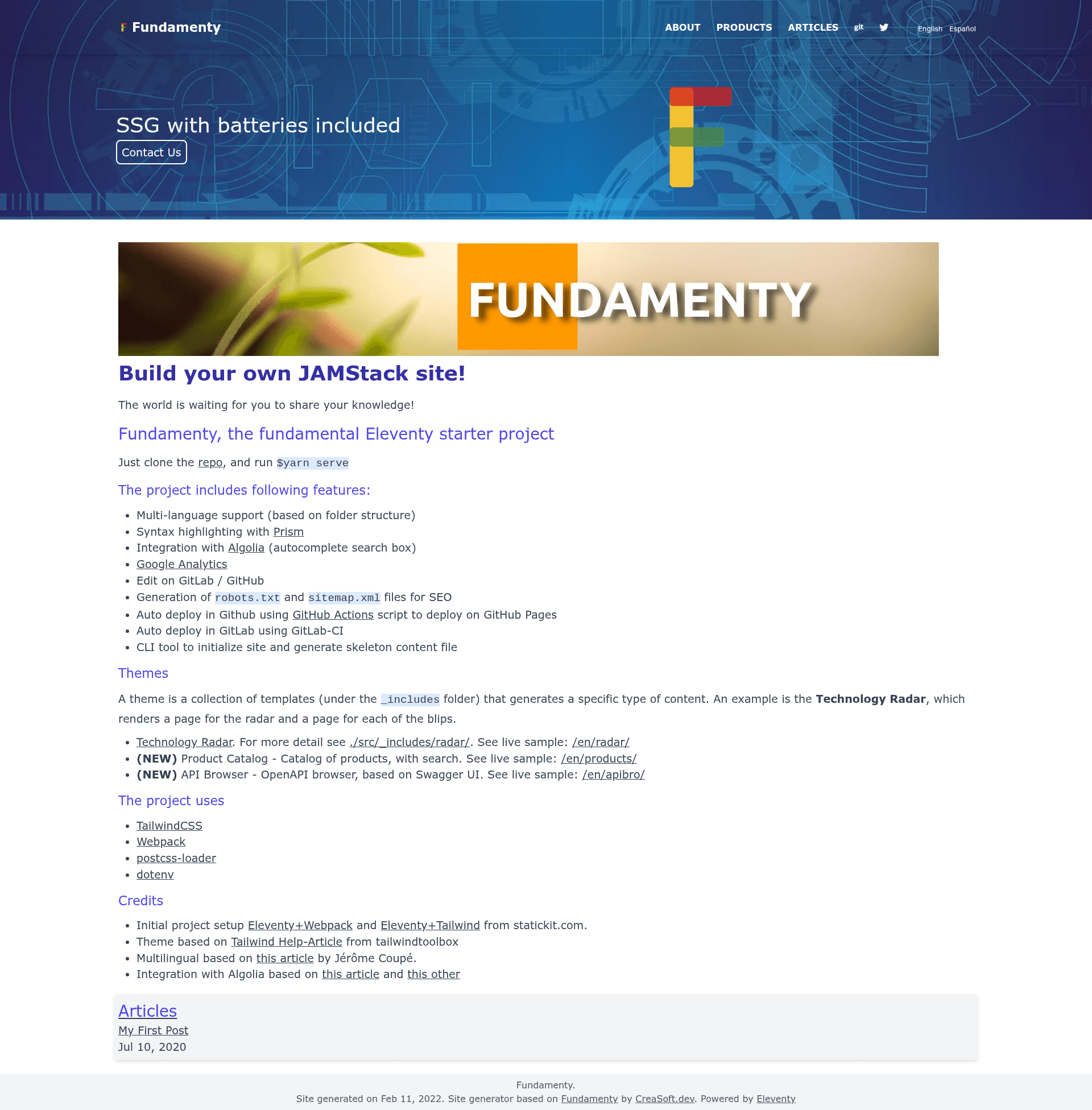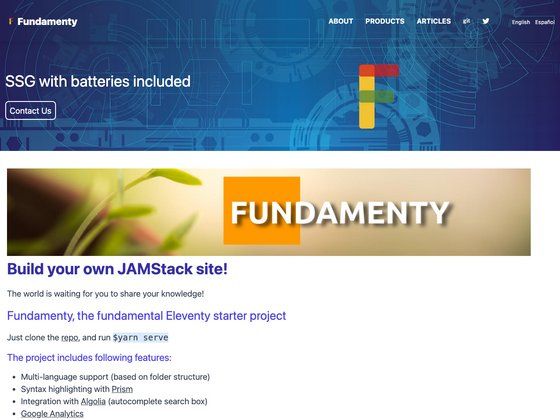
Fundamenty is an Eleventy (11ty) boilerplate template that scaffolds a multilingual static website with Algolia-powered search, Tailwind CSS styling, and optional content themes such as a Technology Radar and Product Catalog. It produces a deployable static site from content organized by language, configuration files, and theme-specific input, and ships with CI scripts for GitHub Pages and GitLab Pages.
What is Fundamenty?
Fundamenty is an Eleventy starter project created by creasoft-dev that builds a multilingual static site with integrated search, analytics, and multiple content layouts. It takes a site configuration file (fundamenty.site.yml), content under src/{lang}/pages, src/{lang}/posts, plus optional theme folders, and outputs a static HTML site ready for hosting on Netlify, GitHub Pages, GitLab Pages, Vercel, Firebase, or surge.sh. The project uses Tailwind CSS for styling, Webpack for asset bundling, and supports Prism syntax highlighting.
Key Features
- Multi-language support — Content is stored in language folders under
src/{lang}; Eleventy generates per-locale collections namedcollections.posts_{lang}, and language bundles live insrc/_data/l10n. - Algolia search integration — Provides an autocomplete search box; configured via environment variables for Application ID, Index Name, and search/admin API keys.
- Built-in themes — Includes a Technology Radar (ThoughtWorks-style), a Product Catalog with search, and an API Browser based on Swagger UI.
- CLI scaffolding tool —
fundamenty-cliinitializes the site (generatingsite.json.genand.env.gen) and creates skeleton posts and content files. - Deployment scripts — GitHub Actions workflow (
.github/workflows/deploy-gh-pages.yml) and GitLab-CI (.gitlab-ci.yml) automate publishing to GitHub and GitLab Pages. - SEO and site files — Automatically generates
robots.txtandsitemap.xmlfrom configuration. - External service integrations — Supports Google Analytics (
GOOGLE_TAG_ID) and Disqus comments (DISQUS_SITE_NAME) via environment variables. - Docker support — Includes a Dockerfile to build and run the site as a container, exposed on port 8080.
Who is it for?
- Developers creating multilingual documentation or corporate sites — they can leverage the built-in localization structure and menu configuration files.
- Teams publishing technology radars — the radar theme renders a radar page and per-blip pages, useful for tracking internal tech adoption.
- OpenAPI-heavy projects — the API Browser theme lets teams display Swagger UI directly from an OpenAPI spec, with no extra front-end work.
- Developers needing a pre-configured Eleventy setup — the template wires up Webpack, Tailwind, dotenv, and CI scripts so they can start writing content immediately.
What can you do with Fundamenty?
- Publish a technology radar: Add blips under
src/{lang}/radarand the Built-in theme generates a radar page and individual blip pages. - Scaffold blog posts fast: Run
yarn fun-cli post/item "My Post Title" -l ento create a dated Markdown file undersrc/en/postswith front matter ready to fill. - Create a product catalog: Use the Product Catalog theme to display a searchable list of products, with content under
src/{lang}/products. - Deploy to multiple hosts: Use the provided GitHub Actions or GitLab-CI scripts, or follow the generic instructions for Netlify, Vercel, Firebase, and surge.sh.
How does Fundamenty work?
Fundamenty uses a CLI initialization step to set up a new site: after cloning and running yarn install, you edit fundamenty.site.yml and run yarn fun-cli site/init --deletegit. This generates two files, src/_data/site.json.gen and .env.gen, which you rename by removing the .gen extension. From there, yarn serve builds and serves the site locally, while the CI scripts handle deployment.
Frequently asked questions
Is Fundamenty free to use?
Fundamenty is an open-source Eleventy starter template. The repository is publicly available and the project credits several open-source dependencies, so it can be used freely; there is no paid license mentioned in the documentation.
What themes are included?
Fundamenty ships with three themes: a Technology Radar, a Product Catalog, and an API Browser that uses Swagger UI. Each theme is a collection of templates under the _includes folder that generates a specific type of content.
Does Fundamenty support multiple languages?
Yes, multilingual support is a core feature. Content is organized by language under src/{lang} directories, and the list of locales is defined in src/_data/site.json. Language bundles for the UI (like menu labels) live in src/_data/l10n.
What environment variables does deployment require?
Only WEB_ROOT_URL and WEB_PATH_PREFIX are needed for the site to generate correctly (the prefix matters when the site lives in a subdirectory). All other variables — GOOGLE_TAG_ID, ALGOLIA_APP_ID, ALGOLIA_INDEX_NAME, ALGOLIA_SEARCH_API_KEY, ALGOLIA_ADMIN_API_KEY, and DISQUS_SITE_NAME — are optional; features they enable are disabled if the variables are not provided.