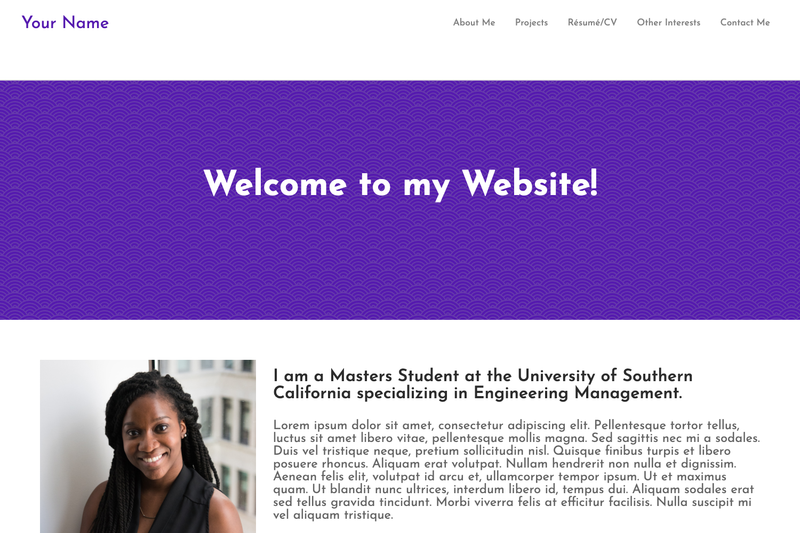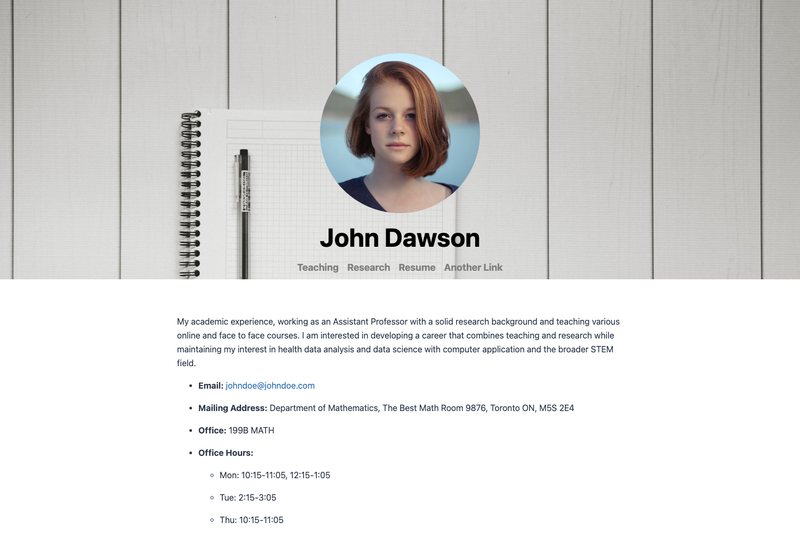
Gatsby Starter Academic Portfolio is an open-source Gatsby theme starter, created by OpenArchitex, that builds a simple academic portfolio website for professors and graduate students.
What is Gatsby Starter Academic Portfolio?
This starter installs the @openarchitex/gatsby-theme-academic-portfolio theme into a Gatsby project, producing a static site that runs on Gatsby and React and uses MDX for content. It provides a minimal, ready-to-run example of the theme, with a profile picture and banner already wired up. The project is maintained on GitHub as part of the OpenArchitex gatsby-themes monorepo, and its repository metadata describes it as "A Simple Portfolio Suitable for Professors and Grad Students."
What makes it stand out?
- Theme shadowing — You can override any theme file by placing a file with the same path in your own Gatsby site, allowing full control over layout and content.
- MDX content files — The banner is stored as banner.mdx, so you can write structured content mixing Markdown and JSX without a separate CMS.
- Image replacement — The example profile-pic.jpg shows how to swap the default profile image by shadowing the theme file.
- Open source and free — The source code is publicly available under the OpenArchitex GitHub organization, with no paid tiers mentioned.
- Academic focus — Explicitly designed for professors and graduate students, unlike general-purpose or corporate portfolio themes.
- Simple structure — As a starter, it contains few files, making it easy to understand how the theme is assembled and customized.
Who should use Gatsby Starter Academic Portfolio?
- Professors who need an uncomplicated personal page to list their affiliation, research interests, and publications.
- Graduate students who want a professional web presence for sharing their CV, research projects, and contact details.
- Academic researchers who prefer static-site generation over a database-backed CMS and are comfortable with Gatsby.
What can you do with Gatsby Starter Academic Portfolio?
- Professors: Create a personal academic homepage by editing the theme's MDX files to replace the example banner and profile photo with their own.
- Grad students: Set up a portfolio quickly by overriding profile-pic.jpg and banner.mdx, then building the site with Gatsby to get a static, deployable set of files.
- Developers: Learn Gatsby theme shadowing by studying how the starter overrides banner.mdx and profile-pic.jpg from the theme.
How does the template work?
The starter installs the @openarchitex/gatsby-theme-academic-portfolio theme into a Gatsby site. You customize the site through theme shadowing: any file you place under the source directory that matches a theme file path overrides it. The starter itself shows two overrides — banner.mdx and profile-pic.jpg — as examples. To make the portfolio yours, replace those two files (or add further shadowed files) and rebuild the site with Gatsby.
Pricing
This starter is open source and free to use. It is published under the OpenArchitex GitHub organization, and no paid tiers or commercial licenses are mentioned on the page.
FAQ
Is Gatsby Starter Academic Portfolio free?
Yes. The source code is publicly available in the OpenArchitex gatsby-themes repository on GitHub, and there is no mention of any paid license or subscription.
What is Gatsby theme shadowing?
Theme shadowing is a Gatsby feature that lets you override a theme's files by placing a file with the same path and name in your own site. For example, the starter overrides banner.mdx and profile-pic.jpg from the theme.
What tech stack does this theme use?
The theme is built on Gatsby and React, and content is written in MDX files. It is part of a monorepo of Gatsby themes published by OpenArchitex.
Can I use this for a non-academic portfolio?
The page describes it as "A Simple Portfolio Suitable for Professors and Grad Students," but because it is a Gatsby theme starter, you can adapt it to other personal portfolio uses by overriding the content files.
How do I get support or report issues?
Open an issue at the gatsby-themes repository on GitHub, as noted in the starter's README.