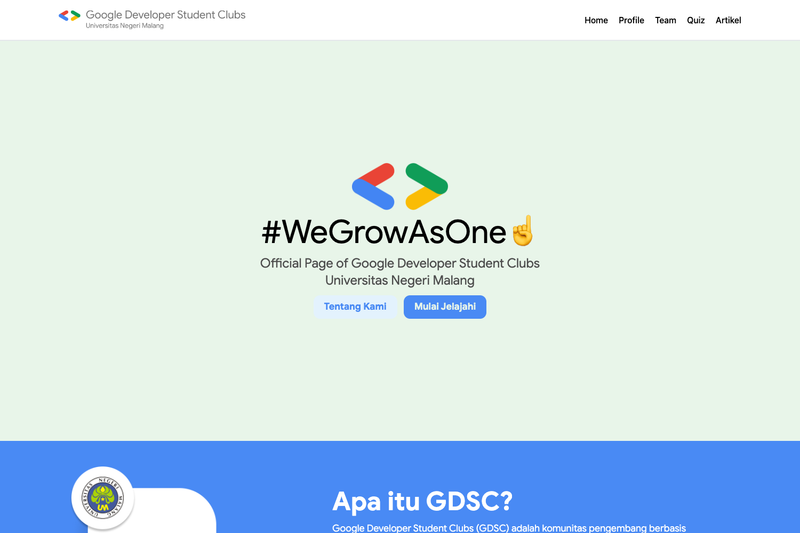
GDSC Universitas Negeri Malang Homesite is an open-source landing-page website built with Next.js and Tailwind CSS for the Google Developer Student Clubs chapter at Universitas Negeri Malang, used to introduce the chapter to the public and share club information.
What is GDSC Universitas Negeri Malang Homesite?
This website is a Next.js and Tailwind CSS project that serves as the official introduction page for GDSC Universitas Negeri Malang. It collects content from folders named post, quizzes, data, asset, and public, and renders it as a browsable site. The project runs on Node.js 18 and can be deployed on Vercel, which sponsors the repository. It was created as the final project for GDSC Universitas Negeri Malang activities.
Key Features
- Next.js framework — The site is built on Next.js, giving it React-based page routing and server-side rendering capabilities.
- Tailwind CSS styling — Styling is handled entirely with Tailwind CSS utility classes, so no separate CSS framework is required.
- GitHub Actions testing — A test workflow (tests.yml) runs automatically on pushes and pull requests, as shown by the repository's test badge.
- Environment-based configuration — The site reads settings from a .env file; the repository includes a .env.example that must be renamed and filled with values from the website team.
- Content folders — Static content lives in asset, public, post, quizzes, and data folders, separating documentation, public files, posts, quizzes, and other data.
- Dual licensing — Content in asset, public, post, quizzes, and data is licensed under CC-BY-SA 4.0, while all other code is licensed under MIT.
Who is it for?
- GDSC Universitas Negeri Malang members — They maintain the site by updating the post and quizzes folders and managing the .env configuration.
- Prospective students and the general public — They use the site to learn about the chapter, its activities, and how to get involved.
- Developers looking for a Next.js and Tailwind CSS starting point — They can clone the repository, run npm install, and adapt the landing page structure for their own organization.
Use cases
- Student organizations — Fork this repository to create a chapter or club landing page pre-wired with Next.js, Tailwind CSS, and a testing pipeline.
- GDSC chapters — Reuse the post and quizzes folder conventions to publish club news, event quizzes, and public resources.
- Open-source contributors — Use the MIT-licensed codebase as a learning reference for structuring a Next.js site with a Vercel deployment workflow.
How does it work?
To run the site locally, clone the repository, install dependencies with npm install, rename .env.example to .env, request the actual environment values from the website team, and then start the development server with npm run dev. The site reads its configuration and content from the designated folders and renders pages through Next.js.
Licensing
The documentation and content stored in asset, public, post, quizzes, and data are released under CC-BY-SA 4.0. All remaining code in the repository is under the MIT license. Vercel sponsors the project by providing deployment infrastructure.