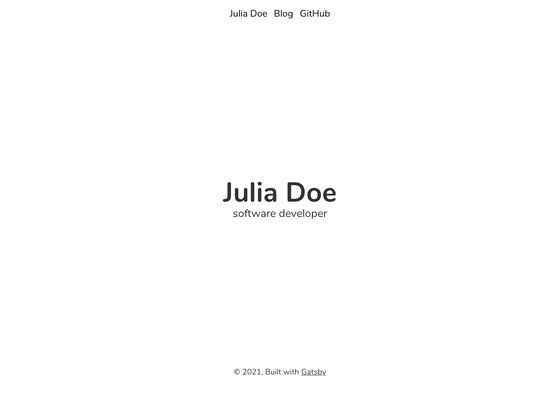
Gatsby Starter Julia is a free and open source GatsbyJS starter that builds a minimal blog website from Markdown content, with a landing page and blog overview, designed for one-click deployment on Netlify.
What is Gatsby Starter Julia?
Gatsby Starter Julia is a starter template for GatsbyJS, a free and open source static website builder built on React. It implements the JAMstack idea and produces high-speed webpages. The starter sources Markdown files from a /content folder and generates a blog with a landing page, a blog overview page, and individual blog post pages via a blog-post template. It is built on top of the official gatsby-starter-default and is available in the niklasmtj/gatsby-starter-julia repository.
Key Features
- Markdown blog sourcing — Blog posts are written as .md files in the /content folder, and the filesystem plugin automatically publishes them on the /blog page.
- Estimated reading time — Each blog post displays a calculated reading time based on its word count.
- Landing and blog pages included — The starter ships with a landing page and a blog overview page, plus a 404 page, all defined as React components in the /pages directory.
- Styled with Emotion — Components use styled components via the Emotion library, with global styles in layout.css.
- Nunito font as an npm module — The Nunito typeface is loaded through an npm package in gatsby-browser.js and used in the layout stylesheet.
- Syntax highlighting with PrismJS — Code blocks are highlighted with PrismJS directly in the markdown-rendered posts.
- Site metadata via React Helmet — Each page includes SEO meta tags using React Helmet, so titles and keywords can be set per page.
- Draft post support — Blog posts marked as drafts are not published, allowing you to keep work-in-progress out of the public site.
- Offline support plugins — The starter includes Gatsby plugins for offline functionality.
- Netlify deployment ready — A one-click Netlify deploy button is included in the README, and the project is preconfigured for the Netlify platform.
Who is it for?
- Developers starting a Gatsby blog — You can scaffold a new project with
gatsby new julia-starter https://github.com/niklasmtj/gatsby-starter-juliaand start editing React components in the /pages directory right away. - Markdown-first bloggers — Writers who prefer to author posts as .md files in the /content folder get a fast blog with reading time and syntax highlighting without touching the underlying build system.
- Teams deploying to Netlify — The included one-click deploy button connects directly to Netlify, so a live site can be up in minutes with no server configuration.
What can you do with Gatsby Starter Julia?
- Publish a blog fast: Write Markdown posts in the /content folder and they appear on the /blog page automatically.
- Customize the design: Change the landing page title in gatsby-config.js, edit page components in /pages, and add styled components with Emotion.
- Deploy with one click: Use the Netlify Deploy button in the README to create a production site from the repository.
- Extend with Gatsby plugins: Add further plugins via gatsby-config.js, since the starter is built on the standard Gatsby file structure (gatsby-node.js, gatsby-browser.js, gatsby-ssr.js).
How does Gatsby Starter Julia work?
Create a new site by running gatsby new julia-starter https://github.com/niklasmtj/gatsby-starter-julia, then start the development server with gatsby develop. The site runs at http://localhost:8000, and a GraphiQL explorer is available at http://localhost:8000/___graphql for querying the sourced Markdown data.
Pricing
Gatsby Starter Julia is free and open source. It is released under the MIT license, as stated in the License section of the README.
FAQ
How do I add a new page to the site?
Create a new React component in the /pages directory, following the pattern in the README: wrap your content in the Layout component, add an SEO component with a title and keywords, and export the component as the default export. The new page is automatically routed.
How do I publish a draft post?
Write a standard Markdown file in the /content folder; posts marked as drafts are not published by the starter's configuration, so the draft flag keeps them hidden from the live blog.
How do I deploy this starter?
The README includes a Netlify Deploy button that takes you to app.netlify.com and creates a new site from the repository. The project is preconfigured for Netlify, so no extra settings are needed.
Is Gatsby Starter Julia free?
Yes, Gatsby is free and open source, and this starter inherits that license. The README states that Gatsby is licensed under the MIT license, and the project is built on the official gatsby-starter-default.