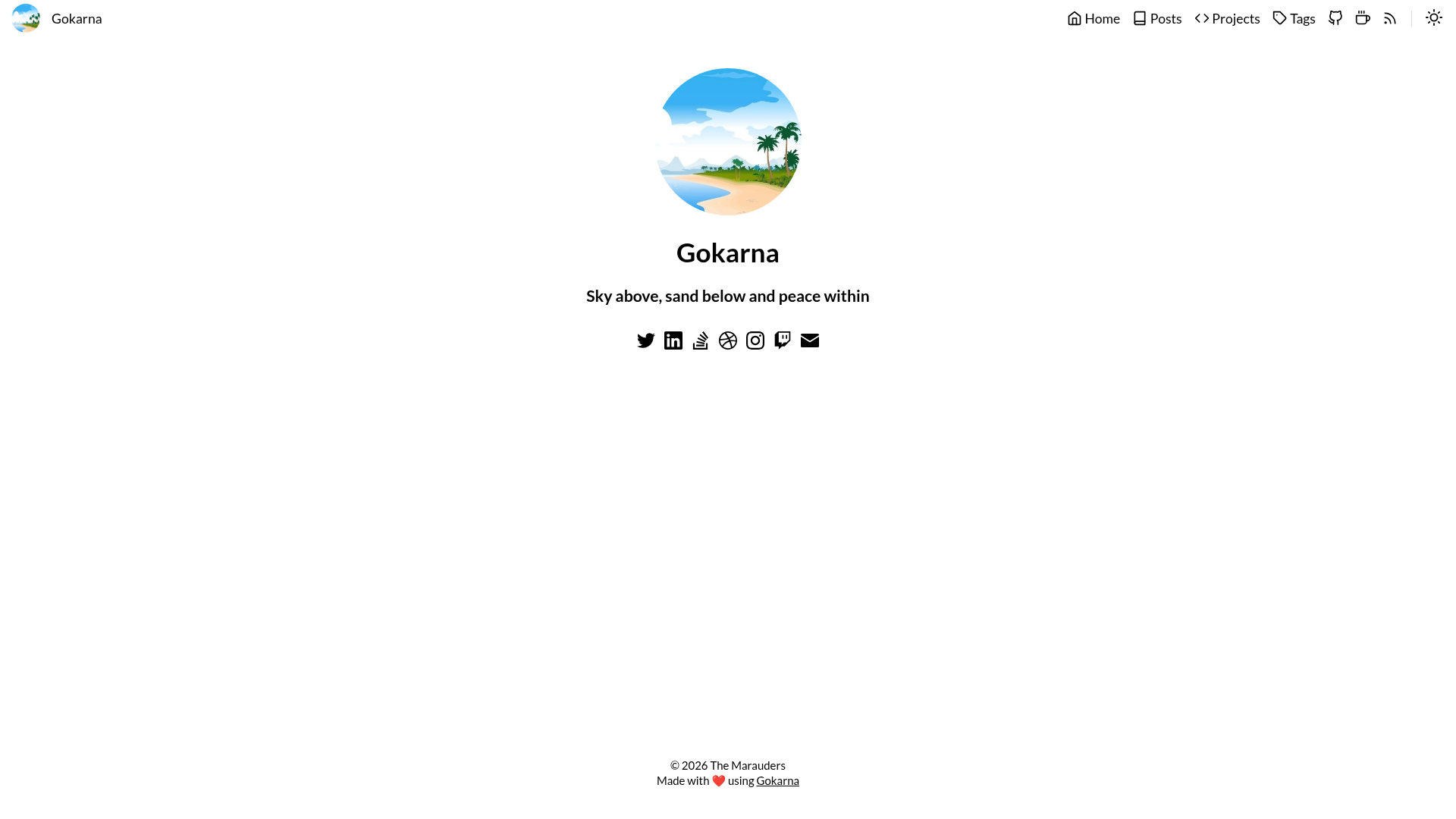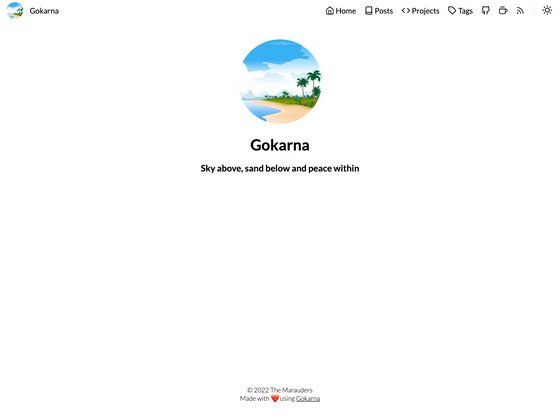
Gokarna is a minimal, opinionated Hugo theme for personal blogs and content sites, built to deliver fast, clean, distraction-free reading. It takes standard Hugo markdown content and configuration and renders a static site with light/dark themes, a configurable homepage, and an auto-generated RSS feed. The theme is developed by Yash Mehrotra and Avijit Gupta, with a live demo at gokarna-hugo.netlify.app.
What is Gokarna?
Gokarna is a Hugo theme designed around minimalism and simplicity, featuring a responsive layout and a Google Lighthouse performance score of 100%. It accepts Hugo content files (markdown posts, front matter, and site config) and generates a complete blog or personal website with light/dark mode, syntax highlighting, and optional math typesetting. The project is released under the GNU GPLv3 license and maintains a public repository at github.com/gokarna-theme/gokarna-hugo.
Key Features
- Light and dark modes — both color schemes ship with the theme, giving readers automatic or manually selected appearance switching.
- Feather and Simple icons — choose between the Feather icon set or the Simple icon set for the homepage, as documented in the advanced theme docs.
- KaTeX math typesetting — render LaTeX-style mathematical notation inside posts without pulling in heavy JavaScript.
- Syntax highlighting — code blocks support a configurable color scheme, so you can match the highlighter to your site's aesthetic.
- Custom head and footer HTML — inject arbitrary HTML, JavaScript, and CSS through dedicated head and footer elements, useful for analytics or custom widgets.
- Configurable table of contents — enable or adjust the table of contents per post or globally, helping readers navigate long articles.
- Multilingual translations — bundled translations for Spanish/Catalan, German, French, Polish, Brazilian Portuguese, Russian, and Traditional Chinese (7 languages).
- Google Lato fonts — the default typography loads the Lato font family from Google Fonts.
- Auto-generated RSS feed — every Gokarna site produces an RSS feed automatically, ready for syndication or podcasting.
Who is it for?
Gokarna suits personal bloggers and technical writers who want a fast, minimal site without wrestling with design decisions. Developers comfortable with Hugo will appreciate the clean codebase, documented customization hooks, and ability to add custom HTML/CSS/JS. Site owners serving multilingual audiences can switch the languageCode in Hugo's config and immediately use one of the seven included translation tables.
What can you do with Gokarna?
- Personal bloggers: publish markdown posts and get a responsive site with RSS, syntax highlighting, and a light/dark toggle for readers.
- Technical writers: write posts with KaTeX math and code snippets, then use the configurable table of contents to structure documentation-style pages.
- Multilingual publishers: set the languageCode to Spanish, German, French, Polish, Portuguese, Russian, or Traditional Chinese to serve the interface in that language without extra work.
How does Gokarna work?
Installation uses a git submodule: run git submodule add https://github.com/gokarna-theme/gokarna-hugo.git themes/gokarna, then follow the basic documentation to configure site parameters. Customization is driven by Hugo's config file, with documented options for avatar, footer text, date format, navigation menu, accent color, and which posts appear on the homepage. For advanced tweaks, the theme exposes custom head and footer HTML injection points.
Pros and cons
- Pros: 100% Google Lighthouse score, free and open source under GPLv3, active contributors including James Davidson and David Kröll, and detailed basic/advanced documentation with examples.
- Cons: the theme is Hugo-specific, so it requires knowledge of Hugo's build system and an existing Hugo site; no official WordPress, Jekyll, or Next.js versions are provided.
Pricing
Gokarna is completely free and open source. The authors accept optional sponsorships through GitHub Sponsors and Buy Me a Coffee, but there is no paid tier or premium feature set.
Alternatives
- Hugo PaperMod — another popular Hugo theme that offers more homepage layouts and a wider feature set.
- Beautiful Hugo — a Hugo port of the Beautiful Jekyll theme, which uses a similar single-column blog aesthetic.
FAQ
Is Gokarna free?
Yes. Gokarna is released under the GNU GPLv3 license, so you can use, modify, and redistribute it freely. The authors accept optional donations, but the theme itself has no cost.
Which Hugo version is required?
The theme page does not specify a minimum Hugo version. You need Hugo installed locally to build a site, and the installation uses the standard git submodule workflow.
Can I translate Gokarna into my language?
Yes. The theme includes seven translations: Spanish/Catalan, German, French, Polish, Brazilian Portuguese, Russian, and Traditional Chinese. You can also create your own translation table using Hugo's i18n functions, as noted in the documentation.
Does Gokarna support math typesetting?
Yes. Gokarna integrates KaTeX so you can write LaTeX-style math in your content, and it renders directly in the browser without additional plugins.
Can I add custom scripts or styles?
Yes. The theme lets you inject custom HTML, JavaScript, and CSS into the head and footer elements, which is useful for analytics, custom fonts, or page-specific effects.