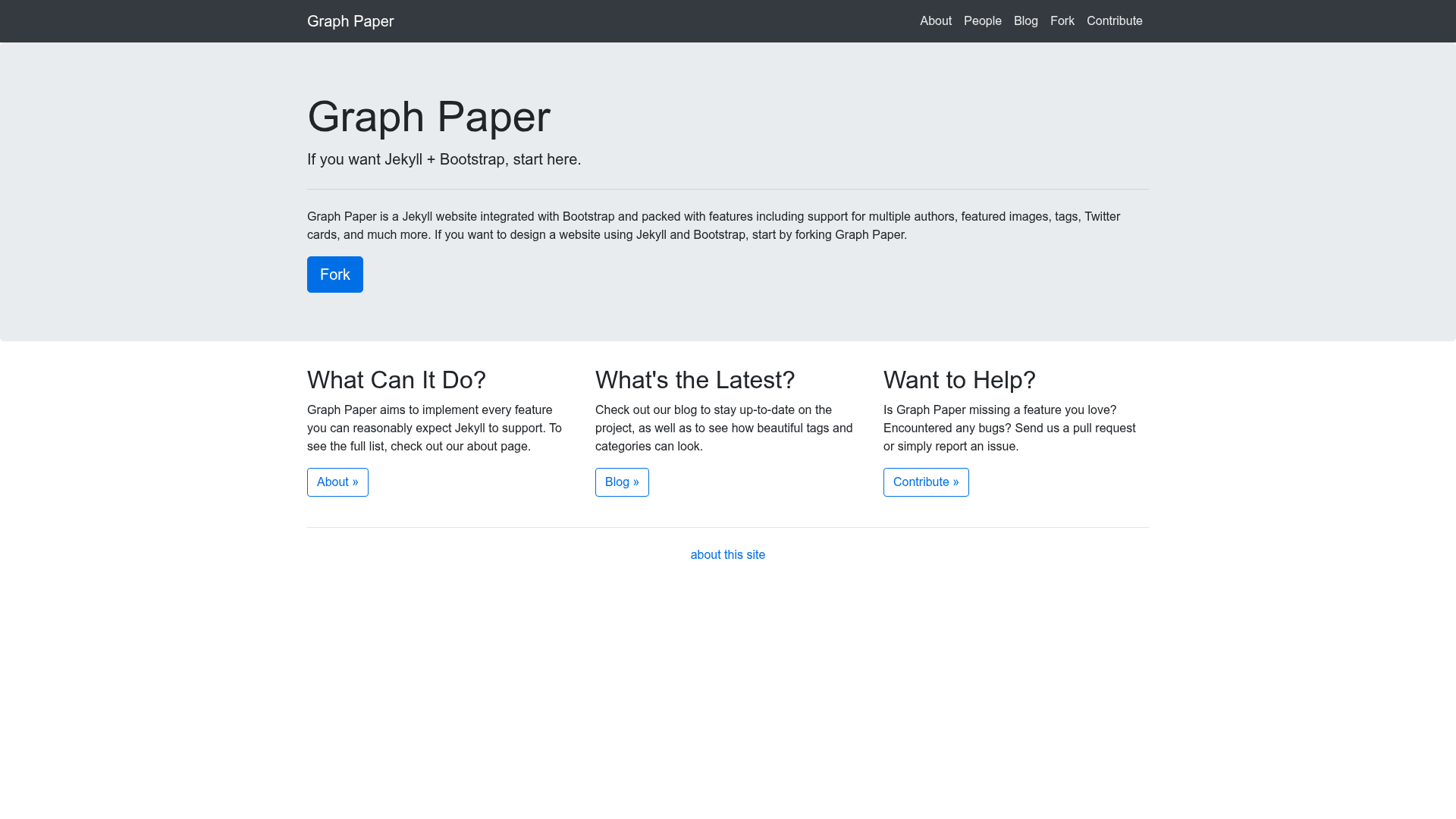
Graph Paper is an open-source Jekyll website template built on Bootstrap v4.5.0, designed to be forked as the starting point for a Jekyll-powered blog or website.
What is Graph Paper?
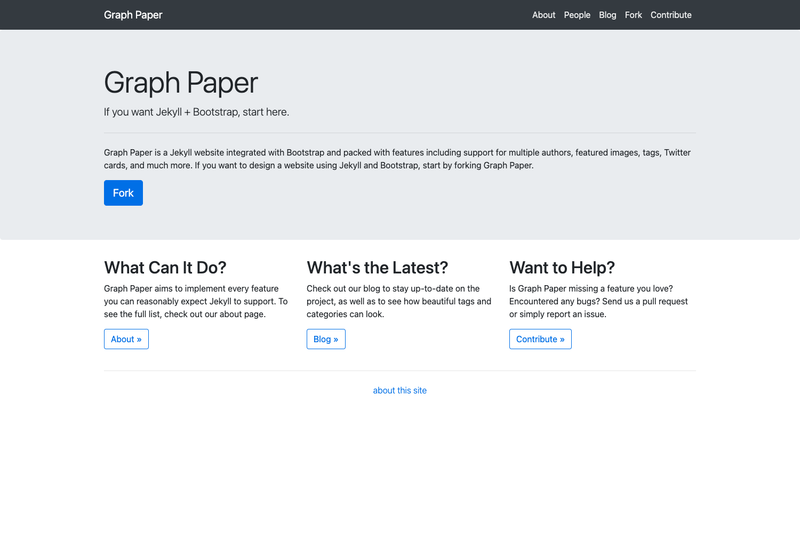
Graph Paper is a Jekyll website template that integrates Bootstrap v4.5.0 and ships with ready-made support for multi-author posts, featured images, tags, categories, Twitter cards, RSS feeds, and Disqus comments. You fork the GitHub repository (maintained by Cam N. Coulter) and then customize it by adding your own posts and Jekyll configuration; the output is a static site that can be hosted on GitHub Pages. The project is released under GPL-3.0-or-later, and blog posts under CC BY-SA 4.0. It is currently unmaintained.
Key Features
Graph Paper implements a wide set of Jekyll features with minimal configuration, so you can delete or modify what you do not need.
- Bootstrap v4.5.0 integration — The Bootstrap grid and components are wired into the Jekyll layout, eliminating the need to set up the framework manually.
- Multiple authors — Each author gets a dedicated page with bio, photo, posts, and social links, plus a per-author RSS feed.
- Featured images — Posts and pages can have featured images that display on archive pages and in social media shares.
- Twitter cards — Social metadata is included so links render with images and descriptions when shared on Twitter.
- Custom SEO support — SEO is implemented without the Jekyll SEO plugin, giving you direct control over defaults.
- Tags and categories — Posts can be filed under tags and categories, shown on dedicated archive pages via pagination.
- Social share buttons — Built-in share buttons for Twitter, Facebook, Tumblr, and LinkedIn appear on posts.
- Disqus comments — Comment support is included through Disqus integration.
- Custom RSS feeds — Hand-coded feed generation for the whole site and per-author, independent of the jekyll-feed plugin.
- Syntax highlighting — Code blocks are highlighted in posts.
Who is it for?
Graph Paper is aimed at people who want a Jekyll site without starting from an empty directory.
- Developers who want a Jekyll + Bootstrap setup already configured can fork the repository and start editing layouts and config right away.
- Bloggers who need multi-author support, tags, pagination, and RSS feeds get these features out of the box.
- Teams or small organizations can use Graph Paper to publish a static, low-maintenance website on GitHub Pages without paying for hosting.
What can you do with Graph Paper?
- Multi-author blogs: set up author profile pages and per-author RSS feeds, so each contributor has a home on the site.
- Portfolio or company site: use featured images, tags, and the Bootstrap grid to present projects or services.
- Content archives: organize posts into tag and category pages with customizable pagination counts.
How does Graph Paper work?
The intended workflow is to fork the Graph Paper repository on GitHub, then customize the Jekyll configuration, adjust layouts, and add your own posts. Because it is a Jekyll site, you can serve it locally with Jekyll and deploy it to GitHub Pages by pushing the site source to a branch.
FAQ
Is Graph Paper still maintained?
Graph Paper is explicitly described as unmaintained. The original creator, Cam N. Coulter, has not released updates, so you may need to maintain it yourself or use it as a starting point to build on. This does not affect the functionality of the existing code, but contributions are not likely to be merged.
Does Graph Paper include a search widget?
Graph Paper does not include a search widget. The project page lists a search widget and line numbers for code blocks as missing features, welcoming contributions to add them. If your site needs a search function, you will have to extend the template or integrate a third-party search solution yourself.
What license is Graph Paper under?
Graph Paper is released under the GNU General Public License v3.0 or later (GPL-3.0-or-later). Individual blog posts in the repository are under CC BY-SA 4.0, and files that are not copyrightable are released under CC0 1.0. Some individual files may be under other licenses, as noted in the .reuse/dep5 file.
Can I host Graph Paper on GitHub Pages?
Yes, you can host Graph Paper on GitHub Pages. The repository metadata lists GitHub Pages as a hosting option, and Jekyll is natively supported by GitHub Pages. Simply push the repository to a branch configured for GitHub Pages, and the site is rebuilt automatically from the Jekyll source.
Does Graph Paper support syntax highlighting?
Yes, Graph Paper includes syntax highlighting for code blocks. However, line numbers are not included; the project page lists line numbers as a missing feature that has not yet been added.