hugo-cat is an open-source Hugo theme for building static websites, a rewrite of Hugo Red Rose that strips out Bootstrap. It runs on Hugo v0.111.3 and is freely available on GitHub, with a live demo at hugo-cat.pages.dev.
What is hugo-cat?
hugo-cat is a theme for the Hugo static site generator, created by the GitHub user httpsecure. It accepts Hugo content files (Markdown with front matter) and outputs a fully static HTML website using its own layout and styling. The theme is based on Hugo Red Rose but has been rewritten from scratch without the Bootstrap framework. According to the repository, it has 22 stars and is open to community contributions.
Key Features
- No Bootstrap dependency — The theme removes Bootstrap entirely, resulting in a leaner CSS foundation and fewer third-party assets.
- Derived from Hugo Red Rose — It inherits the structure and design language of Hugo Red Rose while offering a custom rewrite.
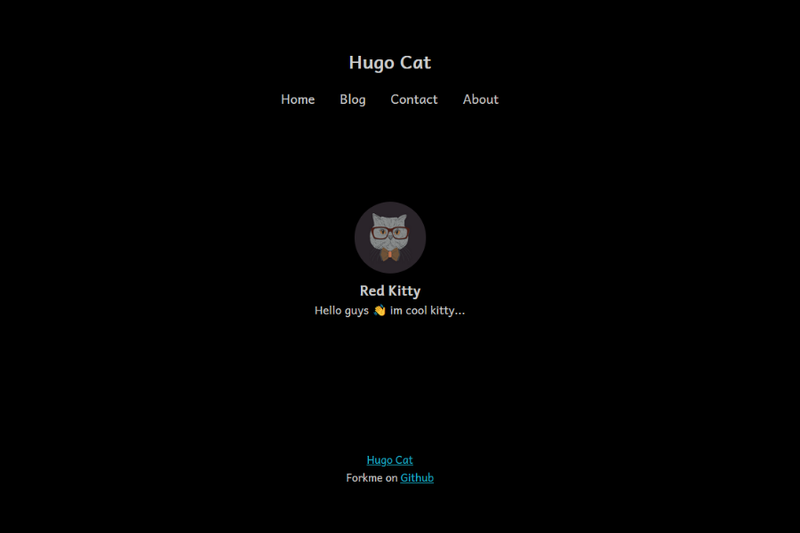
- Live demo — A working preview is hosted at https://hugo-cat.pages.dev/, so you can see the default appearance before installing.
- Hugo-native workflow — The theme integrates with Hugo's standard content directories, templates, and shortcodes.
- Open to contributions — The README explicitly invites contributors to help complete the theme, including writing schema JSON and implementing dark mode.
- Simple installation — Installation follows the standard Hugo process: download the theme, place it in the themes folder, and set it in the site configuration.
Who is it for?
- Hugo developers looking for a minimal, Bootstrap-free starting point to customize into their own project.
- Static site bloggers who want a clean layout without pulling in a heavy CSS framework.
- Open-source contributors interested in developing a Hugo theme further, as the project welcomes features like dark mode.
What can you do with hugo-cat?
- Build a Hugo website: Use the theme's templates and layouts to turn Markdown content into a static site, then deploy it to any static host such as Pages or Netlify.
- Customize the design: Since Bootstrap is removed, you can freely modify the CSS and layout files without fighting framework defaults.
- Contribute improvements: Fork the repository and add missing features like schema JSON or dark mode; the owner explicitly asks for help.
How does hugo-cat work?
The installation is described in the README: install Hugo, create a new site and directory structure, then follow the Hugo quick start to add the theme and render your site. Once set up, Hugo builds your Markdown content into static HTML pages that the theme styles.
Pros and cons
Pros:
- No Bootstrap means less code to load and fewer styling conflicts.
- Backed by a live demo and an active maintainer who invites contributions.
- Free and open source.
Cons:
- Dark mode is not yet implemented; the README lists it as a potential contribution.
- Schema JSON and other completeness features are still missing, as noted in the README.
- With 22 stars, the project has a small user community, so help and plug-ins are limited.
Alternatives
- Hugo Red Rose — the original theme this project is based on, which still depends on Bootstrap.
FAQ
Is hugo-cat free?
Yes, the theme is publicly available on GitHub and can be freely downloaded, used, and modified. No license file is mentioned, so you may want to contact the owner for clarification on commercial use.
What Hugo version does hugo-cat need?
The README references Hugo v0.111.3. It is recommended to use a recent Hugo release; the theme was tested or developed with that version.
Does hugo-cat use Bootstrap?
No. The theme is explicitly a rewrite of Hugo Red Rose without Bootstrap, so it uses its own custom CSS instead.
Can I contribute to hugo-cat?
Yes. The README states that contributions are welcome, specifically mentioning tasks like writing schema JSON and adding dark mode support.
Where can I see hugo-cat in action?
A live demo is hosted at https://hugo-cat.pages.dev/ so you can preview the theme before installing it.