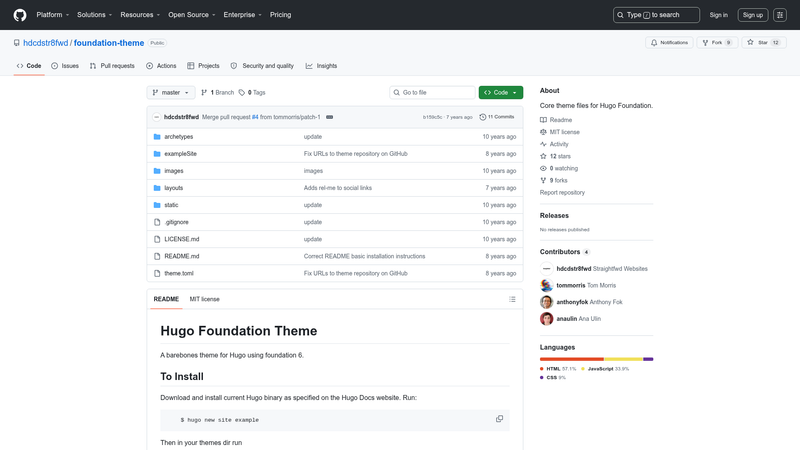
Hugo Foundation Theme is a barebones starter theme for the Hugo static site generator, built on the Foundation 6 CSS framework and distributed via GitHub. It provides the core theme files needed to render a Hugo site with Foundation 6 styling, plus an example configuration to get started.
What is Hugo Foundation Theme?
Hugo Foundation Theme is a minimal Hugo theme that uses the Foundation 6 front-end framework for styling. Its repository contains the essential theme files—layout templates, static assets, and configuration samples—so developers can scaffold a new site rather than starting from scratch. The theme takes Hugo content and configuration as input and outputs a static HTML website styled with Foundation 6 components. It is maintained by hdcdstr8fwd on GitHub.
Key Features
- Barebones structure — Delivers only the core theme files, allowing you to build your own design system without removing pre-existing components.
- Foundation 6 integration — Utilizes the Foundation 6 CSS framework for responsive grids, typography, buttons, and other UI primitives.
- Example site configuration — A
config.tomlinsidethemes/examplesitedemonstrates how to configure the theme for your own site. - Standard Hugo installation — Clone the repository into your
themesdirectory and run Hugo; no additional build tools or package managers are required. - GitHub hosting — The source code is publicly available and has 12 stars on GitHub, indicating community interest.
Who is it for?
- Hugo developers who want a clean slate to craft a custom theme without ripping out opinionated styles.
- Front-end designers familiar with Foundation 6 who need a Hugo integration to quickly mock up responsive pages.
- Technical bloggers who prefer a minimal starting point for a Hugo-based blog and are comfortable writing their own layouts.
What can you do with it?
- Scaffold a new Hugo site by cloning the theme and adapting the sample
config.tomlto match your project. - Build responsive layouts using Foundation 6's grid and utility classes within Hugo templates.
- Learn Hugo theme conventions by studying the minimal file structure and the provided example site.
How does it work?
- Install the Hugo static site generator following the instructions on the Hugo Docs website.
- Create a new site with
hugo new site example. - Change into the
themesdirectory and rungit clone https://github.com/hdcdstr8fwd/foundation-theme. - Open
themes/examplesite/config.tomlto see the required configuration keys and adapt them for your site.
FAQ
Is Hugo Foundation Theme free to use?
The repository is publicly accessible on GitHub, so you can clone and use the theme without paying a fee. No license information is provided in the source, so check the repository for licensing terms.
Do I need Node.js or other build tools?
No. This theme relies only on Hugo to generate the static site. Foundation 6 styles are included within the theme files, and no JavaScript build step is necessary for basic usage.
Can I use this theme for a personal portfolio?
Yes. Hugo can handle static content for a portfolio, and this barebones theme gives you full control over the layout. You would need to create your own templates for project listings, which the example configuration can help you get started with.
What exactly is included in the repository?
The repository includes the theme's core files (templates, styles, and configuration examples) and an examplesite directory containing a sample config.toml. The exact file list is not documented in the README.
Does this theme come with a blog layout?
No. The theme is barebones, so blog post listing and single-page templates are not provided. You can add them yourself using Hugo's template system.