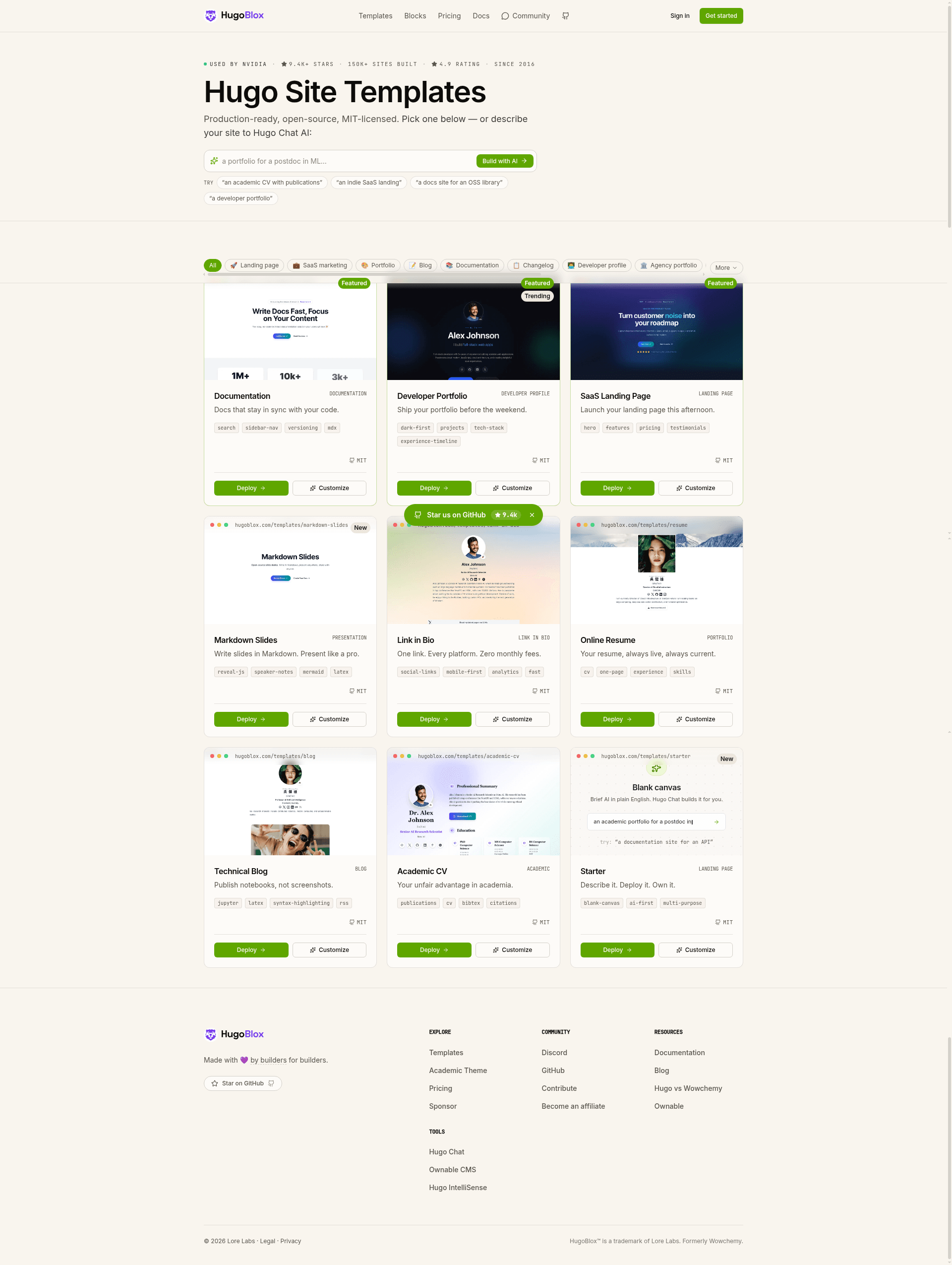
The Hugo Second Brain Theme is a free, open-source starter template by HugoBlox for publishing a personal knowledge base and digital garden as a static website built from Markdown files.
What is the Hugo Second Brain Theme?
The Hugo Second Brain Theme is a starter template built on the Hugo static site generator, created by the HugoBlox (Wowchemy) team. It takes Markdown notes written in any Git-connected editor and produces a deployable website, with the integrated Wowchemy website builder and CMS handling content management. As a 'second brain' template, it is designed around the Zettelkasten card-box note-taking method, storing knowledge in future-proof Markdown rather than a proprietary database.
What makes the Second Brain Theme stand out?
- Future-proof Markdown storage — All notes are kept as plain Markdown files that remain readable independent of any platform or service.
- Zettelkasten note-taking support — The repository metadata explicitly labels it as a 卡片盒笔记法 (Zettelkasten) theme for linked, atomic notes.
- Rich content blocks — Supports audio, video, images, math, code, and Mermaid diagrams through the HugoBlox content framework.
- Git-based editing workflow — Edit notes online in GitHub or any Git-connected Markdown app such as Obsidian or Visual Studio Code.
- Fast deployment — Generate the site with Hugo and deploy via GitHub or Netlify; a live demo is available at docs.hugoblox.com and a starter can be running in under 10 minutes.
- Customization options — Customize the site with widgets, light/dark themes, and language packs.
- Academic integrations — Automatically import citations from BibTeX using the Hugo Academic CLI.
Who is it for?
- Researchers and academics: maintain a searchable knowledge base and attach BibTeX citations.
- Obsidian users: publish an existing Obsidian vault as a public website without leaving their Markdown editor.
- Writers and students: practice Zettelkasten note-taking and turn linked notes into a structured digital garden.
- Developers: use Git for version control and deploy to GitHub Pages or Netlify.
What can you do with the Hugo Second Brain Theme?
- Build a public digital garden: publish interconnected notes with support for math, code, and diagrams.
- Create a personal second brain: store private or public notes in Markdown and edit them from Obsidian or Visual Studio Code.
- Publish documentation or a course site: use the rich content blocks and widgets to organize tutorials, references, and knowledge articles.
How does the Hugo Second Brain Theme work?
Workflow follows the standard HugoBlox process: clone or create a site from the template, write notes in Markdown, generate the site with Hugo, and deploy to GitHub or Netlify. The integrated Wowchemy CMS provides a browser-based editing option alongside the Git-connected Markdown apps.
Pricing
The theme is free and open source. HugoBlox offers optional GitHub sponsorship, which unlocks perks such as exclusive academic templates and widgets, but the core template itself is free to use.
FAQ
Is the Hugo Second Brain Theme free?
Yes, the theme is free and open source. The project requests optional support through GitHub sponsorship, which unlocks perks like exclusive academic templates and widgets, but the template itself does not require payment.
Can I edit my notes in Obsidian?
Yes. Because the site is built from Markdown files, you can open the entire site directory in Obsidian or Visual Studio Code and edit notes locally. Changes are synced through Git and then rebuilt with Hugo.
What content formats are supported?
Notes can include audio, video, images, math, code, and Mermaid diagrams. The HugoBlox documentation at docs.hugoblox.com covers writing Markdown and LaTeX in detail.
How long does it take to get started?
The project claims you can have a demo site running in under 10 minutes by following the Get Started link. Deployment uses Hugo to generate the site and GitHub or Netlify to host it.