Hugo Tale is a minimal Hugo theme that ports Chester How's Tale Jekyll theme to the Hugo static site generator, giving storytellers a clean canvas for their writing.
What is Hugo Tale?
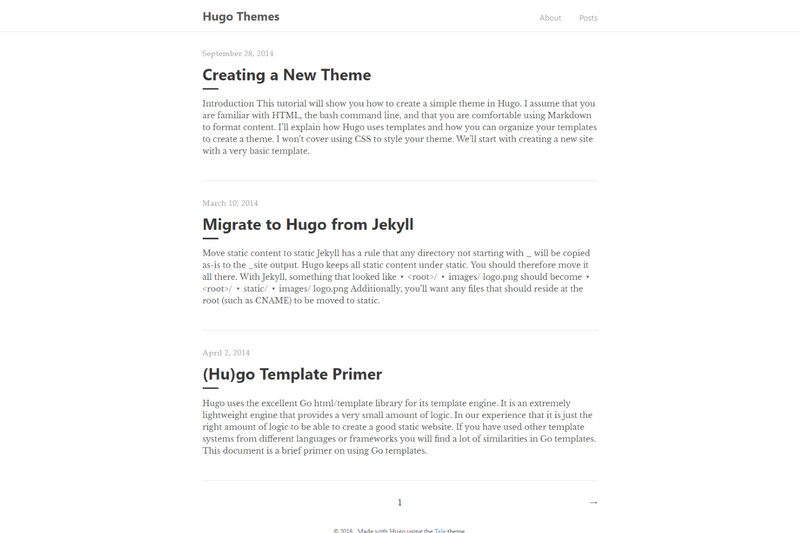
Hugo Tale is a port of the Tale theme for Jekyll into Hugo, created by EmielH. It takes Markdown content and generates a static blog with a post index, individual post pages, and a top navigation menu. The theme is designed to be minimal and content-focused, with no unnecessary visual decoration.
Key Features
- Dark mode toggle — A dark mode switch is included and visible by default; site owners can hide it by setting the
hideDarkModeToggleparameter totrue, and developers can calltoggleDarkMode()from their own custom toggle. - Internationalisation (i18n) — Language files are provided in the
i18ndirectory, supporting languages other than English; switch the default language by settingdefaultContentLanguageinconfig.toml(for example,defaultContentLanguage = "nl"for Dutch). - Disqus comments — Add your site's Disqus shortname via the
disqusShortnameconfiguration key and setcomments: truein page frontmatter to enable comments on static pages. - Google Analytics — Integrates with Hugo's built-in
google_analytics_asynctemplate; enabling it adds the tracking snippet to all pages. - OpenGraph support — Uses Hugo's embedded OpenGraph template so shared links get rich social previews.
- Custom summaries — You can define a manual summary by setting the
summaryvariable in page frontmatter; otherwise Hugo's auto-generated summary is used. - Placeholder partials — The theme ships with
single/header.html,single/footer.html, andindex/introduction.htmlpartials that you can override to add author info, related posts, or a site introduction without modifying the theme itself. - Additional CSS loading — Add extra stylesheets by listing their filenames in the
cssparameter inconfig.toml; multiple files are supported.
Who is it for?
- Writers and storytellers looking for a simple, readable blog layout that keeps the focus on the prose.
- Hugo users who prefer the Tale aesthetic but want the speed and flexibility of Hugo over Jekyll.
- Developers who need a lightweight base theme that can be extended with custom partials, CSS, and menu structures.
What can you do with Hugo Tale?
- Personal bloggers: Publish Markdown posts and get a clean blog index, post pages, and a menu without configuring a frontend framework.
- Multilingual authors: Use the built-in i18n support to translate the interface and set a default language, as documented with the Dutch example.
- Site maintainers: Add Disqus comments and Google Analytics to your static site in a few configuration lines.
- Theme extenders: Override the placeholder partials or load custom CSS to tailor the look and functionality without forking the theme.
How does Hugo Tale work?
Install the theme as a git submodule or by cloning it into the themes directory, then set theme = "tale" in config.toml. Hugo automatically picks up the theme's layouts, and you write content as Markdown files. The theme renders a blog index, section pages, and single post templates, and it supports taxonomies, though you must add links to taxonomy pages yourself in files such as header-menu.html.
Pros and cons
- Pros: Minimal and fast by design; includes dark mode, i18n, Disqus, Google Analytics, and OpenGraph support out of the box; provides placeholder partials for easy customisation.
- Cons: Taxonomy support is basic — you need to manually link to taxonomy pages; the design is intentionally sparse and may not suit sites that need rich layouts.
Alternatives
- Tale for Jekyll — the original theme by Chester How on which this Hugo port is based.
FAQ
Is Hugo Tale free to use?
Hugo Tale is an open-source theme available on GitHub under the license file included in its repository. No pricing information is listed, and it is intended for free use in Hugo projects.
Does Hugo Tale support dark mode?
Yes, the theme includes a built-in dark mode toggle that is visible by default. You can hide it by setting the hideDarkModeToggle parameter to true in the site configuration.
Can I use Hugo Tale in languages other than English?
Yes, the theme supports internationalisation via the i18n directory. You can set a default language such as Dutch using the defaultContentLanguage key in config.toml, and you can add your own translations.
How do I add comments to my Hugo Tale site?
Set the disqusShortname key in your config.toml and add comments: true to the frontmatter of the pages where you want comments to appear. The Disqus integration will then display the comment widget on those pages.
What are the placeholder partials in Hugo Tale?
The theme includes three placeholder partials: single/header.html, single/footer.html, and index/introduction.html. You can create matching files in your site's layouts/partials directory to inject custom content at the top or bottom of blog posts, or at the start of the post list on the index page.