HugoBlox is an open-source website framework that turns structured Markdown into professional sites — landing pages, blogs, portfolios, publications, and docs — with AI-generated pages and free static deployment.
What is HugoBlox?
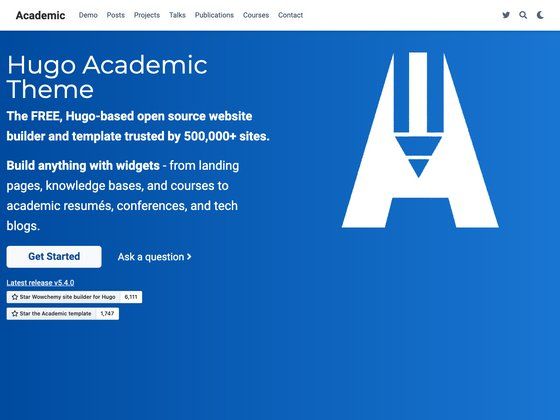
HugoBlox is an open-source website framework (MIT licensed) that builds static HTML sites from Markdown content with structured front matter. It accepts Markdown files, shortcodes, and HugoBlox "blocks" as input and produces deployable static sites without a database or runtime server. HugoBlox runs on the Hugo Extended static site generator with Tailwind CSS and is developed by Lore Labs (the same team behind Hugo Academic, which HugoBlox evolved from). The project also includes two companion tools: Hugo Chat, an AI that generates pages from plain-English descriptions, and Ownable CMS, a visual editor that runs inside VS Code.
Key Features
- AI page generation — Hugo Chat takes a plain-English request like "Create a landing page with hero, pricing, and testimonials" and outputs structured Hugo pages with correct front matter, shortcodes, and HugoBlox blocks; free messages are included daily.
- 20+ structured content types — includes landing pages, blogs, portfolios, publication pages with BibTeX/DOI import, documentation with sidebar navigation, team profiles, event pages, slide decks (reveal.js), resumes/CVs exportable to PDF, and native rendering of Jupyter notebooks (
.ipynb) and LaTeX. - Markdown ownership — every generated page is a plain Markdown file you can read, edit, and version control; content is never locked in a database or proprietary format.
- Tailwind CSS block system — snap together prebuilt blocks (hero, features, pricing, testimonials, CTA) to assemble landing pages without writing CSS.
- Visual editing with Ownable CMS — install the Ownable extension in VS Code to drag-and-drop blocks, preview live, and validate YAML without leaving your editor.
- One-command CLI — scaffold a new site with
npm install -g hugobloxandhugoblox create site; requires Hugo Extended and Node.js. - Deploy anywhere — output is static HTML, so it works on Netlify, Vercel, Cloudflare Pages, GitHub Pages, or any static host with free-tier hosting.
Who is it for?
HugoBlox is built for researchers, consultants, founders, developer advocates, and teams that want a professional web presence without giving up ownership of their content or paying for hosting.
- Academic researchers — publish publication lists, team pages, and slide decks with BibTeX metadata; HugoBlox is used by NVIDIA Research, MIT, Stanford, King's College London, and Google.
- Consultants and freelancers — create landing pages with services, pricing, testimonials, and contact forms in minutes using Hugo Chat.
- Founders and startups — ship a marketing site with hero, features, pricing, and blog sections, then deploy for free on Vercel or Netlify.
- Developer advocates and documentation teams — build searchable docs with sidebar navigation and versioning, rendered from Markdown.
What can you do with HugoBlox?
- Researchers: generate publication pages with correct BibTeX metadata and team profiles; postdocs can edit their own pages as Markdown without CMS training.
- Consultants: ask Hugo Chat to generate a landing page with services, testimonials, and a contact form; host it for free.
- Developers: scaffold a documentation site with the CLI, write in Markdown, and deploy to GitHub Pages without a server.
- Founders: prototype a startup marketing site with pricing and FAQ sections, keep all content as Markdown files you own.
How does HugoBlox work?
- Pick a template — choose from hugoblox.com/templates or scaffold with the CLI (
npm install -g hugoblox, thenhugoblox create site). - Generate pages with AI — open Hugo Chat and describe what you need; it generates structured Hugo pages with front matter, shortcodes, and HugoBlox blocks.
- Edit and deploy — optionally edit visually with Ownable CMS in VS Code, then push to GitHub and deploy to Netlify, Vercel, Cloudflare, or any static host.
Pricing
The HugoBlox framework is free and MIT licensed, including all templates and the CLI. Hugo Chat includes free messages every day with no credit card. A paid HugoBlox Pro tier adds visual editing, AI automations, BibTeX import, and priority support — see hugoblox.com/pricing for plan comparison.
Alternatives
The page names several alternatives in its comparison table: AI site builders like Lovable, v0, and Bolt (which generate React code rather than Markdown), and CMS platforms like WordPress and Webflow (which lock content in a database). HugoBlox positions itself the middle: AI-generated pages with ownership as plain Markdown.
FAQ
Is HugoBlox free?
Yes, the HugoBlox framework is MIT licensed and free to use, including all templates and the CLI. Hugo Chat provides free messages every day without a credit card. Optional paid Pro tier adds visual editing, AI automations, BibTeX import, and priority support.
What does HugoBlox do?
HugoBlox turns structured Markdown into professional static websites — landing pages, blogs, portfolios, publications, documentation, and more. It uses Hugo and Tailwind CSS, supports 20+ content types, and integrates with Hugo Chat for AI page generation and Ownable CMS for visual editing in VS Code.
What is Hugo Chat?
Hugo Chat is an AI assistant that generates Hugo pages from plain-English descriptions. For example, you can type "Create a landing page with hero, pricing, and testimonials" and get structured pages with correct front matter, shortcodes, and HugoBlox blocks. It includes free messages daily.
What tech stack does HugoBlox use?
HugoBlox runs on Hugo Extended and Tailwind CSS. It renders Markdown content with front matter and shortcodes, supports Jupyter notebooks (.ipynb), LaTeX, and reveal.js slide decks. The CLI requires Hugo Extended and Node.js. Output is static HTML deployable to any static host.
Can I deploy HugoBlox sites for free?
Yes. Because HugoBlox generates static HTML with no database and no runtime, you can deploy to free tiers of Netlify, Vercel, Cloudflare Pages, or GitHub Pages. The README states hosting can be $0/month.