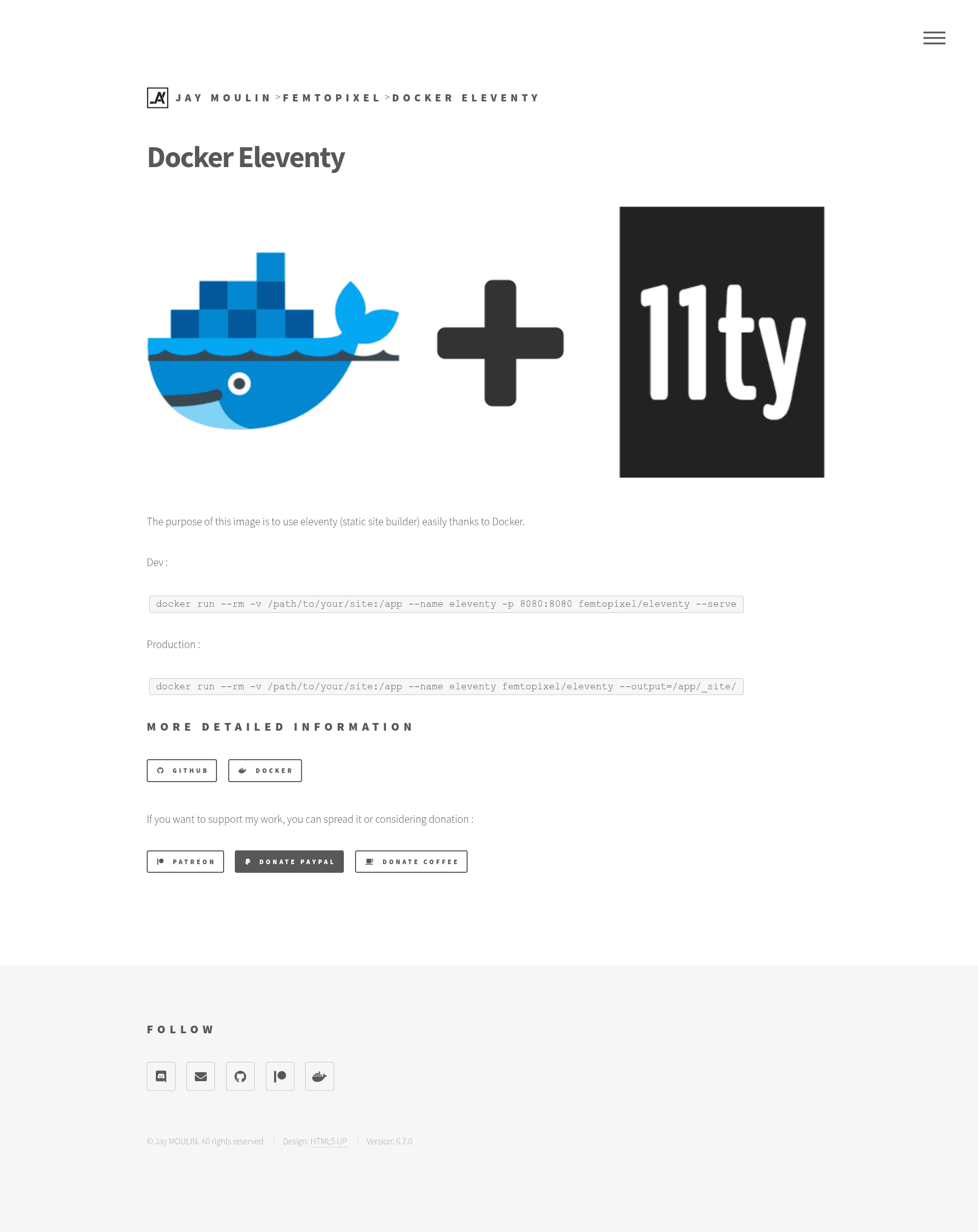
Docker Eleventy is a Docker image that packages the Eleventy static site generator so you can build and serve sites without installing Node.js locally.
What is Docker Eleventy?
Docker Eleventy is a community-maintained Docker image published on Docker Hub as femtopixel/eleventy. It wraps the Eleventy static site generator, a flexible tool that compiles templates and content into plain HTML. The image accepts a mounted site directory and runs Eleventy commands, such as --serve for a local development server or --output=/app/_site/ for a production build. The image is multiarch, meaning it supports multiple CPU architectures, including ARM and x86.
Key Features
- Multiarch support — Built for multiple CPU architectures, so the image runs on ARM devices like Raspberry Pi as well as standard x86 servers.
- Dev server mode — Running
docker run -p 8080:8080 -v /path/to/site:/app femtopixel/eleventy --servestarts a live-reloading development server on port 8080. - Production build mode — The command with
--output=/app/_site/generates the static site into the_sitedirectory inside the container, which is written back to the mounted volume. - Simple volume-based workflow — Your site files stay on the host; the container mounts them at
/app, so no copying files in or out is required. - Docker Hub distribution — Published as
femtopixel/eleventywith releases automated by GitHub Release Notifier. - Free and permissive license — The project is open source, but relies on community financial support (PayPal, Buy Me a Coffee, Ko-fi) for continued maintenance.
Who is it for?
- Static site developers who want a consistent Eleventy environment across machines without installing Node.js or npm locally.
- CI/CD pipelines that need to build Eleventy sites in a clean, disposable container step.
- Designers and content editors who prefer using a simple Docker command over managing a local Node.js toolchain.
- Developers on ARM devices (e.g., Raspberry Pi) who need a multiarch image that runs on their hardware.
What can you do with it?
- Local development: Mount your site and run
--serveto preview changes with automatic reload athttp://localhost:8080. - Production deployment: Run the image with
--output=/app/_site/to generate the static HTML output ready to upload to any host. - Automated builds: Use the image in a Docker-based CI workflow to produce your site's output on every commit.
How does it work?
The workflow uses Docker volume mounting. You run a docker run command that binds a local directory to the /app path inside the container. The container then executes Eleventy with the arguments you pass (e.g., --serve or --output=/app/_site/). The output appears in the mounted directory on your host.
Pros and cons
Pros:
- No Node.js installation needed on the host.
- Multiarch simplifies deployment across different hardware.
- Simple two-command workflow for dev and production.
Cons:
- As of 2021, the project no longer has a free support team; maintenance depends on donations.
- Running via Docker adds image download time and container overhead compared to a local npm install.
Pricing
The image is open source and available under a free and permissive license. The author asks for financial support through PayPal, Buy Me a Coffee, and Ko-fi to sustain development.
FAQ
Is the Eleventy Docker image free?
Yes, the image is published on Docker Hub and the source is available under a free and permissive license. You can pull and run it without paying. The author requests donations to support ongoing maintenance.
How do I run Eleventy locally with this image?
Use docker run --rm -v /path/to/your/site:/app --name eleventy -p 8080:8080 femtopixel/eleventy --serve and open your site at http://localhost:8080. Replace /path/to/your/site with the absolute path to your Eleventy project.
How do I build a production version of my site?
Run docker run --rm -v /path/to/your/site:/app --name eleventy femtopixel/eleventy --output=/app/_site/. The generated static files will appear in the _site folder inside your mounted site directory.
Where can I get support?
The repository states that as of 2021 there is no free support team. The project depends on community contributions and donations. For issues, you can open an issue on the GitHub repository.