Newsletter
Join the Community
Subscribe to our newsletter for the latest news and updates

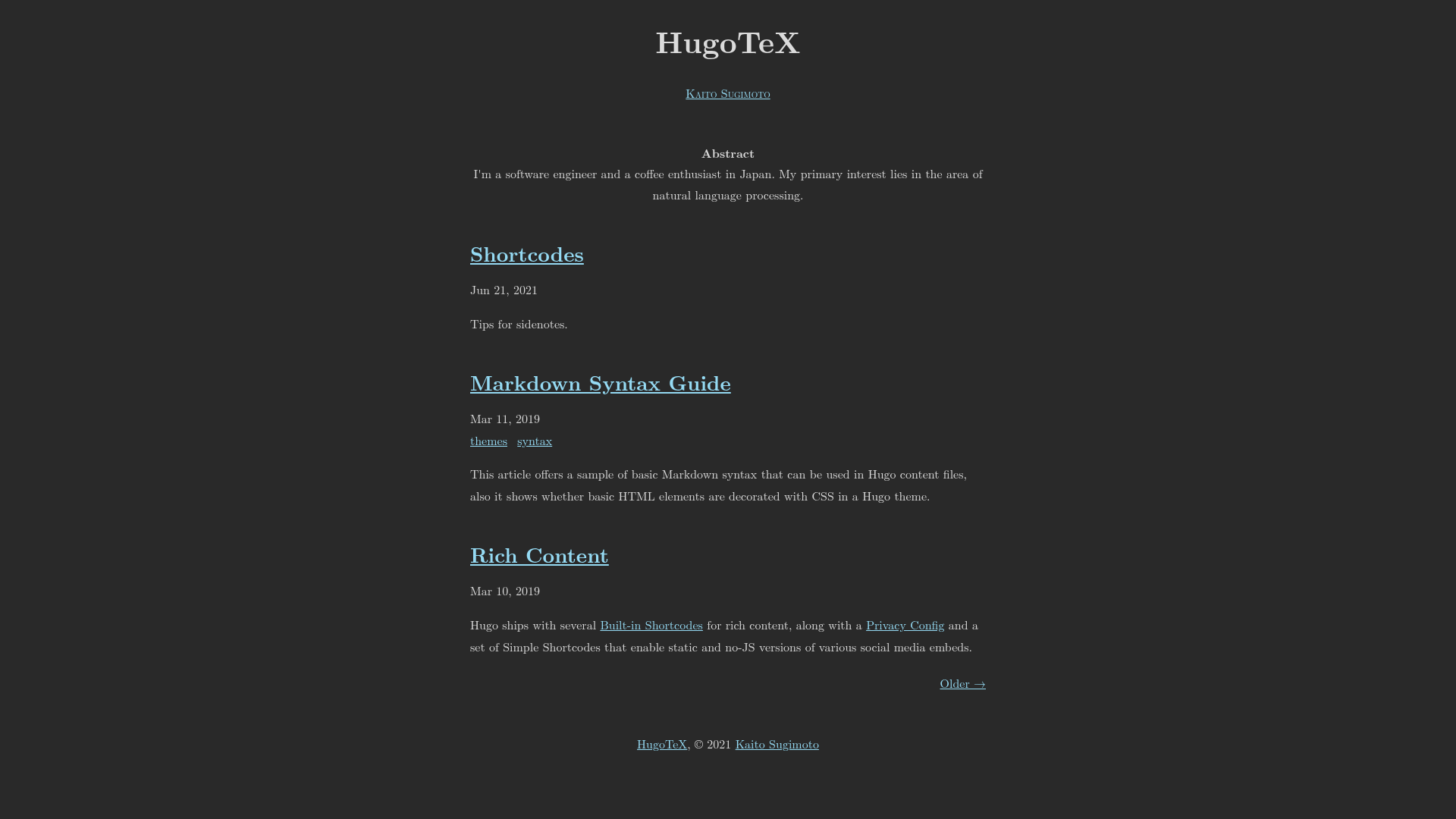
A LaTeX-inspired Hugo theme for elegant technical writing and academic content, featuring server-side KaTeX math rendering and zero client-side JavaScript.
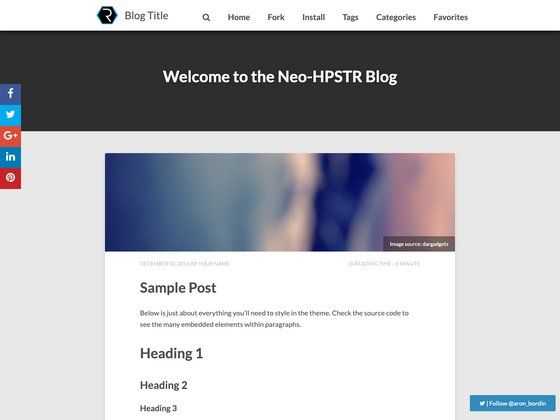
Responsive, modern Jekyll blog theme with animated navigation, Disqus comments, social sharing, and SCSS customization.
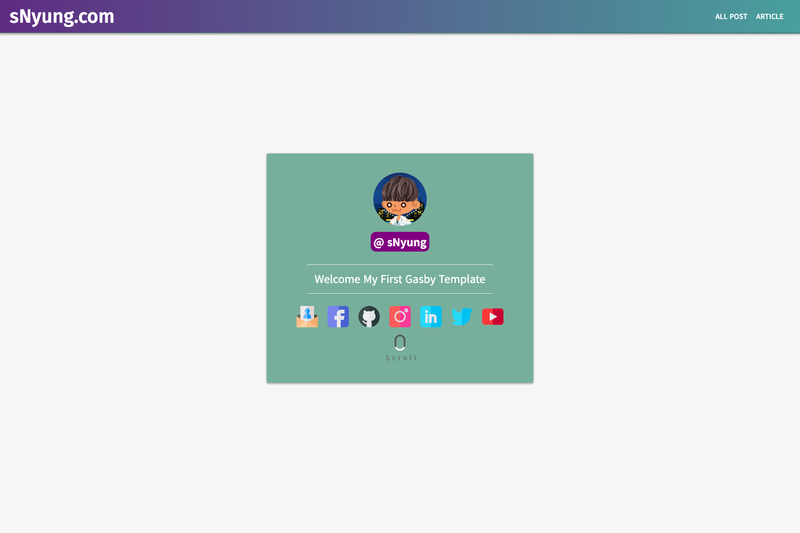
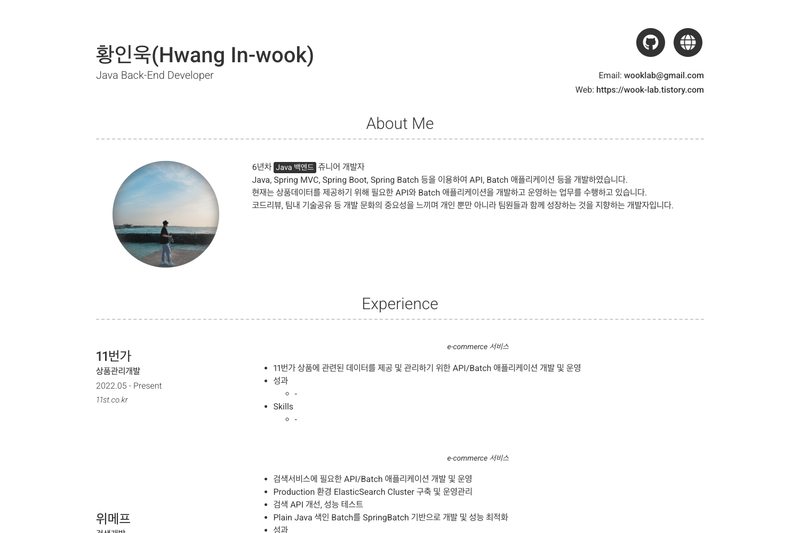
Gatsby blog starter with SCSS, Utterances comments, pagination, React Helmet SEO, automated post generation, and resume page.
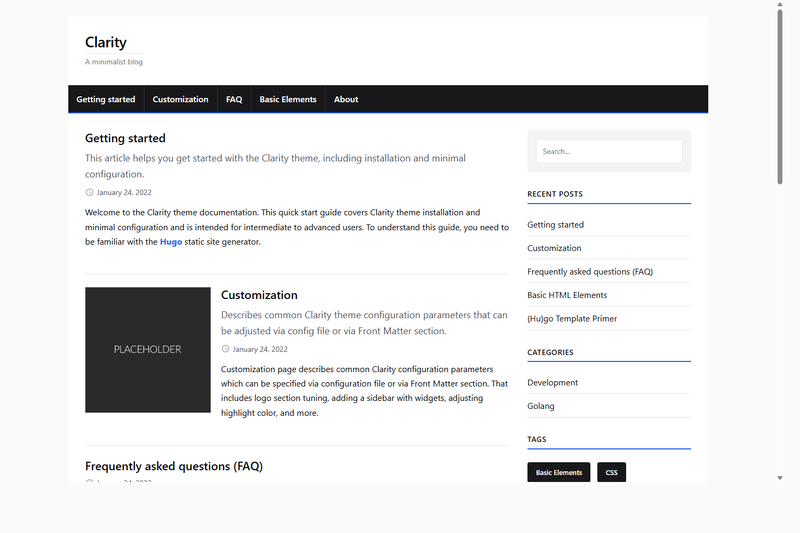
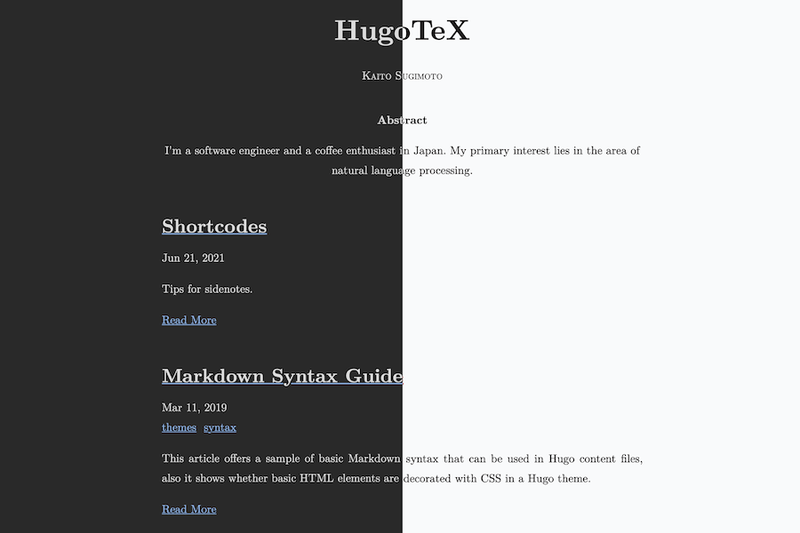
A modern Hugo theme with automatic dark mode, CSS Custom Properties, and 15+ language translations.

A modern, card-based Hexo blog theme with dark mode, multiple comment systems, search backends, and built-in widgets.
HugoTeX is a free, MIT-licensed Hugo theme that applies LaTeX's classic document typography to static sites for academic writing, technical blogging, and math-heavy content.
HugoTeX is a Hugo theme, requiring Hugo 0.158.0 or newer, that turns Markdown content — prose, code blocks, and mathematical notation — into a static HTML site styled like a LaTeX document. Inline math in single dollar signs and display math in double dollar signs are typeset at build time, so no math JavaScript is shipped to the browser. The theme is maintained by the HugoTeX team on GitHub, powers the live demo at hugotex.pages.dev, and bases its styling on LaTeX.css and latex-css.
HugoTeX concentrates its feature set on print-style typography and on doing heavy work at build time rather than in the browser.
transform.ToMath during the build; pages load with zero client-side math JavaScript and stay fully readable with JavaScript disabled.prefers-color-scheme; setting darkmode = true or lightmode = true in hugo.toml forces dark or light mode.more comment divider renders automatically as an academic-style abstract at the top of each article.paraiso-dark and monokai; a separate DarkStyle under [Params.SyntaxHighlighting] can differ from the light style in [markup.highlight].themes directory.ico (16, 32, and 48 px), an svg for modern browsers, and a 180x180 png used as both fallback and Apple touch icon.HugoTeX targets writers whose content mixes prose, code, and mathematics, plus any Hugo user who wants LaTeX-like page styling.
$E = mc^2$ with proper typesetting supported by KaTeX.HugoTeX supports four concrete workflows, all running on a standard Hugo installation.
more divider becomes a formal abstract, with equations processed at build time.assets/css/custom.css.To try it, clone the repository, enter exampleSite, and run hugo server -t ../.. to preview the demo at localhost:1313. In an existing project, add the theme as a submodule, set theme = "HugoTeX" in hugo.toml, and enable the Goldmark passthrough extension with single-dollar inline and double-dollar block delimiters so math renders through transform.ToMath on every build.
Yes. HugoTeX is released under the MIT License, so it can be used, modified, and redistributed freely, including in commercial projects.
HugoTeX requires Hugo 0.158.0 or newer. The quick start also assumes Git is installed, since the recommended installation method adds the theme as a git submodule.
Yes. Math is typeset server-side with KaTeX through Hugo's transform.ToMath, so equations render even with JavaScript disabled and add no render-blocking client-side scripts.
Enable the Goldmark passthrough extension in hugo.toml with inline $ and block $$ delimiters, and set enableInlineShortcodes = true. Once configured, write LaTeX-style math directly in Markdown and it is processed at build time.
Omit both mode parameters to follow the user's prefers-color-scheme automatically. Set darkmode = true to force dark mode, or lightmode = true to force light mode, in the [Params] section of hugo.toml.