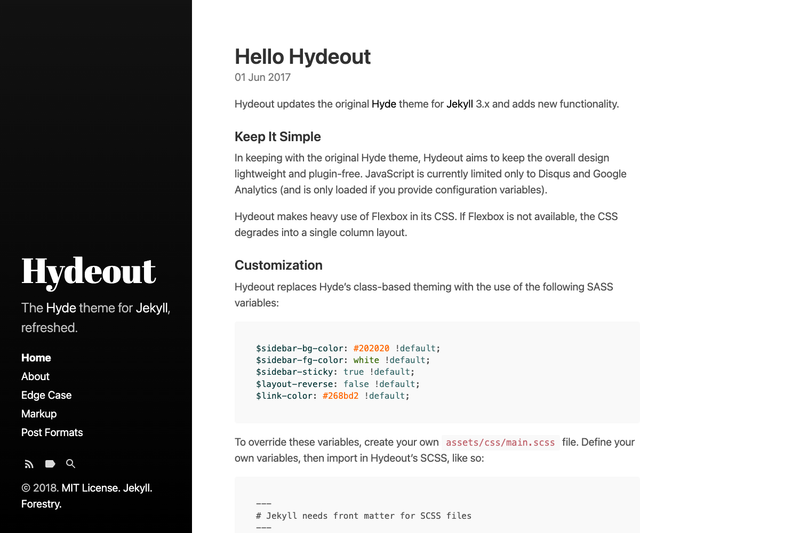
Hydeout Jekyll Starter is a lightweight, plugin-free Jekyll 3.x blog theme — an updated fork of the classic Hyde theme — preconfigured for the Forestry CMS and deployable to Netlify or AWS.
What is Hydeout Jekyll Starter?
Hydeout is a Jekyll 3.x blog theme that updates the original Hyde theme by Mark Otto with new functionality and a starter kit wired for Forestry, a content management system. It takes Markdown posts and pages as input and produces a static HTML site via bundle exec jekyll build. The theme was maintained by Andrew Fong (fongandrew) and is open-sourced under the MIT license.
Key Features
- Plugin-free JavaScript — The only JavaScript is optional Disqus comments and Google Analytics, loaded only when you provide configuration variables.
- Flexbox-based layout — Heavy use of Flexbox for the sidebar and content columns; degrades to a single-column layout when Flexbox is unavailable.
- Forestry CMS integration — The starter repo imports directly into Forestry, letting you edit posts, pages, sidebar links, categories, and site settings in a visual editor.
- Theme color customization — Adjust sidebar background, foreground, and link colors through Site Configuration; override any Sass variable in
_sass/hydeout/_variables.scss. - Reverse layout — Flip the sidebar to the opposite side with one configuration toggle.
- Disqus and Google Analytics — Enable comments and analytics by adding a Disqus shortname and a tracking code in Site Configuration.
- Tags and Search pages — Built-in special pages that appear as icons at the bottom of the sidebar and can be added or removed.
- Flexible deployment — Deploy to Netlify with build command
bundle exec jekyll buildand publish directory_site, or use AWS S3/CloudFront, GitHub Pages, FTP/SFTP, and webhooks.
Who should use Hydeout Jekyll Starter?
- Bloggers who want a minimal, typography-focused Jekyll blog with a two-column layout and category/tag organization.
- Developers who want a clean, customizable Jekyll 3.x theme with Sass variables and no build-time plugins.
- Forestry/static-CMS users who need a Jekyll starter preconfigured to work with Forestry's CMS without extra setup.
- Teams deploying to Netlify or AWS who want a static site with a one-click Netlify deploy or a CloudFormation-based S3/CloudFront stack.
What can you do with Hydeout Jekyll Starter?
- Bloggers: import the starter into Forestry and start writing Markdown posts; the theme renders them into a static blog with sidebar categories.
- Developers: customize the theme by overriding Sass variables in
_variables.scss, deploying the built_sitedirectory anywhere static hosting works. - Forestry users: manage posts, pages, sidebar links, categories, and site settings through Forestry's CMS without touching code.
- Netlify deployers: connect the repo to Netlify, set the build command and publish directory, and get automatic rebuilds on every commit.
How does Hydeout Jekyll Starter work?
- Import the starter repo into Forestry using the quick-start link, which sets up the Jekyll project in your Git account.
- Deploy the site — the easiest path is Netlify: connect your Git provider, set build command
bundle exec jekyll buildand publish directory_site, then click Deploy Site. - Edit content in Forestry — create posts/pages, set drafts, manage sidebar links, categories, tags, and search pages, then turn Draft off and save to trigger a rebuild.
FAQ
Is Hydeout free?
Yes. The theme is open-sourced under the MIT license, so it is free to use, modify, and redistribute. The starter repo is fully configured and also free to import.
How do I deploy Hydeout to Netlify?
Connect your Git provider to Netlify, select your repository, enter the build command bundle exec jekyll build, set the publish directory to _site, and click Deploy Site. Then copy your Netlify URL into the Site Configuration URL field in Forestry.
Can I add comments and analytics?
Yes. Add your Disqus shortname in Site Configuration → Additional Settings to enable comments, and add a Google Analytics tracking code in the same section to enable analytics. Both JavaScript features load only if the configuration variable is present.
What happens if Flexbox isn't supported?
Hydeout's CSS degrades to a single-column layout when Flexbox is unavailable, so the content remains readable in older browsers. The theme is designed to be lightweight and plugin-free, with JavaScript limited to Disqus and Analytics.
How do I create a category page?
Navigate to Categories in Forestry, click Add New → New Page, and give it a title. The title becomes the category by default, and you can assign posts to it by adding the category name in the post's categories field. Category pages automatically appear in the sidebar.