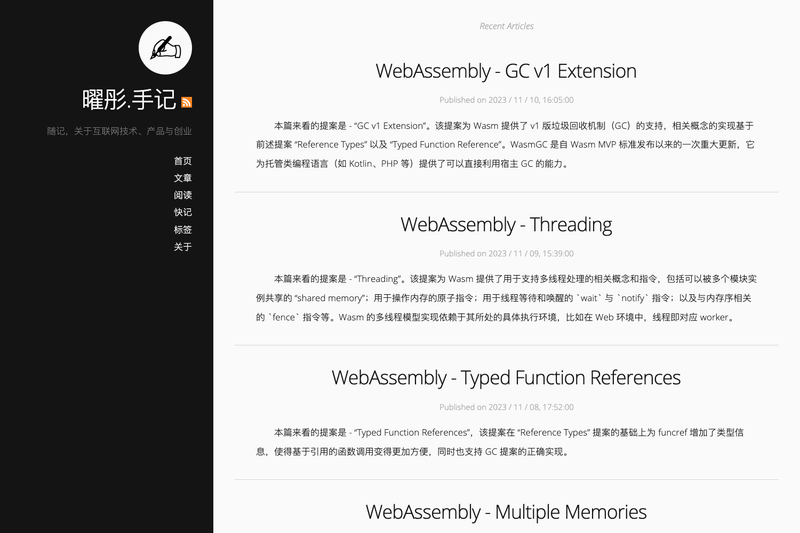
Hyperion is a deeply customized Hexo blog system that can be served either in static mode or in a normal browser/server (B/S) mode, built around Hexo's static page generation with Nginx, Expressjs, GraphQL, MySQL, Workbox, Google Analytics, and PWA support. It is a personal repository with 1 star, described by its author as 'My latest Hexo blog system.'
What is Hyperion?
Hyperion is a Hexo blog system that generates static pages from Markdown posts stored in /source/_posts. It can be deployed as a pure static site, with Nginx acting as a reverse proxy to quickly handle static files, or in a B/S mode where Expressjs provides basic HTTP services. The project also includes a GraphQL + MySQL API for a commenting sub-system, Workbox for caching static resources, Google Analytics for visitor tracking, and PWA support. The only todo item, 'Migrate to HTTP2,' is marked completed.
Key Features
- Dual serving modes — Run as a static site (HTML generated by Hexo) or as a Node.js/Express app for dynamic requests.
- Nginx reverse proxy — Nginx is configured as a backward proxy to quickly deal with static files, offloading them from the Node.js process.
- Hexo static generation — Content in
/source/_postsis compiled by Hexo into static pages, so no database is needed for post storage. - GraphQL + MySQL comment sub-system — Comments and other dynamic data are served through a GraphQL API backed by MySQL.
- Workbox caching — Static resources are cached with Workbox, enabling offline support and faster repeat visits.
- Google Analytics — Visitor statistics are tracked via GA, giving blog owners audience data.
- PWA support — The blog meets progressive web app requirements, so it can be installed and served offline once cached.
- HTTP2 migration — The listed HTTP2 migration is complete, allowing multiplexed and faster asset delivery.
Who is it for?
- Hexo users — Bloggers who want a production-ready Hexo setup with a built-in comment API, PWA, and analytics can use Hyperion as a reference or starting point.
- Self-hosting developers — People comfortable managing Nginx, MySQL, and Node.js can deploy Hyperion as a complete blog stack on their own servers.
- Developers exploring GraphQL comments — Those who want to run their own comment system on a static blog can reuse the GraphQL + MySQL components.
What can you do with Hyperion?
- Run a personal blog: Write posts in Markdown under
/source/_posts, generate the static HTML, and host it anywhere that serves files. - Offer native comments: Use the GraphQL + MySQL API to operate your own comment system, avoiding third-party comment widgets.
- Serve assets with Nginx: Place Nginx in front to handle static files quickly, keeping Expressjs free for API requests.
- Install the blog as a PWA: Thanks to Workbox and PWA support, visitors can add the blog to their home screen and access cached content offline.
How does Hyperion work?
Hyperion's workflow begins when Hexo reads Markdown posts from /source/_posts and generates static HTML output. In B/S mode, Expressjs acts as the HTTP server and exposes the GraphQL API backed by MySQL for comments and other dynamic endpoints. Nginx sits in front, serving static files directly and proxying dynamic requests to Express. Workbox handles client-side caching, while Google Analytics tracks visitor behavior.