i12bretro/tutorials is a free HTML documentation site that hosts hundreds of step-by-step tutorials, each published as a standalone static HTML page and paired with a YouTube walkthrough video.
What is the i12bretro Tutorials repository?
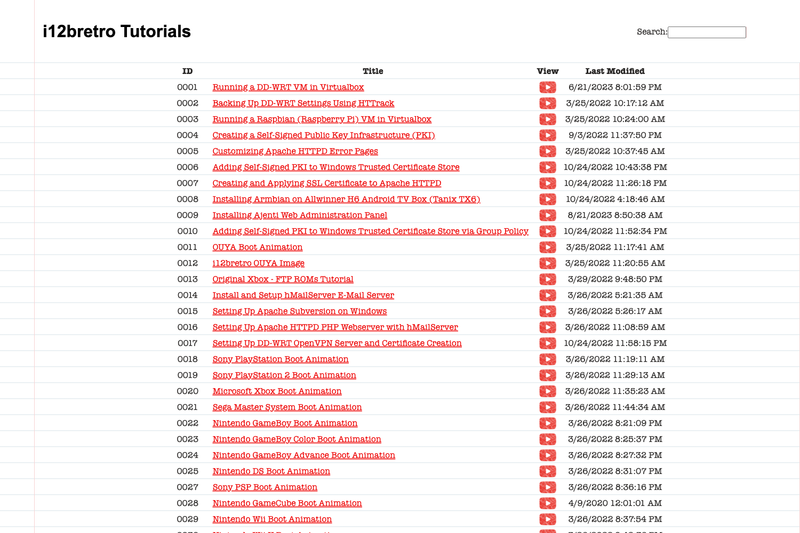
The repository, maintained by i12bretro, is a static HTML index of tutorials written in plain HTML. It takes a numbered list of tutorial titles and produces a searchable table with links to individual HTML pages (for example, 0001.html for the DD-WRT VirtualBox guide). Each tutorial entry includes a title, a direct view link, a YouTube video link, and a last-modified timestamp. The project is hosted on GitHub Pages and has 160 stars, with entries ranging from ID 0001 to 0258.
Key Features
- Numbered tutorial IDs — every tutorial is assigned a unique four-digit ID from 0001 to 0258, making individual guides easy to reference, bookmark, and link to.
- YouTube video integration — each tutorial row includes a YouTube icon linking to a video walkthrough, so users can follow along visually or read the static page.
- Broad topic coverage — tutorials span virtualization (VirtualBox, Proxmox), single-board computers and Android TV boxes (Armbian, LibreElec, Lakka), server administration (Apache, nginx, OpenVPN, mail servers), and retro gaming (boot animations, emulator setups).
- Self-hosting focus — many entries show how to deploy self-hosted alternatives like Nextcloud, ownCloud, Bitwarden via Vaultwarden, FreshRSS, Matomo, and shlink.
- SSL and certificate guides — a recurring theme is creating self-signed PKI certificates and applying them to web servers, VPNs, and admin panels (Apache HTTPD, Windows IIS, Pi-Hole, OpenVPN Access Server).
- Regular updates — the last-modified column shows continuous maintenance, with some tutorials updated as recently as December 2024 (for example, the Tailscale in Docker guide).
- Searchable and sortable index — the main page includes a search box and a table with ID, Title, View, and Last Modified columns, allowing users to quickly find a tutorial by keyword or browse by date.
Who is it for?
- Homelab enthusiasts — follow guides to create virtual machines for Windows, Linux, pfSense, and TrueNAS, or to set up services like Pi-Hole and Portainer.
- IT administrators — use the LDAP/Active Directory authentication, SSL certificate, and Group Policy tutorials to harden their infrastructure.
- Retro-gaming hobbyists — install emulation environments (EmuElec, Batocera, Lakka) and boot animations for classic consoles from PlayStation to Xbox.
- Owners of cheap Android TV boxes — turn devices like the Tanix TX6 or Sunvell T95x into Linux servers, media centers, or retro-gaming machines with Armbian, LibreElec, and similar distros.
What can you do with it?
- Homelab owners: stand up a Windows 10 VM in under 10 minutes, or connect a homelab to the internet with Tailscale in Docker.
- System administrators: set up SSL for the Pi-Hole admin interface, apply self-signed certificates to IIS, or enable LDAP authentication in Apache Guacamole.
- Self-hosters: deploy a password vault with Vaultwarden on Debian, or roll your own Google Docs with Nextcloud and OnlyOffice in Docker.
- Retro gamers: install Lakka on an S905x Android TV box, or copy games to a PlayStation 2 Fat hard drive.
How does it work?
The main page presents a searchable HTML table. Each row links to a standalone tutorial page (like 0001.html) and a YouTube video. Users browse or search the index, click the HTML link to read the written steps, and can open the associated YouTube video for a visual demonstration. Tutorials are static HTML, so they load quickly and require no backend.
Pricing
The entire tutorial collection is free to access. All pages are publicly visible on GitHub Pages, and the repository itself is open source, so anyone can view the tutorial content or inspect the site's HTML structure.
FAQ
Is the i12bretro Tutorials site free?
Yes, all tutorials are publicly accessible at no cost on GitHub Pages. The source repository is also open, so you can view the HTML for any tutorial page.
Do the tutorials include video guides?
Most tutorials have a YouTube link in the index table. Each row shows a YouTube icon that takes you to a video walkthrough of the same steps covered in the HTML page.
What topics are covered?
The tutorials cover virtualization with VirtualBox and Proxmox, Linux on Android TV boxes, self-hosted applications such as Nextcloud and Bitwarden, web server configuration, SSL certificates, LDAP authentication, and retro gaming.
How are the tutorials organized?
Each tutorial has a unique four-digit ID, starting at 0001 and going up to 0258. The main page is a sortable table with columns for ID, Title, View (HTML link), and Last Modified date, plus a search box.