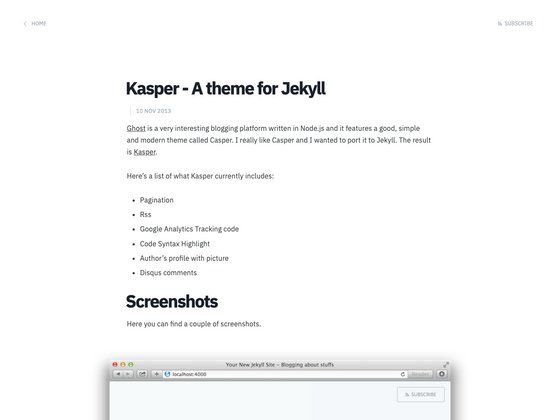
Kasper is a free, open-source Jekyll theme that ports Ghost's default Casper v1 design to Jekyll, giving bloggers a minimal, content-first layout with built-in pagination, RSS, and comments.
What is Kasper?
Kasper is a Jekyll theme that reproduces the look and feel of Ghost's default Casper theme (v1) inside the Jekyll static site generator. It takes a Jekyll site's configuration file and Markdown posts and renders them into a blog with a large featured image header, clean typography, and a responsive layout. The theme was created by rosario and is distributed on GitHub under the MIT License, meaning you can fork, modify, and reuse it freely.
Key Features
- Pagination — Splits post listings across multiple pages using the jekyll-paginate plugin, so you can control how many posts appear per page.
- RSS feed — Generates an Atom/RSS feed automatically so readers can subscribe to new posts.
- Google Analytics — Includes a tracking code snippet that you can activate by adding your Analytics ID to the theme's configuration.
- Code syntax highlighting — Formats code blocks with highlighted syntax out of the box, suitable for developer blogs.
- Author profile — Displays an author's profile picture and name on posts, using Jekyll's author data structure.
- Disqus comments — Integrates Disqus so readers can comment on individual posts.
- Ghost Casper design — Inherits the original Casper v1 look: a full-bleed cover photo, centered post content, and a dark header with big typography.
Who is it for?
- Bloggers who prefer Jekyll's static-site workflow but want the visual style of Ghost's default theme.
- Developers who want a minimal, fast blog with built-in syntax highlighting and pagination without configuring them from scratch.
- Writers who need a simple editorial layout with a feature image, byline, and commenting via Disqus.
What can you do with Kasper?
- Publish a personal blog — Set up a blog with a featured image on each post and automatic RSS and pagination by editing _config.yml and adding Markdown files.
- Run a tech/developer blog — Use the code syntax highlighting to share code snippets, and integrate Google Analytics to track traffic.
- Rebuild a Ghost blog on Jekyll — If you're migrating from Ghost, you can reuse the same visual style while moving to Jekyll's simpler hosting options (e.g., GitHub Pages).
How does Kasper work?
Clone the repository, install Jekyll and the jekyll-paginate gem, then edit _config.yml to set your site's base URL and domain name. Run jekyll serve to build the site locally and preview it at localhost:4000, or jekyll build to generate a static _site folder for deployment.
Pricing
Kasper is free and open-source, released under the MIT License. There are no paid tiers or premium features; you can use it for personal or commercial projects without charge.
FAQ
Is Kasper free to use?
Yes, Kasper is released under the MIT License, so you can use, modify, and redistribute it freely, including in commercial projects, as long as you retain the copyright notice.
What do I need to run Kasper?
You need Ruby, Jekyll, and the jekyll-paginate plugin. The README instructs installing Jekyll and jekyll-paginate with gem install jekyll and gem install jekyll-paginate, then running jekyll serve to preview the site.
How do I set the base URL for my site?
In _config.yml, set baseurl to an empty string (baseurl: "") for a site hosted at the root domain, or to a sub-path like /blog if hosting in a subdirectory. Also set domain_name to your actual domain.
Does Kasper support comments and analytics?
Yes, Kasper includes built-in integration for Disqus comments and Google Analytics. You just need to provide your Disqus shortname and Google Analytics tracking ID in the theme's configuration.
Is Kasper the same as Ghost's Casper theme?
Kasper is a Jekyll port of Casper v1, not a Ghost theme. It replicates the design and some features (pagination, RSS) in the Jekyll environment, but it is a separate project maintained on GitHub.