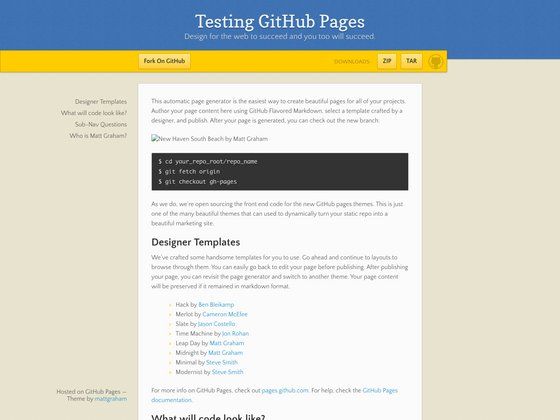
Leap Day is an open-source Jekyll theme for GitHub Pages, created by Matt Graham, that renders Markdown content into a GitHub-styled static page. The theme is available for download, forking, and reuse anywhere on the web, with a live demo at madebygraham.com/leapday.
What is Leap Day?
Leap Day is an open-source Jekyll theme originally designed and developed for GitHub Pages. It takes Markdown and HTML content as input and produces a static HTML page styled with Sass (SCSS), using variables in a _variables.scss file to control colors and sizing. The theme is maintained in the pages-themes/leap-day repository and includes a 1.0 tag for users who adopted it before August 2014.
Key Features
- GitHub Pages ready — Works as a Jekyll theme for GitHub Pages, and the readme states it can be downloaded, forked, and used anywhere else on the web.
- Sass-based customization — Most colors and sizing are defined in _variables.scss, letting you restyle the entire theme by editing one file.
- Legacy version preserved — The 1.0 tag (pre-August 2014) is available for original users, ensuring old sites keep their original layout.
- Local preview workflow — Running
script/serverexecutesjekyll serveandcompass --watch, so .scss edits recompile automatically and are served at http://localhost:4000. - Simple content editing — Content is written in .md, .html, or .scss files; changes appear after a browser refresh, with optional livereload support.
- Reuse-friendly license — The readme explicitly says "Use, reuse and modify away," allowing free modification and redistribution.
Who is it for?
- GitHub Pages users — Set up a project site or personal site by forking the theme and replacing the Markdown content with your own.
- Developers seeking a GitHub-style design — Use Leap Day for project documentation or landing pages that match the familiar GitHub repository look.
- Original Leap Day users — Those who used the theme before August 2014 can pin the 1.0 tag to preserve the older design.
Use cases
- Project documentation: Host a project README or wiki-style page on GitHub Pages with a layout that mirrors GitHub's own repository pages.
- Personal homepage: Build a simple personal site by editing the SCSS variables to change the color scheme and writing your bio in Markdown.
- Open-source project landing: Create a clean overview page that feels consistent with the GitHub platform, using the theme's built-in styling.
How does Leap Day work?
Leap Day works as a standard Jekyll theme. You write content in Markdown or HTML, then run script/server to start a local server that compiles SCSS via Compass and serves the site at http://localhost:4000. After editing .md, .html, or .scss files, refresh the browser to see the changes.
FAQ
Is Leap Day free?
Yes, Leap Day is open source and free to use. The readme grants permission to use, reuse, and modify the theme without restriction.
Does Leap Day work with GitHub Pages?
Yes, it was first designed and developed for GitHub Pages and is part of the pages-themes organization. You can use it as a remote theme or fork it directly.
What technologies does Leap Day use?
Leap Day is a Jekyll theme that uses Sass (SCSS) for styling and Compass for compiling SCSS in the local development script. Content is written in Markdown and HTML.
How do I preview Leap Day locally?
Run script/server from the theme directory. This starts jekyll serve and compass --watch, then open http://localhost:4000 in your browser to view the site.
Can I customize the colors and sizing?
Yes, most colors and sizing are defined in the _variables.scss file. Edit that file to change the theme's appearance, and the SCSS compiler will regenerate the stylesheet automatically.