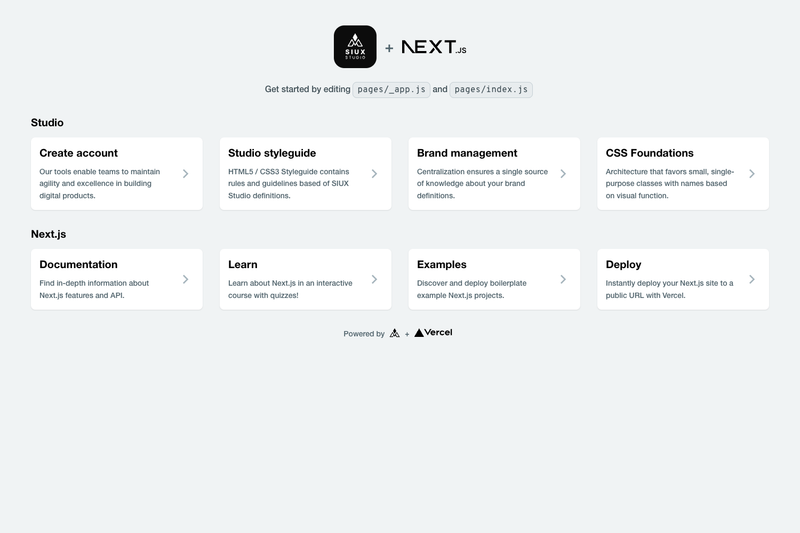
Next React GraphQL Apollo Hooks is a high-performance boilerplate for building Next.js websites with React, Apollo Client, and a GraphQL server, including automatic static type generation via GraphQL Code Generator. It is maintained by Atheros Intelligence and used as the foundation for their production projects and educational content on GraphQL Mastery.
What is Next React GraphQL Apollo Hooks?
This template is a starter kit that combines Next.js, React, GraphQL (Apollo Server), Apollo Client, React Apollo Hooks, Node.js, TypeScript, GraphQL Code Generator, and Jest. It takes a fresh clone of a repository and produces a working full-stack setup with a GraphQL API endpoint at /graphql and type-safe React components, ready for further development. The project is not meant to be a complete solution but an introduction to building high-performance websites with these technologies.
Key Features
- Next.js — React framework for server-side rendering and static site generation, with built-in routing and performance optimizations.
- Apollo Client + Apollo Server — End-to-end GraphQL implementation: a server for query resolution and a client for data fetching with hooks.
- React Apollo Hooks — Uses the React Hooks API for GraphQL queries and mutations, avoiding render props and higher-order components.
- TypeScript — Static typing across the codebase for better maintainability and developer experience.
- GraphQL Code Generator — Automatically generates TypeScript types from the GraphQL schema, removing the need for manual type definitions.
- Jest — Testing framework included for unit and integration tests.
- Environment-based configuration — Uses dotenv with a custom variable
CUSTOM_ENVto load the appropriate.envfile from asecretsfolder, keeping environment-specific settings separate. - Security audit support — Includes
package-lock.jsonso you can runnpm auditto check for dependency vulnerabilities. - Production recommendations — Advises enabling HTTP/2 and compression (for example nginx) for the best performance, along with a current Node.js LTS version.
Who is it for?
- React/Next.js developers who want a pre-configured GraphQL setup without having to wire Apollo, TypeScript, and code generation together manually.
- Full-stack teams starting a new project that needs a GraphQL API and React front end running on a single Node.js server.
- Learners exploring the integration of Next.js with Apollo hooks and GraphQL Code Generator, using this repository alongside GraphQL Mastery articles.
- Agencies or startups looking for a lightweight, high-performance boilerplate to adapt for client work.
What can you do with it?
- Backend developers: Expose a GraphQL API at
/graphqland define resolvers with Apollo Server, then have TypeScript types generated automatically from the schema. - Frontend developers: Fetch data in React components using Apollo hooks with fully typed queries, reducing runtime errors.
- DevOps engineers: Configure environment-specific settings through
.envfiles in thesecretsfolder and usenpm auditto maintain dependency security. - Technical writers: Use the starter kit as a reproducible example for tutorials on high-performance Next.js + GraphQL architecture.
How does the template work?
Clone the repository with git clone [email protected]:atherosai/next-react-graphql-apollo-hooks.git, then install dependencies using npm ci (recommended to preserve the locked package-lock.json). For environment setup, create files like /secrets/production-staging.env containing variables such as NODE_ENV, CUSTOM_ENV, PORT, API_URL, and HOST; the dotenv library loads the correct file based on the two environment variables.
FAQ
What Node.js version is required?
The package.json specifies an engines field that requires Node.js version 10 or newer and npm version 6 or newer. The author recommends using the latest Node.js LTS version, even though older versions should work.
How do I install dependencies?
Use npm ci instead of npm install to preserve the secure dependencies recorded in package-lock.json. This ensures a clean and reproducible installation.
How does environment configuration work?
Environment variables are managed with dotenv. The combination of NODE_ENV (development or production) and CUSTOM_ENV (such as local, staging, or production) determines which .env file in the /secrets directory is loaded. For example, NODE_ENV=development CUSTOM_ENV=local loads /secrets/development-local.env.
Can I run a security audit?
Yes, the repository includes package-lock.json, so you can run npm audit to identify and fix vulnerable dependencies.