Minimal Jekyll Theme is a one-column Jekyll theme created by Desired Persona, built with Tachyons-sass, that ships as a Ruby gem and targets GitHub Pages-hosted blogs with multiple layouts, social sharing, and analytics integrations.
What is minimal-jekyll-theme?
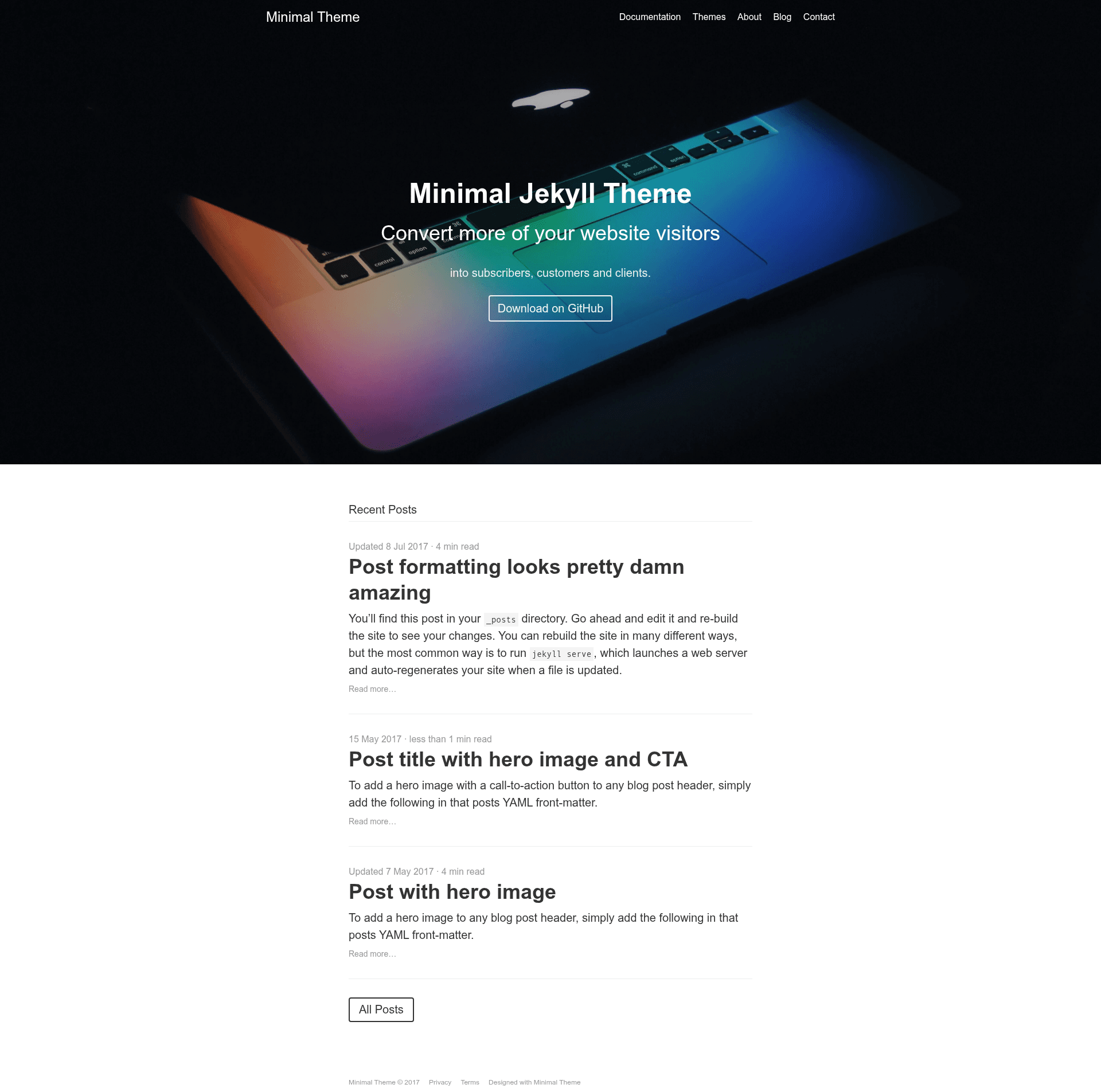
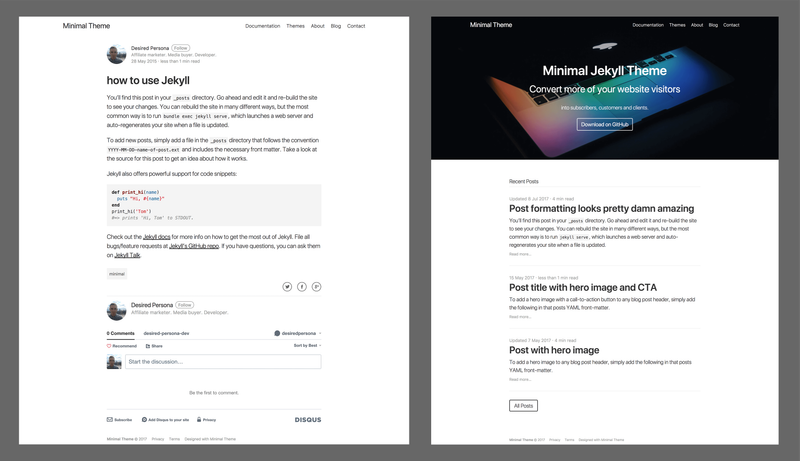
Minimal Jekyll Theme is a minimal one-column Jekyll theme packaged as a Ruby gem, currently in beta v0.2.1. It takes Jekyll site content — posts, pages, and site metadata — and produces a responsive static site styled with system fonts and the Tachyons-sass CSS framework. The theme is compatible with Jekyll 3.5.x and GitHub Pages, but is not recommended for production use with Jekyll v4 until v1.0.0 is released.
Key Features
- Mobile-first responsive design — Styled with Tachyons-sass and system fonts, the layout adapts to any screen size without loading webfonts.
- Multiple layouts — Includes dedicated page, post, landing page, archives, categories, and tags layouts, with demos linked in the documentation.
- Social share icons — Built-in share buttons let readers share posts on social networks without extra plugins.
- Header and footer navigation — Configurable navigation menus appear in both the header and footer.
- Post header image with optional CTA — Individual posts can feature a cover image with an optional call-to-action overlay.
- Multiple author support — The theme recognizes multiple authors, making it suitable for group blogs.
- Analytics and tracking — Includes async Google Analytics tracking and Facebook Pixel support.
- Jekyll plugin ecosystem — Depends on jekyll-feed, jekyll-sitemap, jekyll-seo-tag, and jekyll-archives to generate an Atom feed, sitemap, SEO tags, and archive pages by year, month, day, category, and tag.
- Disqus comments — Posts can be configured with Disqus comment threads.
Who is it for?
- Personal bloggers who want a fast, minimal site on GitHub Pages without external CSS frameworks.
- Multi-author publications that need built-in multiple author support and auto-generated archive pages.
- Developers who prefer a Jekyll theme that uses system fonts and stays lightweight, with no JavaScript framework overhead.
- Marketers who need built-in social sharing, Google Analytics, and Facebook Pixel tracking without hacking layouts.
What can you do with minimal-jekyll-theme?
- Create a landing page using the dedicated landing layout with a post header image and call-to-action button.
- Publish a blog with structured archives — archives are auto-generated for year, month, day, category, and tag, so readers can browse content chronologically or by topic.
- Enable comments and sharing on posts via Disqus and social share icons.
- Track site traffic directly through the theme's Google Analytics and Facebook Pixel integrations.
Pros and cons
- Pros: MIT licensed, free to use commercially; mobile-first; multiple layouts; integrates with the standard Jekyll plugin ecosystem.
- Cons: Beta status; not recommended for production use with Jekyll v4, so sites should stay on Jekyll 3.5.x or GitHub Pages until v1.0.0.
FAQ
Is minimal-jekyll-theme free?
Yes, the theme is released under the MIT license, so you can use, modify, and redistribute it freely, including in commercial projects.
Is minimal-jekyll-theme compatible with Jekyll 4?
No, the current beta (v0.2.1) is compatible with Jekyll 3.5.x and GitHub Pages. The project page states it is not recommended for production use with Jekyll v4, with v1.0.0 tracking on the GitHub projects board.
What layouts does minimal-jekyll-theme include?
It includes layouts for page, post, landing page, archives, categories, and tags. Each layout is documented with demos at the theme's documentation site.
Does minimal-jekyll-theme support social sharing?
Yes, the theme includes social share icons, so readers can share posts on social media without requiring additional plugins.
Can I add comments to my posts?
Yes, the theme integrates Disqus comments, allowing you to enable discussion threads on individual posts after configuring your Disqus shortname.