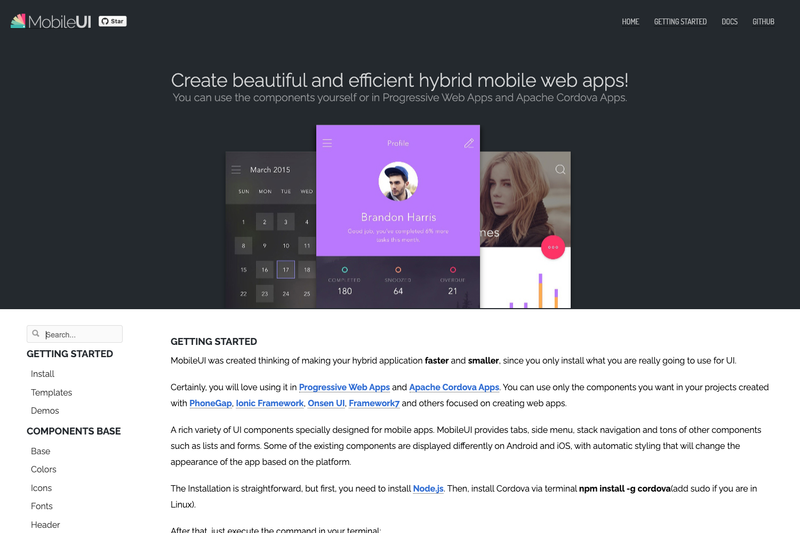
MobileUI is an NPM-distributed UI component library for building mobile web and hybrid applications with HTML, CSS, and JavaScript.
What is MobileUI?
MobileUI is a set of pre-built UI components that you install via NPM and use directly in mobile web projects. It takes HTML, CSS, and JavaScript as inputs and outputs ready-to-use interface elements such as tabs, side menus, stack navigation, lists, and forms. The library ships with automatic platform-aware styling, so the same source code renders with an iOS look on iPhones and an Android look on Android devices. The official documentation lives at mobileui.github.io, and the project repository on GitHub lists Cordova and mobile-app topics, indicating a focus on hybrid app development.
Key Features
- Platform-adaptive styling — Components automatically change their appearance to match iOS or Android conventions, letting one codebase serve both platforms.
- Core mobile components — Includes tabs, side menu, stack navigation, lists, and forms, covering common mobile app interface patterns.
- Modular NPM installation — You install only the components you actually use, which keeps hybrid applications faster and smaller according to the project description.
- Simple CLI verification — After installing Node.js, run
npm install mobileui -gto install globally, then typemobileuiin the terminal to check the installed version. - Documentation site — The official docs at mobileui.github.io cover installation, features, and component usage.
- Open contribution — A contributing guide is available at the GitHub repository, inviting developers to add or improve components.
Who is MobileUI for?
- Hybrid app developers — People building apps with Cordova or similar web-to-native wrappers can add ready-made mobile UI without writing it from scratch.
- Mobile web developers — Those who need mobile-optimized interfaces with native-looking navigation and forms can drop in components rather than hand-rolling CSS.
- Prototypers and small teams — Developers who want fast, consistent iOS and Android UIs from a single HTML, CSS, and JS codebase will benefit from the automatic platform styling.
What can you do with MobileUI?
- Build tab-based app navigation — Use the tabs component to switch between main sections of a mobile web app.
- Implement a side menu — Add a collapsible drawer menu for secondary navigation or settings.
- Create stack navigation flows — Manage screens that push and pop like native mobile stacks.
- Render lists and forms — Display data lists and capture user input with components styled for mobile screens.
How does MobileUI work?
First, install Node.js on your system. Then run npm install mobileui -g in your terminal to install MobileUI globally. To confirm the installation, type mobileui and the terminal will show the installed version number. After that, you can pull the UI components you need into your HTML, CSS, and JavaScript files.
FAQ
How do I install MobileUI?
Install Node.js first, then run npm install mobileui -g in your terminal. The -g flag installs it globally so the mobileui command is available anywhere. You can verify the installation by typing mobileui to see the version.
Does MobileUI work on both iOS and Android?
Yes. MobileUI components include automatic styling that changes their appearance based on the platform. The same source code renders with iOS-style visuals on Apple devices and Android-style visuals on Android devices.
What do I need to use MobileUI?
The only stated requirement is Node.js. Once Node.js is installed, you use NPM to install the MobileUI package, and then you can use the components in your HTML, CSS, and JavaScript mobile web project.