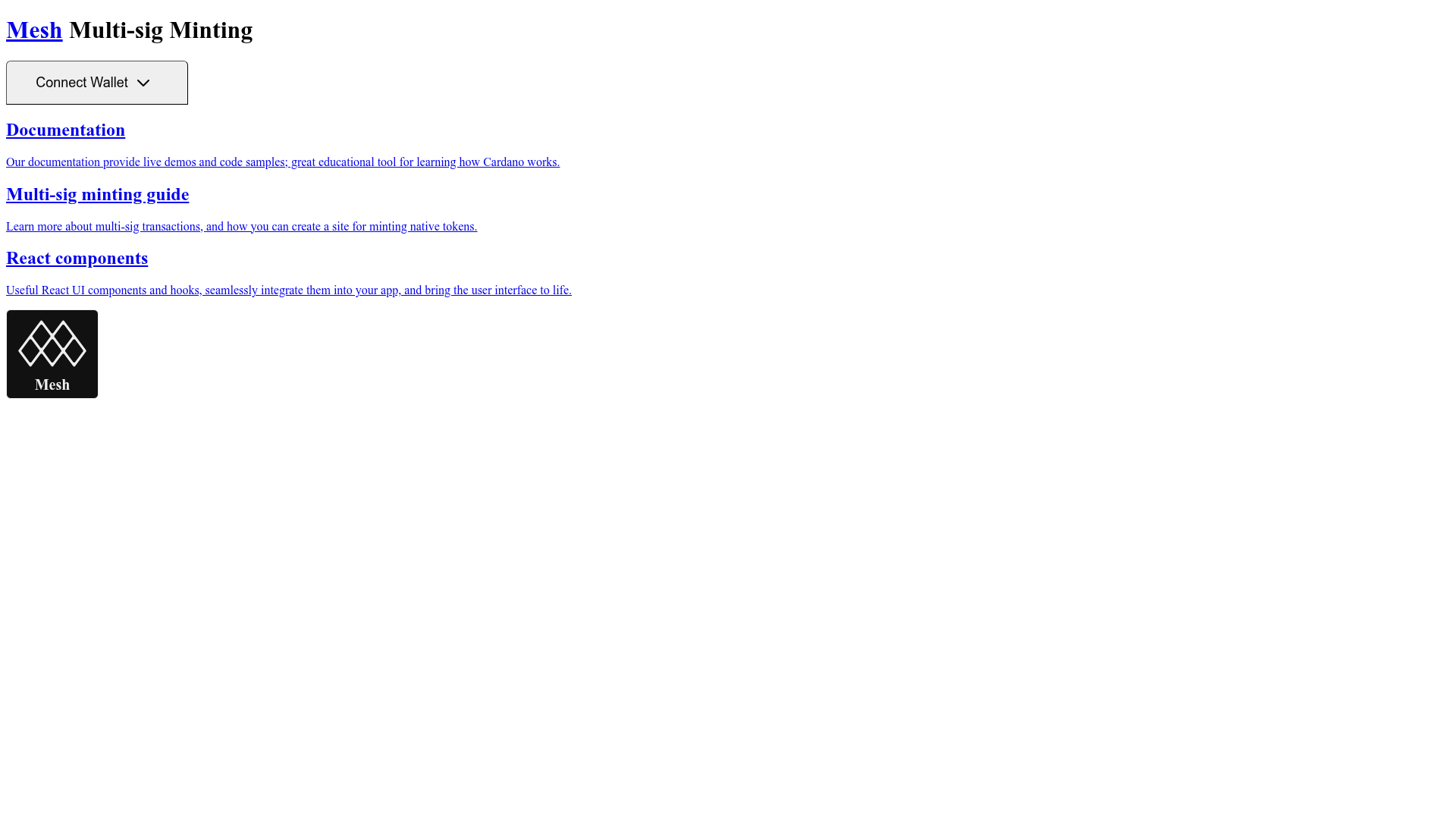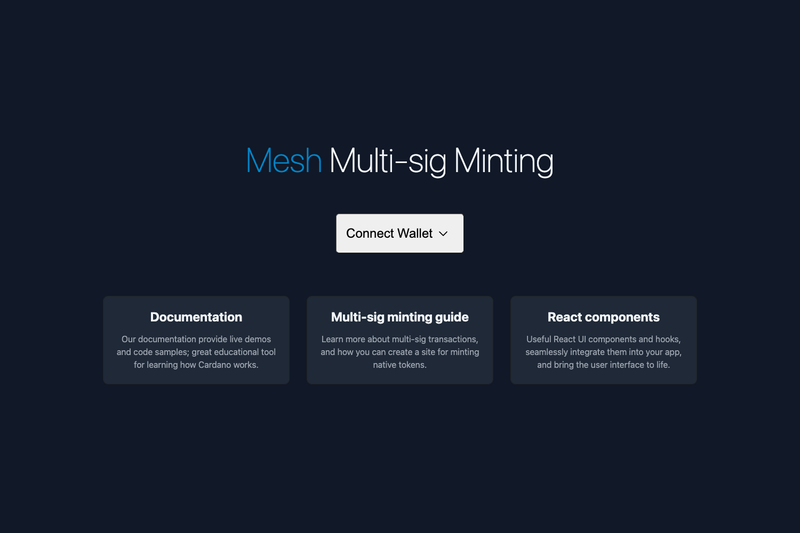
Multi-sig Minting Next.js TypeScript is a Cardano blockchain starter template from the MeshJS ecosystem for selling native tokens through a multi-signature minting flow, where the backend server builds the transaction and the user signs it in the browser.
What is the Multi-sig Minting Next.js TypeScript template?
This starter project builds a dApp for selling native Cardano tokens. It combines Next.js with TypeScript and uses MeshJS for wallet connectivity and transaction building. The input is a Cardano wallet address and token-sale parameters; the output is a signed minting transaction. The template runs inside a Next.js server and can be launched locally or via Demeter's cloud workspace.
Key Features
- Next.js + TypeScript — A full-stack React framework with server-side rendering, API routes for the backend transaction builder, and type safety across the entire codebase.
- Multi-sig minting workflow — The backend constructs the transaction; the frontend only collects the user's signature, a separation designed for multi-signature token sales.
- MeshJS React components and hooks — Prebuilt components for connecting Cardano wallets and hooks for reading wallet state, linked from the MeshJS React documentation.
- MeshJS APIs — Includes wallet integration and transaction builder APIs that handle Cardano serialization under the hood.
- One-command setup —
npx create-mesh-app minting-next-ts-templatescaffolds the complete project in a single command. - Demeter cloud workspace — A preconfigured cloud environment lets you run the template without installing Node.js locally.
- Learning resources included — The README links to MeshJS guides, API docs, and React component docs, plus Twitter and Discord community channels.
Who is it for?
- Cardano dApp developers — Use this as a tested starting point for any token-sale or minting application, avoiding the need to build transaction flows from scratch.
- Web3 full-stack developers — Developers familiar with Next.js can see a clear separation between backend transaction building and frontend signing with MeshJS.
- Blockchain startups — Teams selling a native token can adapt the multi-sig flow to require multiple approvals before tokens are minted.
- MeshJS learners — Anyone exploring MeshJS gets a working example that combines React hooks, APIs, and a Next.js backend.
What can you do with it?
- Token sale operator: deploy a site where buyers connect a Cardano wallet, review a price, and sign a transaction that mints the native token to them.
- Multi-sig committee: modify the backend logic so a transaction needs several signatures before submission, matching the template's multi-sig design.
- Educator or developer: run the template in Demeter to demonstrate how MeshJS wallet components and transaction APIs work together in a real application.
How does it work?
Run npx create-mesh-app minting-next-ts-template to generate the project locally, or open the provided Demeter workspace for a cloud development environment. On the backend, a Next.js API route builds a minting transaction for selling native tokens. On the frontend, MeshJS wallet connection components let the user review and sign that transaction, which is then submitted to the Cardano network.
FAQ
What does this template do?
This template is a starter for selling Cardano native tokens. A backend server builds the minting transaction, and the user signs it on the frontend, enabling a multi-signature minting flow.
How do I start the project?
Run npx create-mesh-app minting-next-ts-template in your terminal to scaffold the project locally. You can also open the Demeter workspace link from the README to run it in the cloud.
What is MeshJS?
MeshJS is the development toolkit used throughout this template. It provides the React components, hooks, and APIs described in the README for wallet integration and transaction building on Cardano.
Is this a Next.js project?
Yes, the template is built on Next.js with TypeScript. It uses Next.js server-side capabilities to host the backend that builds transactions, and React on the frontend for the wallet interface.