Newsletter
Join the Community
Subscribe to our newsletter for the latest news and updates

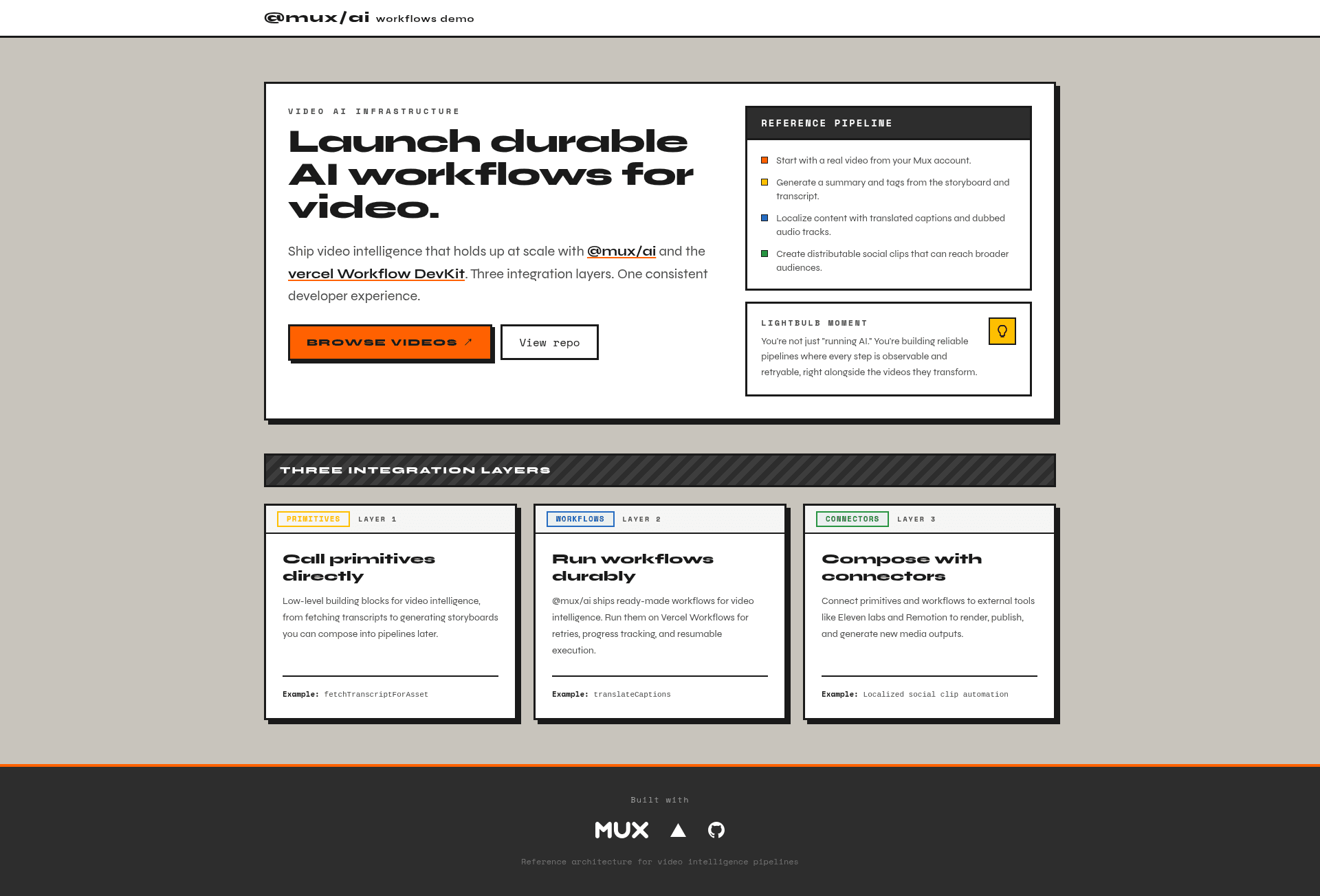
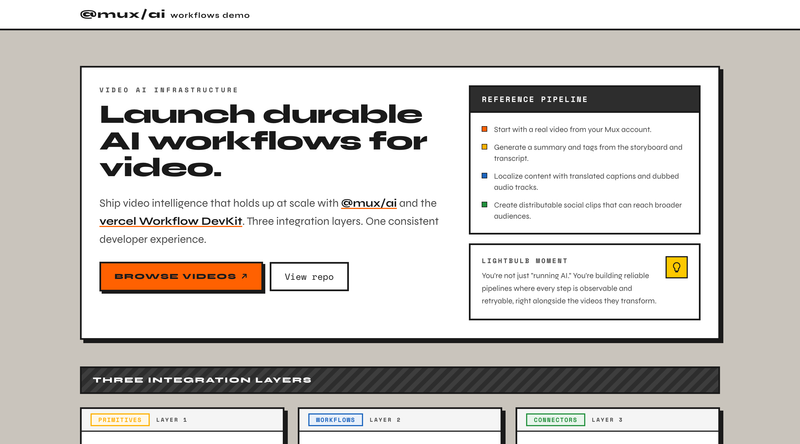
Open-source Next.js starter demonstrating durable video AI pipelines with @mux/ai and Vercel Workflows.
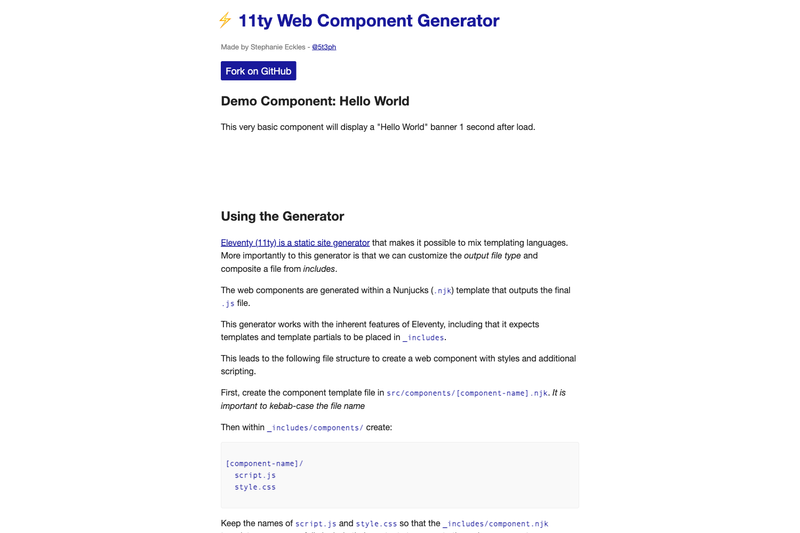
Use the power of 11ty to generate web components (custom elements).
Official Turborepo starter with two Next.js apps and three shared packages, fully typed in TypeScript.
Official Gatsby starter that scaffolds a minimal TypeScript site, editable at src/pages/index.tsx and deployable to Gatsby Cloud.

Starter files for a simple Gatsby site with Netlify CMS, ready for blogging.
The @mux/ai + Vercel Workflows Starter is an open-source Next.js boilerplate that builds durable video AI pipelines by combining Mux media APIs with Vercel Workflows.
This Next.js starter template from Mux demonstrates how to build durable video AI pipelines using @mux/ai and the Vercel Workflow DevKit. It takes Mux assets, transcripts, and captions as inputs, and produces translated captions, dubbed audio, summaries and tags, semantic search over video content, and rendered social clips via Remotion. The app runs on Next.js and deploys to Vercel with one click, using PostgreSQL with pgvector for storing catalog metadata and generating embeddings, and OpenAI for embeddings generation.
The app is organized around a media detail page that exposes feature co-located folders. You start a workflow from the UI; it runs durably in Vercel Workflows, and if you refresh or navigate away the state is restored from localStorage. To set up locally, run npm install and npm run dev, and inspect workflow runs with npx workflow web. Database setup requires running npm run db:migrate and then npm run import-mux-assets to load your Mux catalog and generate embeddings.
This is an open-source starter template on GitHub under the muxinc organization. You will need your own credentials for Mux, OpenAI, a PostgreSQL database with pgvector, and S3-compatible storage to run the full pipeline.
At minimum you need MUX_TOKEN_ID, MUX_TOKEN_SECRET, OPENAI_API_KEY, and DATABASE_URL. The Vercel deploy flow also requests S3_ENDPOINT, S3_REGION, S3_BUCKET, S3_ACCESS_KEY_ID, and S3_SECRET_ACCESS_KEY for Remotion rendering storage.
Yes. The starter demonstrates durable workflows: start a captions, dubbing, or summary workflow, refresh or navigate away, and it will still run asynchronously with status rehydrated from browser localStorage.
Remotion is used for composing video clips. You can use remotion:studio for live preview, remotion:render:local for local rendering, and remotion:deploy to deploy the Remotion site to AWS Lambda for production rendering. Deployments are automated when changes to the remotion/ folder are merged into main.
No. The import-mux-assets script only embeds subtitles from an existing captions track on the Mux asset. To translate captions, use the translate-captions workflow with a language that matches the source track.