netherworld-console (地府管理系统) is an open-source full-stack dashboard project that simulates the Chinese underworld as a working bureaucracy — tracking souls from the Book of Life and Death through capture, trial, judgment, and reincarnation — and packages it as three runnable applications: a Node.js + Express + MySQL API, a Vue + Element UI admin console, and a separate Vue user frontend.
What is netherworld-console?
netherworld-console is a three-part web application: an admin dashboard (Vue + Element UI), a user-facing frontend, and a backend API built with Node.js, Express, and MySQL. It is developed by the GitHub user moyuc1966 (author alias 墨羽晨) and distributed as open source. The system models a fictional afterlife workflow: when a record is added to the Book of Life and Death with birth and death dates, the record moves to the awaiting soul capture list once the death date passes; soul reapers then bring the soul to the King Yan court for trial, where the judgment can be reincarnation, the 18 levels of hell, or a return to the living world with merit earned on the wooden-fish page.
Key Features
- Three-part architecture — the project ships as three folders (api, admin, user) that run separately and must be started in order: API first, then the user frontend, then the admin console.
- Book of Life and Death management — the admin can add, query, and export records containing name, birth and death dates, address, yin and yang virtue, wealth in life, death type, cause of death, a life description, marital status, and afterlife status.
- Automated workflow pipeline — a soul record automatically enters the
to be capturedlist when its death date arrives, then advances through reaper capture, court trial, judgment records, and the six realms of reincarnation wheel. - Role-based access control — multi-user, multi-permission administration covering roles, permissions, and admin accounts; the default super admin account is admin with password 123456, and the live preview is at http://df.earthonline.club/home.
- User-facing merit features — the user frontend includes a wooden-fish (敲木鱼) merit-tapping page with an auto-tap mode and a side to import life-death records.
- Chinese hell modules — dedicated admin sections for the King Yan court trial (阎王殿审判), trial records, the 18 levels of hell (十八层地狱), equipment management, and six realms of reincarnation (六道轮回).
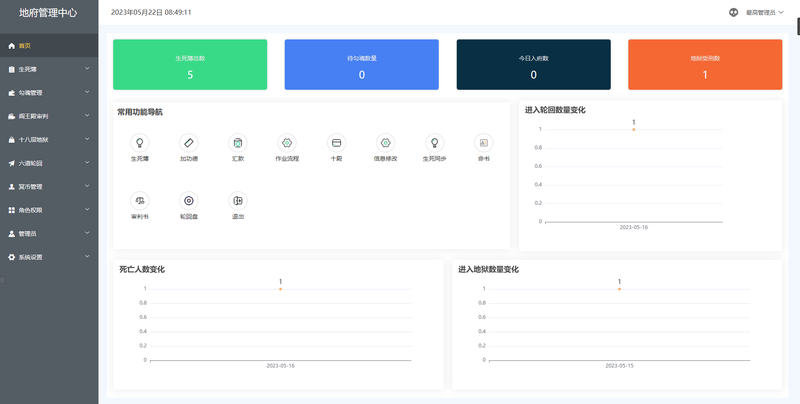
- Dashboard statistics — the admin home page shows data statistics previews across the whole system.
- Documented local setup — the README gives step-by-step instructions for importing api/afterlifedb.sql into MySQL 8, configuring the connection in api/link/config.js, and running each app on its default port (API on 3000, admin usually on 8080).
Who should use netherworld-console?
- Full-stack developers learning Vue and Node — the repo is a complete working example of a Vue 2 + Element UI admin, a Vue user app, and an Express REST API sharing one MySQL database, useful for studying how the three pieces authenticate and talk to each other.
- Developers who want a themed admin starter — every menu item in the console (statistics, records, roles, permissions, system settings) maps to a real API endpoint, so it can be repurposed as a role-and-menu-driven admin scaffold.
- Content creators and hobbyists — the readme invites people to make videos about the project on Douyin, Zhihu, and Kuaishou (crediting 墨羽晨), and the playful Chinese mythology theme makes it a distinctive demo project.
What can you do with netherworld-console?
- Deploy a fictional bureaucracy demo — run all three apps on a server and present a complete afterlife administration with real login, roles, and permissions.
- Study role-permission implementation — trace how the role, permission, and administrator management pages in the admin console control what each logged-in user can see and do.
- Customize the workflow — change the SQL seed data in api/test.sql or the judgment logic to alter which souls are reincarnated, sent to hell, or returned to the living world.
How does netherworld-console work?
The README defines a strict installation sequence. First, create a MySQL database named afterlifedb and import api/afterlifedb.sql. Second, edit api/link/config.js with the database host, username, and password, then run npm i and node index.js inside the api folder so the service starts on http://localhost:3000. Third, configure the API and admin URLs in user/src/main.js and admin/src/main.js respectively, then run npm run serve in each frontend folder; npm run build outputs the user app to a dist folder for static hosting.
FAQ
Is netherworld-console free to use?
Yes, the project is open source and hosted on GitHub in the repository moyuc1966/netherworld-console. The author asks that videos made about the project on Douyin, Zhihu, or Kuaishou credit the original author, 墨羽晨.
What tech stack does netherworld-console use?
The backend is Node.js (tested on version 16.15.0) with Express and MySQL (tested on version 8.0.28). Both frontends use Vue with the Element UI component library. The database is named afterlifedb.
How do I log in to the admin console?
The default super administrator account is admin and the password is 123456. The author requests that visitors to the live preview at http://df.earthonline.club/home not change these credentials.
Does the project include test data?
Yes. The 2023-06-24 update added api/test.sql with test data for quicker experimentation, and the full database schema is provided in api/afterlifedb.sql for a fresh install.
What happens to a soul record after its death date passes?
When the death date on a Book of Life and Death record is reached, the record is added to the awaiting-capture list. Soul reapers capture the soul into the court, the judge reviews the record, and the outcome is one of: reincarnation, punishment in the 18 levels of hell, or a return aided by merit earned through the wooden-fish feature.