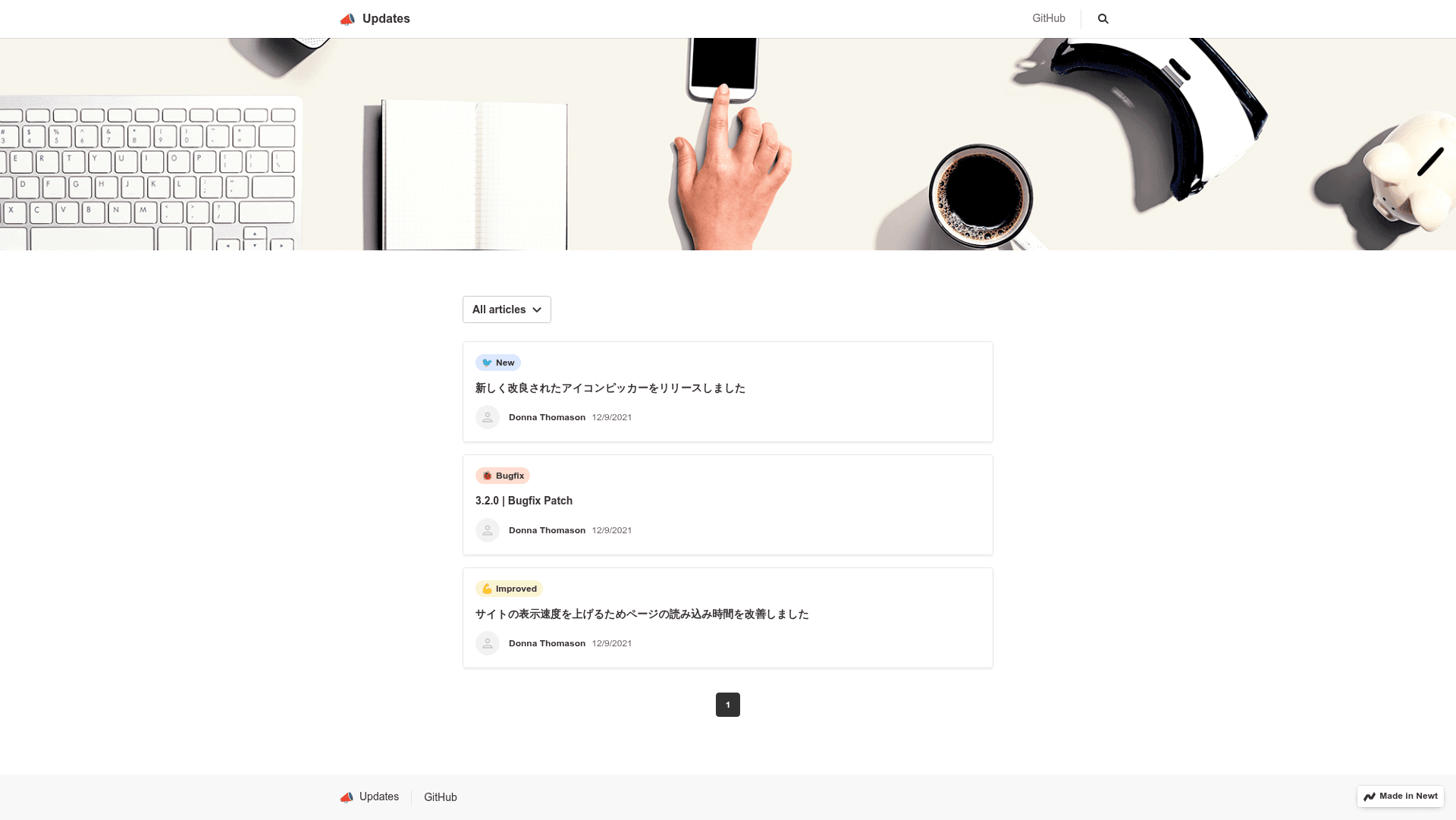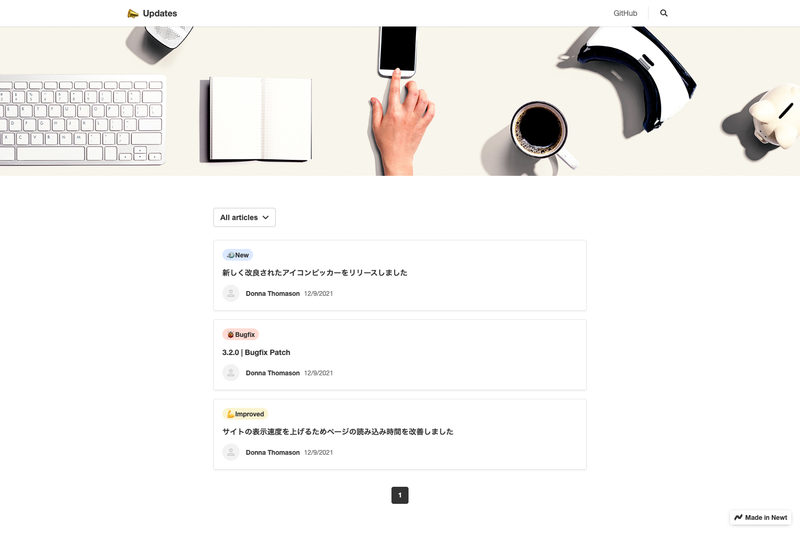
Newt Starter Nextjs Updates is a TypeScript starter template from Newt Inc. that pairs the Newt headless CMS with a Next.js App Router frontend to produce a complete update-notes (changelog) site with listing, category, search, and detail pages.
What is Newt Starter Nextjs Updates?
Newt Starter Nextjs Updates is a starter repository that scaffolds a changelog or update-notes website using the Newt headless CMS as its content backend and Next.js App Router for rendering. It takes content defined in Newt spaces (Article, Author, and Category models) and serves it through pre-built pages for listing, pagination, category filtering, search, and article details. The template is built with Next.js and TypeScript, created and maintained by Newt Inc., and released under the MIT License. Note that the Newt CMS service itself is scheduled for retirement on 2026-11-24; after that date, the admin panel and API will no longer work.
Key Features
- Next.js App Router — Uses the modern App Router under the
app/directory with TypeScript files for all page templates, including list, paginated list, category, search, and detail routes. - Pagination — The list page supports pagination via paths like
/page/1,/page/2, controlled by theNEXT_PUBLIC_PAGE_LIMITenvironment variable (set to 12 in the example). - Category filtering — Filters articles by category slug through routes such as
/categories/improved, with paginated variants like/categories/improved/1. - Full-text search — A dedicated
/search?q=...page filters articles by query string. - Three content models — Defines Article, Author, and Category with specific fields: Article (title, slug, meta, body, author reference, categories reference), Author (fullName, profileImage), and Category (emoji, name, slug, colorCode).
- Custom meta field — Article includes a custom field type for SEO title, description, and OG image, enabling social sharing optimization.
- Environment-based configuration — All Newt settings (space UID, app UID, CDN API token, article/category model UIDs) are set via
.env.local, following a.env.local.examplefile. - Vercel deployment — A one-click "Deploy with Vercel" button links the GitHub repository to a new Vercel project.
Who is it for?
- Next.js developers who want a ready-made changelog or update-notes site using App Router and server-rendered pages.
- Teams already using Newt CMS who need a reference implementation for building public content sites with the Newt API.
- Startups and product teams that want to publish product update notes quickly with categorized, searchable history.
What can you do with it?
- Product teams: Publish update notes with categories and a searchable archive, letting users filter by improvement type or keyword.
- Developers: Use the source code as a learning reference for integrating Newt with Next.js App Router, including pagination and dynamic routing.
- Marketers: Set up an SEO-friendly changelog with custom meta titles and OG images for better link sharing and discovery.
How does it work?
- Create a Newt space and app (using the "Updates" app template or manually), then generate a CDN API token from space settings.
- Copy
.env.local.exampleto.env.localand fill in the space UID, app UID, API token, article model UID, category model UID, and page limit. - Install dependencies with
yarn installornpm install, then start the dev server withyarn devornpm run devatlocalhost:3000.
FAQ
Is Newt Starter Nextjs Updates free?
Yes, the template code is released under the MIT License, meaning it is free to use, modify, and distribute, including for commercial projects.
What is the end-of-life date for Newt?
Newt Inc. has announced that the Newt headless CMS service will be retired on 2026-11-24. After that date, the admin panel and API will be unavailable, so any site using this starter will lose its content backend and stop functioning.
Does the template support search and pagination?
The list page supports pagination through routes like /page/1 and /page/2, and a search page at /search?q=... filters articles by keyword. Category pages also support pagination.
What content models are included?
The starter defines three models: Article (title, slug, meta, body, author, categories), Author (fullName, profileImage), and Category (emoji, name, slug, colorCode). These are stored in a Newt space.
Can I use this template without Newt CMS?
No, the template is tightly integrated with Newt as its content backend. It depends on Newt's CDN API token, space UID, app UID, and model UIDs to fetch content. To use another CMS, you would need to replace the data-fetching layer entirely.