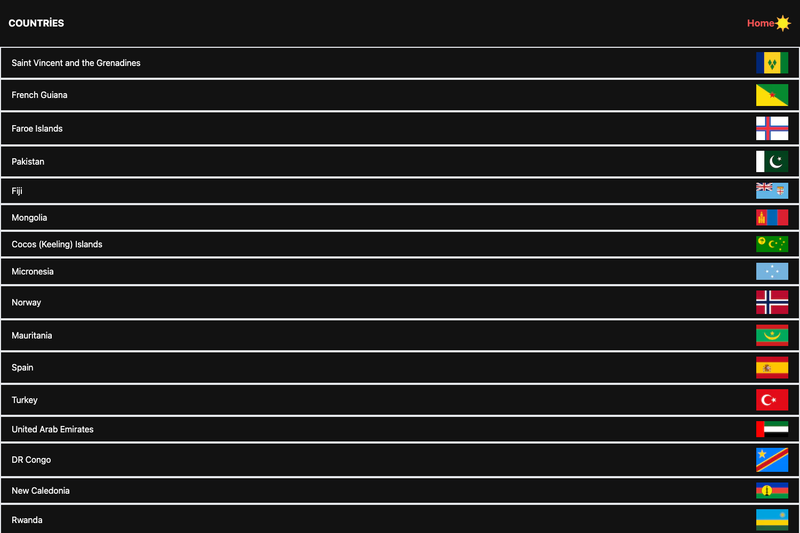
Next Country Fetching is a boilerplate Next.js 13 project that demonstrates fetching country data from the REST Countries API, with UI components from Flowbite and styling via Tailwind CSS.
What is Next Country Fetching?
Next Country Fetching is a starter web application built with Next.js 13, bootstrapped using create-next-app. Its core function is to serve as a learning-oriented template for querying the REST Countries API and displaying country information. The project takes a country name as input and returns country details such as population, region, and flags through API calls. It runs on Node.js and is typically started with npm run dev or yarn dev, serving pages at http://localhost:3000.
Key Features
- Next.js 13 app directory — Uses
app/page.jsxfor the main page, which auto-updates when edited, and supports API routes. - API routes — Includes an example endpoint at
/api/hello, defined inpages/api/hello.js, with thepages/apidirectory mapped to/api/*. - Tailwind CSS — Utility-first CSS framework integrated for rapid UI development.
- Flowbite — Open-source UI component library built on top of Tailwind CSS, available in the project's dependencies.
- next-themes — Adds dark and light mode support to the template.
- REST Countries API — External data source used for fetching country-specific information in the example.
- next/font — Automatically optimizes and loads Inter, a custom Google Font, with zero layout shift.
Who is it for?
- Next.js beginners who want to see how a minimal project is structured and how data fetching works in the app router.
- Tailwind CSS developers looking for a pre-configured setup with Flowbite and theming already installed.
- Hobbyists building a country reference app who need a quick starting point with a real API integration.
What can you do with it?
- Frontend learners: Study how to call a REST API from a Next.js page and render the results on the client.
- UI developers: Experiment with Flowbite components and Tailwind classes in the template's page layout.
- Deployment testers: Deploy the project to Vercel using the provided deployment documentation and see the app live in production.
How does it work?
- Install dependencies with your preferred package manager.
- Run
npm run devoryarn devto start the development server. - Open
http://localhost:3000and editapp/page.jsxto see live updates. - Access the sample API route at
http://localhost:3000/api/helloto verify serverless functions.
FAQ
How do I run the development server?
Use npm run dev, yarn dev, or the equivalent command for your package manager. The server starts on http://localhost:3000 and hot-reloads changes made to app/page.jsx.
What is the pages/api directory?
Files in pages/api are treated as API routes rather than React pages. The included pages/api/hello.js is accessible at /api/hello and returns a sample JSON response.
Does this template include Tailwind CSS?
Yes. The repository metadata lists tailwind-css as a topic, and the project depends on Flowbite, which requires Tailwind CSS to function.