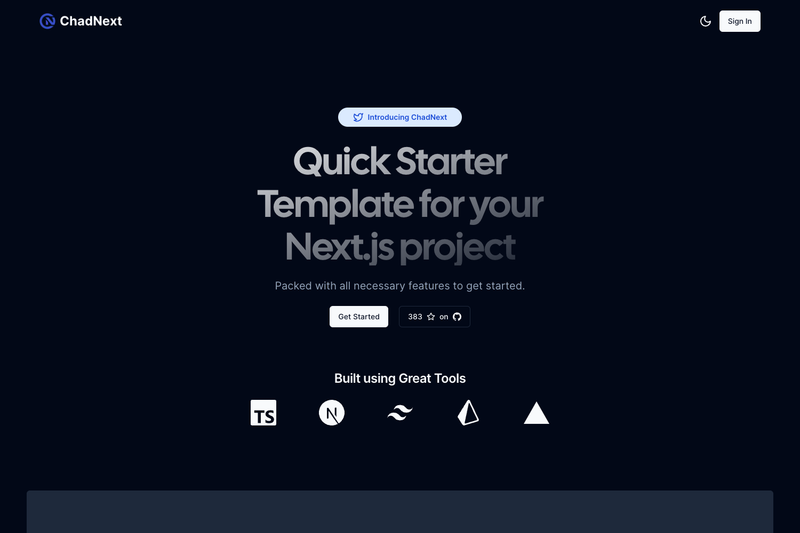
ChadNext is an open-source Next.js 15 starter template — a production-ready boilerplate that ships with authentication, database access, payments, email, file uploads, and internationalization pre-configured. It lets developers skip repetitive wiring and get from a fresh clone to a deployed full-stack application quickly.
What is ChadNext?
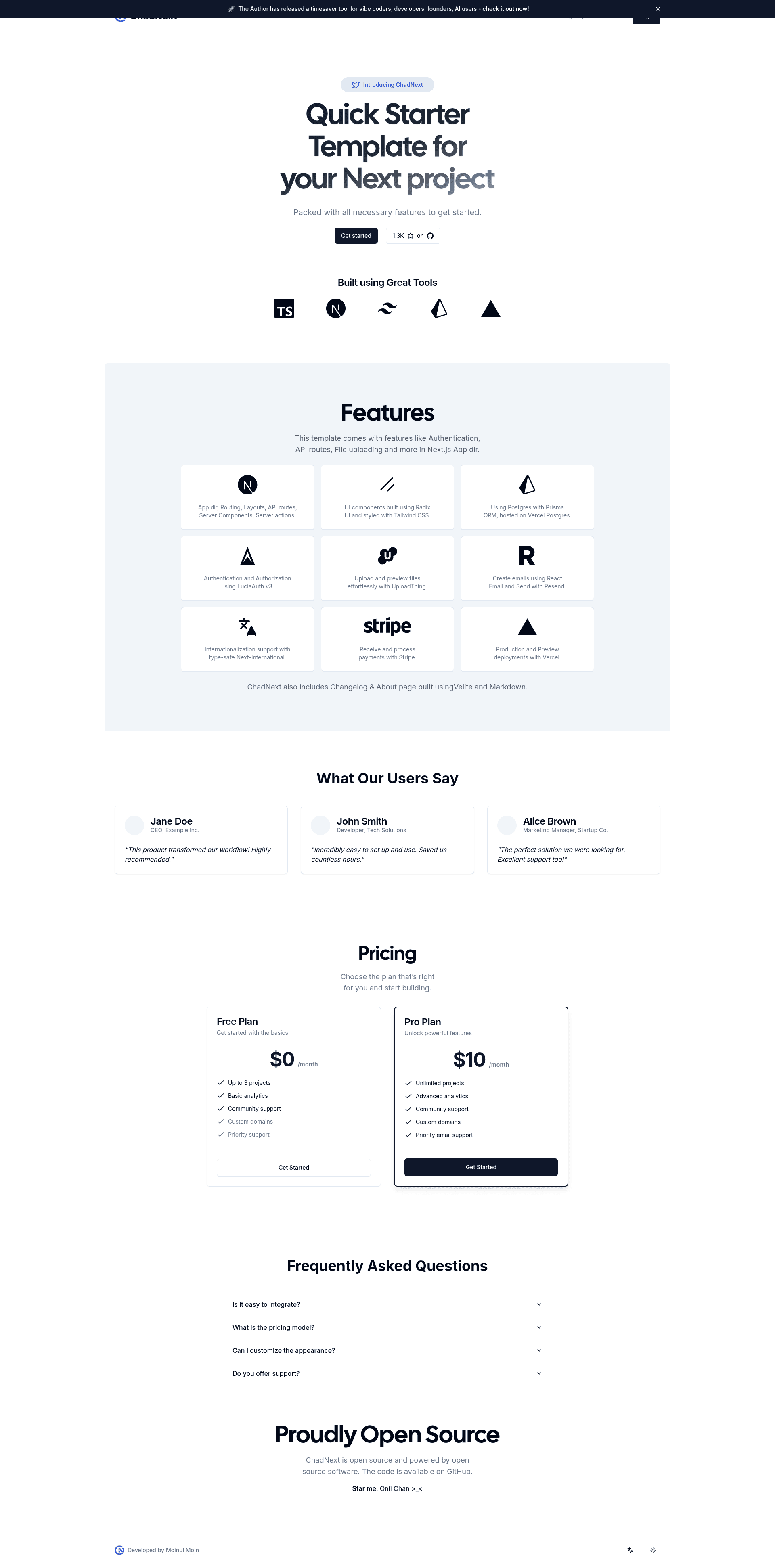
ChadNext is a quick starter template for Next.js projects created by Moinul Moin. It runs on the Next.js 15 App Router and bundles Shadcn UI, LuciaAuth, Prisma, Server Actions, Stripe, and internationalization. The template takes a cloned repository plus environment variables for each service as input, and produces a deployable web app with user login, billing, a database layer, and styled UI components already connected.
Key Features
- Next.js 15 App Router — Uses the newest App Router with server components, layouts, and Server Actions for data mutations.
- Shadcn UI + Tailwind CSS — A copy-paste component library built on Radix UI and Tailwind CSS, giving you accessible, utility-styled components out of the box.
- LuciaAuth with GitHub OAuth — Simple session authentication pre-configured; you only need to supply
GITHUB_CLIENT_IDandGITHUB_CLIENT_SECRET. - Prisma ORM — Database access with Prisma, including a schema and a
pnpm prisma db pushcommand to sync your database structure. - Stripe integration — Payment processing wired for subscriptions and one-time purchases using your Stripe secret and webhook keys.
- Internationalization — Built-in i18n routing so you can serve locale-specific versions of pages.
- Resend + React Email — Transactional email delivery through Resend with React Email templates for styled messages.
- UploadThing — File uploads handled by UploadThing, configured with
UPLOADTHING_SECRETandUPLOADTHING_APP_ID.
Who should use ChadNext?
- Solo founders and indie hackers — Spin up an MVP with auth, payments, and a database in a single day, then iterate on the product.
- Next.js developers — Study a coherent codebase that combines App Router, Server Actions, Prisma, Stripe, and i18n.
- Agencies — Use it as a baseline for client projects that need multi-language support, theming, and common integrations.
- Open-source contributors — The repository participates in Hacktoberfest, so it is a friendly place to contribute features and fixes.
What can you do with ChadNext?
- Launch a subscription SaaS: Wire up Stripe and GitHub OAuth to take payments and authenticate users from the start.
- Build an internal dashboard: Use Prisma and Server Actions to create a database-backed admin interface with styled tables and forms.
- Ship a multi-language website: Leverage the built-in internationalization to serve content in several locales.
- Send transactional emails: Use Resend and React Email for password reset links, receipts, or notifications.
How does ChadNext work?
The README documents a five-step setup: clone the repo, run pnpm install, copy .env.example to .env and follow the instructions inside, run pnpm prisma db push to create the database schema, then start the dev server with pnpm dev. For deployment, a one-click Vercel button clones the repository and prompts you for the required environment variables in the Vercel interface.
Pros and cons
- Pros: Free and open source under the MIT License; one-click deployment to Vercel; a long list of batteries-included integrations; an active repository with over 1,300 stars.
- Cons: Requires separate accounts and API keys for GitHub OAuth, Stripe, Resend, UploadThing, and a database before the full feature set works; the sheer number of environment variables can be overwhelming for beginners.
Pricing
ChadNext is free. The template is licensed under the MIT License, so there are no costs, subscriptions, or usage tiers for the code itself; you only pay for the external services you connect (database, Stripe, etc.).
Alternatives
- create-t3-app — A popular community starter that takes a modular approach and lets you select tRPC, Prisma, NextAuth, and Tailwind through an interactive CLI.
- Supabase Starter — A Next.js template from Vercel that integrates Supabase for database and authentication instead of Prisma and LuciaAuth.
FAQ
Is ChadNext free?
Yes, ChadNext is open source under the MIT License, so you can use, modify, and deploy it without paying for the template itself.
What do I need to run ChadNext?
You need Node.js and pnpm, plus accounts for the services you plan to use: a database for Prisma, GitHub for OAuth, Stripe for payments, Resend for email, and UploadThing for file uploads. All required variables are listed in .env.example.
Does ChadNext include authentication?
Yes, the template integrates LuciaAuth and provides a GitHub OAuth flow. Set GITHUB_CLIENT_ID and GITHUB_CLIENT_SECRET in your environment variables to enable login.
How do I deploy ChadNext?
Use the one-click deploy button on the repo, which clones the project to Vercel and asks for the required environment variables. Alternatively, clone the repo, push it to your own Git provider, and connect it to Vercel.
What database does ChadNext use?
ChadNext uses Prisma ORM, which can connect to many databases, including PostgreSQL, MySQL, and SQLite. The setup runs pnpm prisma db push to create the tables defined in the Prisma schema.