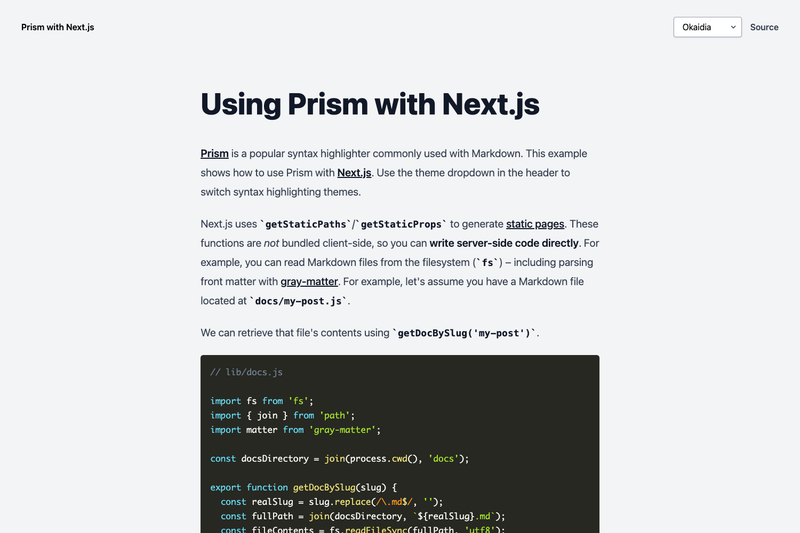
Next.js Prism Markdown is an open-source example repository that demonstrates how to render Markdown files as a website using Next.js, with Prism for syntax highlighting and a built-in theme switcher for highlighting colors. It was created by Lee Robinson, the GitHub user leerob, and includes a one-click Vercel deployment button for instant hosting.
What is Next.js Prism Markdown?
Next.js Prism Markdown is a starter project for building static or server-rendered sites that consume local Markdown files. It takes Markdown documents as input and produces styled HTML pages with code blocks highlighted by Prism, plus the ability to switch between multiple syntax highlighting themes at runtime. The project is built on the Next.js framework and can run anywhere Node.js is supported, with Vercel as the recommended deployment platform.
Key Features
- Next.js framework — Uses React-based Next.js with file-system routing and static generation, so each Markdown file in the content directory becomes a route on the site.
- Prism syntax highlighting — Integrates Prism to highlight code blocks in many programming languages, with a mechanism for dynamically switching between different Prism themes.
- gray-matter parsing — Employs gray-matter to parse YAML front matter from Markdown files, extracting metadata such as title, description, and date.
- remark Markdown processing — Uses remark to convert Markdown syntax, including headings, lists, links, and code blocks, into HTML that can be rendered by React.
- Tailwind CSS styling — Includes Tailwind CSS as a dependency for utility-first styling of the site's layout and content.
- One-click Vercel deployment — Offers a Deploy with Vercel button that imports the GitHub repository and sets up a live preview in one action.
Who is it for?
Next.js Prism Markdown is for developers who want a ready-made starting point for a Markdown-driven website. It is especially useful for building a blog, a knowledge base, or a documentation site where content is authored as Markdown. It also serves as a reference for programmers learning how to combine Next.js, remark, gray-matter, and Prism in a single project.
What can you do with it?
- Personal bloggers: Write posts as Markdown files with YAML front matter and generate a static blog with automatic code highlighting.
- Technical writers: Build documentation sites that render nested Markdown documents and display code samples with Prism themes.
- Frontend learners: Study the integration of remark and gray-matter inside a Next.js project, and experiment with switching Prism themes.
How does it work?
The project reads Markdown files from the content directory, captures their front matter with gray-matter, and transforms the remaining Markdown into HTML with remark. Prism then applies syntax highlighting to code blocks. To switch themes, the site swaps the active Prism stylesheet at runtime through the theme-switching logic shown in the example.
FAQ
Is Next.js Prism Markdown free to use?
Yes, the repository is publicly available on GitHub under the leerob account, so it can be cloned, modified, and deployed without cost.
What is Prism?
Prism is a lightweight syntax highlighting library that supports a large number of programming languages and offers many themes. This project uses Prism to color code blocks and lets you toggle between themes.
Does this project require a CMS?
No. Content is stored as plain Markdown files on the file system, which keeps the workflow simple and version-control friendly. The example relies on gray-matter for metadata, so no external CMS or database is needed.
Can I deploy this to Vercel?
Yes, the repository includes a Deploy with Vercel button that imports the project and creates a Vercel deployment automatically. Vercel is well suited for Next.js because of its native support for static generation.