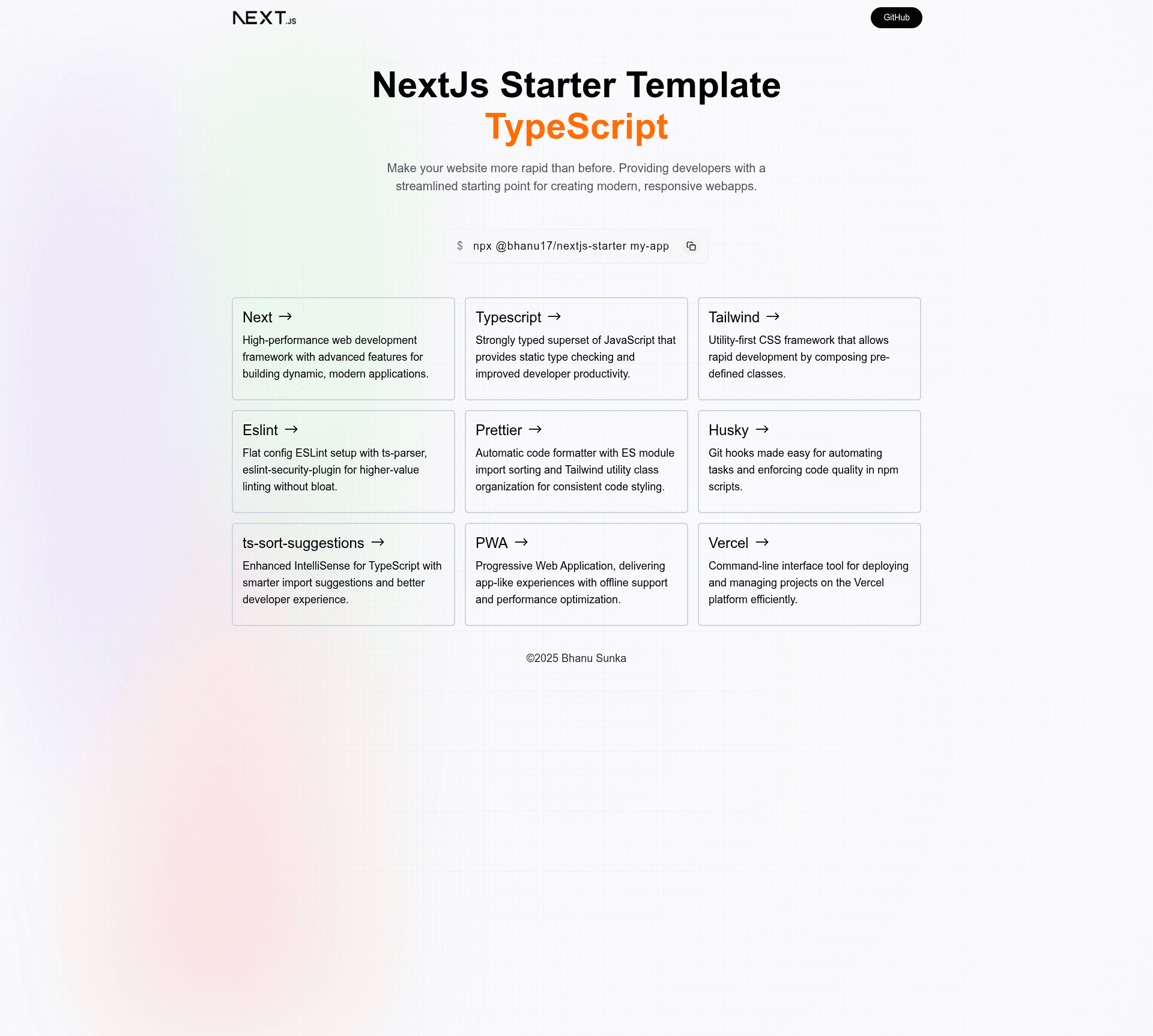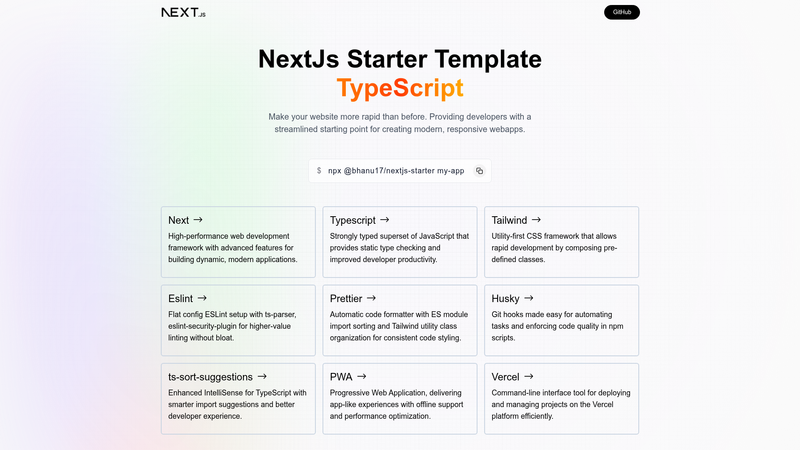
Next.js 15 Starter Template is a GitHub boilerplate that scaffolds a Next.js 15 application with TypeScript, Tailwind CSS, ESLint, Prettier, Husky, pnpm, and PWA support already configured.
What is Next.js 15 Starter Template?
Next.js 15 Starter Template is a boilerplate repository created by Bhanu Sunka to eliminate the repetitive setup time for new Next.js projects. It accepts a project name via the command npx @bhanu17/nextjs-starter my-app and generates a working application with TypeScript, Tailwind CSS, and a full linting and formatting pipeline. The template runs on Next.js 15.x and is MIT-licensed, with a live demo available on Vercel.
What makes Next.js 15 Starter Template stand out?
- Next.js 15 — Built on Next.js 15.x, the template uses the latest app router and server-side rendering capabilities.
- TypeScript — All source code is written in TypeScript for type safety and better IDE support.
- Tailwind CSS — The utility-first CSS framework is integrated, including the Tailwind CSS Prettier plugin to automatically sort utility classes.
- ESLint flat config — The project uses ESLint with flat config, including TypeScript parser, react-hooks-extra plugin, and a security plugin.
- Prettier — Code formatting is set up and configured to work with ESLint and Tailwind CSS.
- Husky — Git hooks run linting and formatting checks before commits, helping maintain code quality.
- pnpm — The package manager is pnpm, chosen for its speed and disk-space efficiency compared to npm or Yarn.
- PWA support — Progressive Web App features let the deployed site be installed on devices and work offline.
- Vercel deployment — One-click deployment to Vercel is built in, with support for the Vercel CLI and analytics.
Who should use Next.js 15 Starter Template?
- Next.js developers who want to skip the repetitive manual setup of TypeScript, Tailwind, and linting tools can start with this opinionated configuration.
- Freelancers and agencies building multiple client sites can use the GitHub template button to create new repos in one click.
- Hobbyists learning Next.js can examine the pre-configured linting, formatting, and PWA setup to understand a production-ready project structure.
What can you do with Next.js 15 Starter Template?
- Scaffold a new project — Run
npx @bhanu17/nextjs-starter my-app(replacingmy-appwith your desired name) to get a local copy with all dependencies configured. - Deploy instantly to Vercel — Type
vercelin your terminal after installation, and the app will be live in about a minute with built-in analytics. - Follow the readiness checklist — The template includes a checklist to rename fields in
package.json, update the license author, change layout metadata, and modify the PWA manifest inpublic.
How does Next.js 15 Starter Template work?
The template provides two entry points: a command-line generator via npx and a "Use this template" GitHub button that creates a new repository from it. After scaffolding, you edit the files listed in the checklist, run pnpm dev for development, and deploy using the Vercel CLI. The pre-configured Husky hooks run ESLint and Prettier automatically when you commit.
Pricing
Next.js 15 Starter Template is free and open source under the MIT license. You can use it for personal or commercial projects, modify it, and maintain your own fork.
FAQ
How do I start a new project with this template?
Run npx @bhanu17/nextjs-starter my-app, replacing my-app with your project name. Afterwards, install dependencies with pnpm install and start the development server with pnpm dev.
Is pnpm required?
Yes, the template is built around pnpm. The README instructs you to install pnpm globally with npm i -g pnpm before using the npx generator.
Can I deploy this template to Vercel?
Yes. The template includes Vercel integration by default. Typing vercel in your terminal starts the deployment process, and the project supports one-click deployment through GitHub's template feature.
Does the template include PWA features?
Yes, it comes with Progressive Web App configuration, enabling features like installability and a native app-like experience in supporting browsers.
What license is the template released under?
The project is licensed under the MIT license, allowing free use, modification, and distribution. The license file is included in the repository.