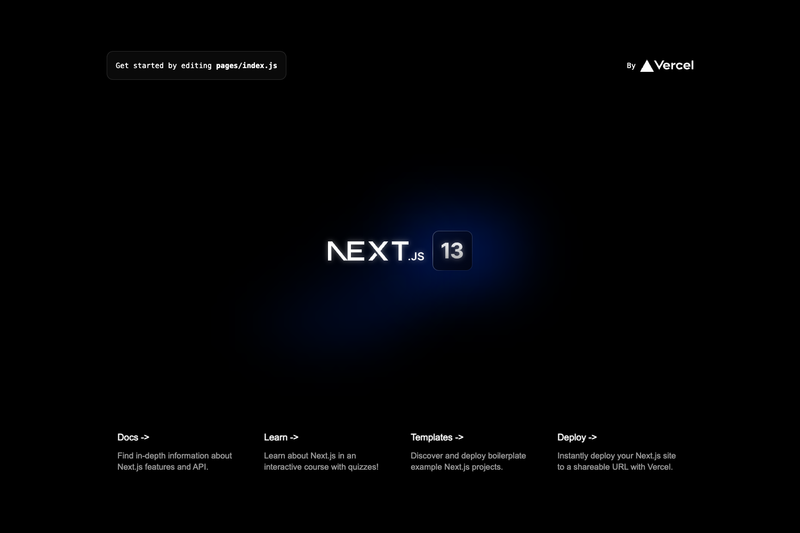
The Next.js + TailwindCSS starter is a boilerplate template that combines the Next.js React framework with TailwindCSS utility classes and TypeScript support, designed to get a new production-ready web app running with no configuration.
What is the Next.js + TailwindCSS starter?
This is a minimal starting point for building React applications with Next.js. It takes a project directory and creates a runnable app skeleton with a homepage (pages/index.js), an API route (pages/api/hello.js), and a default Next.js configuration. The template runs on Node.js and uses yarn as its package manager; starting the development server with yarn dev makes the app available at http://localhost:3000. It is generated by the official create-next-app tool and the source repository is the default Next.js template with TailwindCSS added.
The template includes hybrid static and server rendering, so pages can be pre-rendered at build time or rendered on the server. TypeScript is supported out of the box, and smart bundling handles code splitting automatically. No configuration is needed beyond installing dependencies.
Key Features
- Hybrid rendering — Next.js supports both static site generation and server-side rendering, letting you choose the best strategy per page.
- TailwindCSS preconfigured — Utility-first CSS classes are available immediately, so you can style elements without creating separate CSS files.
- API routes — Any file placed in
pages/apiis exposed as an endpoint under/api/*, allowing serverless functions inside the same project; the template includes a working/api/helloexample. - TypeScript ready — The project includes TypeScript support, with type checking and editor autocompletion built in.
- Automatic font optimization —
next/fontloads the Inter Google Font automatically and optimizes its delivery for performance. - Route pre-fetching — Next.js pre-fetches linked pages in the background to make navigation feel instant.
- Smart bundling — Production builds automatically split and minify JavaScript for faster loading.
- Vercel deployment — The template includes official instructions and a one-click deployment flow for the Vercel platform, made by the Next.js team.
Who is it for?
- Frontend developers who want a ready-made Next.js + TailwindCSS setup and would otherwise spend time configuring the toolchain themselves.
- Product teams that need a fast, production-grade foundation for a new React application, including API endpoints and TypeScript from day one.
- Students and learners who want to study Next.js by editing a working example: changing
pages/index.jsinstantly updates the browser view. - Developers familiar with the Pages Router who want a lightweight template to build on, rather than a full-featured boilerplate with many extra dependencies.
What can you do with it?
- Prototype a web app: modify
pages/index.jsto define the landing UI and watch it hot-reload as you save. - Add backend logic without a separate server: create new files in
pages/apito handle requests at corresponding/apipaths. - Deploy instantly to Vercel: push the repository and connect it to Vercel for automatic builds and hosting, with the official platform integration.
- Experiment with
next/font: use the built-in Inter font or swap in other fonts via thenext/fontconfiguration.
How does the starter work?
- Run
yarn devfrom the project root to start the development server. - Open
http://localhost:3000to see the default page. - Edit
pages/index.js; the page auto-updates as you save. - Access the sample API at
http://localhost:3000/api/hello; modifypages/api/hello.jsto change its response.
Deploying on Vercel
The fastest deployment path is the Vercel Platform, which is created by the Next.js maintainers. The template's readme links directly to a deployment flow and to Next.js deployment documentation, so you can publish the app with minimal setup.