OpenTheme is a Jekyll theme built on the Semantic UI framework that lets you publish websites and mobile-hybrid apps directly to GitHub Pages.
What is OpenTheme?
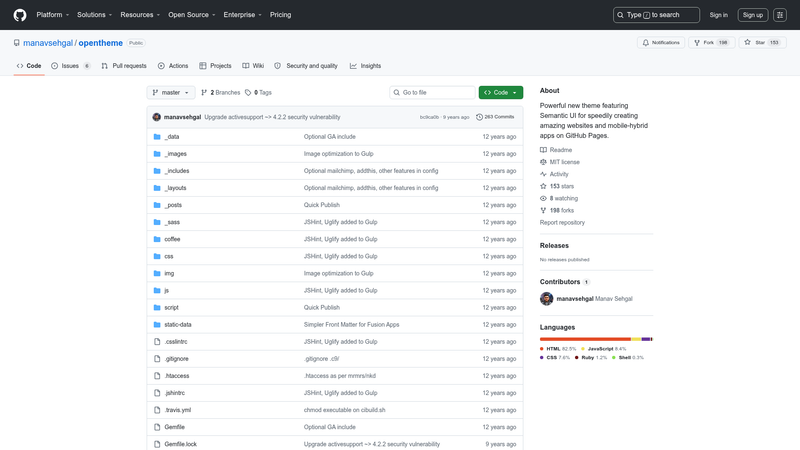
OpenTheme is a static-site theme that pairs Jekyll's page-building pipeline with Semantic UI's component library, designed specifically to run on GitHub Pages. It takes Markdown posts, structured data files (YAML, CSV, JSON), and HTML layouts as input, and produces a fully static website that GitHub Pages serves without any custom build step. The project is hosted on GitHub and has 153 stars, indicating community interest. Its file structure follows standard Jekyll conventions: _includes, _layouts, _posts, and _data.
What makes OpenTheme stand out?
- Semantic UI integration — OpenTheme uses Semantic UI as its CSS and component framework, giving sites a cohesive set of styled buttons, grids, menus, and modals out of the box.
- GitHub Pages-native deployment — Fork the repository, replace the bundled API keys in _config.yml, and publish posts or data files directly from GitHub; no external build server needed.
- Single-page app folder — The _posts/apps directory is dedicated to single-page apps, so you can host interactive tools as static pages on GitHub Pages.
- Flexible data formats — The _data folder accepts YAML Front Matter, CSV, and JSON, all natively processed by Jekyll, letting you drive content from structured data.
- Gulp-based local workflow — Run
bundle install, npm install, and gulp to build, test, serve, and watch the site locally, with BrowserSync host and port configurable in gulpfile.js.
- Helper shell scripts — The /scripts folder includes shove.sh to push changes to your repo and clone.sh to copy changes to GitHub Pages, simplifying the publish routine.
- Custom asset folders — Site-specific JavaScript goes in js/custom.js and CSS in css/custom.css, while vendor libraries are added as minified files where available.
- Jekyll layout system — Reusable _includes and _layouts make it easy to create consistent pages and posts.
Who should use OpenTheme?
- Developers who want a no-cost site on GitHub Pages — Fork OpenTheme, configure _config.yml, and start writing Markdown posts or data files; the theme builds and deploys on GitHub's infrastructure.
- Jekyll users seeking a Semantic UI aesthetic — Instead of hand-coding Semantic UI components, they get a preconfigured theme with the framework already integrated.
- Indie makers hosting small web apps — The apps folder supports single-page apps that can be served from GitHub Pages, suitable for prototypes or lightweight tools.
- Teams that need a fast local preview — The Gulp/BrowserSync setup gives an environment that rebuilds and reloads automatically during development.
What can you do with OpenTheme?
- Publish a blog or project site — Add Markdown posts to _posts/blog and they appear on the site; GitHub Pages rebuilds the static files on every push.
- Create a data-driven page — Populate _data with CSV or JSON and use Jekyll's Liquid templating in layouts to render lists, tables, or profiles.
- Host a mobile-friendly landing page — Use Semantic UI's responsive grid and components to build a landing page that adapts to phones and tablets.
- Automate deployment with shell scripts — Use shove.sh to push updates to your repository or clone.sh to copy the built site to GitHub Pages without leaving the command line.
How does OpenTheme work?
- Fork the OpenTheme repository to your own GitHub account.
- Open _config.yml and replace the API keys in the "API Keys" section with your own keys.
- Add posts, data files, or pages, then commit and push; GitHub Pages builds and serves the site automatically.
For local development, install dependencies with
bundle install and npm install, then run gulp to serve the site with BrowserSync and watch for changes.
Pros and cons
- Pros: Free hosting via GitHub Pages; no separate deployment step; Semantic UI provides ready-made components; local workflow with auto-reload.
- Cons: The development automation in the script folder is marked as a to-do — it currently only contains shell scripts, with Gulp pipeline automation, E2E tests, and lint tests still to be built. Also, the bundled API keys must be replaced before use, so you need to edit _config.yml.
Alternatives
- Lanyon — a minimal Jekyll theme from the Poole project that focuses on content and simple layouts, named as a reference project in OpenTheme's docs.
FAQ
Is OpenTheme free?
OpenTheme is published on GitHub for anyone to fork and use, consistent with typical open-source themes, though the repository does not explicitly state a license in the content reviewed. You can adopt it for GitHub Pages without paying hosting fees.
Does OpenTheme work with GitHub Pages?
Yes, OpenTheme is built specifically for GitHub Pages. Jekyll is natively supported there, so you can fork the repository, edit posts or data files, and the site is rebuilt and served automatically on push.
Do I need to replace the API keys in _config.yml?
Yes. The "API Keys" section in _config.yml contains keys bundled with the theme, and the setup instructions explicitly require replacing them with your own before publishing. Failing to do so would leave your site using the theme's keys.
Can OpenTheme build a mobile-hybrid app?
OpenTheme includes a dedicated _posts/apps folder for single-page apps and uses Semantic UI's responsive components, so you can host app-like interfaces on GitHub Pages. It is not a native mobile app builder, but a web-based foundation for mobile-friendly pages.
What is Semantic UI?
Semantic UI is a CSS framework that provides pre-styled components like buttons, grids, and menus. OpenTheme uses it as its styling layer, which is why the theme looks consistent and responsive without hand-written CSS for common elements.