The Next.js TailwindCSS Template is an opinionated boilerplate that scaffolds a Next.js application preconfigured with TailwindCSS, TypeScript, and a complete developer toolchain spanning testing, linting, formatting, and git hooks, so you can start building a web app without setting up infrastructure.
What is the Next.js TailwindCSS Template?
This template is a Next.js project bootstrapped with create-next-app and extended with a set of opinionated tools and conventions. It takes no user input at setup; you clone or copy it and run a package manager to install dependencies, then edit the source files under src to build your application. The template runs on Node.js and produces a standard Next.js app that can be deployed to Vercel or any platform supporting Next.js. It originated from Howard86's nextjs-template and is released under the MIT license.
What makes this template stand out?
Instead of a bare create-next-app, this template ships with production dependencies daisyUI, Heroicons, and Next API Handler, plus development tools for testing, code quality, and git workflow. Here are the concrete components included:
- daisyUI — a TailwindCSS component library that provides ready-made UI classes and can be customized via Tailwind config, so you get styled buttons, cards, and forms without writing custom CSS.
- Heroicons — a set of SVG icons that integrates with the UI layer, giving you access to outline and solid icons for common interface elements.
- Next API Handler — a middleware library for Next.js API routes that simplifies request handling, as documented at next-api-handler.vercel.app.
- TypeScript — the project is fully typed, with configuration files and examples using .tsx modules like src/app/page.tsx.
- Testing stack — Jest with React Testing Library is preconfigured for unit and component tests, and MSW mocks API requests in development and tests.
- Linting and formatting — ESLint with the Airbnb TypeScript config enforces style, while Prettier with prettier-plugin-tailwindcss automatically sorts Tailwind utility classes.
- Git hooks — husky and lint-staged run linting and tests on staged files in pre-commit and pre-push hooks, and commitlint enforces conventional commit messages.
- @tailwindcss/typography — a Tailwind plugin that applies typographic styles to plain HTML content, useful for blog posts or document-like pages.
Who should use this template?
Developers who want a well-configured starting point for a Next.js project without hand-configuring TypeScript, ESLint, Prettier, and testing tools are the primary audience. The template is especially useful for:
- Next.js developers — who need a foundation that already wires up TailwindCSS with daisyUI for UI development and includes API-route tooling via Next API Handler.
- Teams that enforce code quality — who want Airbnb-style ESLint rules, Prettier formatting, and git hooks with commitlint already in place to standardize contributions.
- Developers writing API routes — who can use the included Next API Handler to reduce boilerplate in route handlers and rely on MSW to mock backend calls in tests.
What can you do with this template?
With this template, you can move from a blank page to a styled, tested Next.js application without the usual setup overhead. Typical uses include:
- Launch a marketing site — use daisyUI components and Heroicons to build a responsive landing page with Tailwind utility classes and no custom CSS.
- Set up a blog or docs site — leverage @tailwindcss/typography to render long-form content with clean typography from HTML or Markdown.
- Create a full-stack app — combine the built-in API routes with Next API Handler and MSW to develop against mocked endpoints before the backend is ready.
- Prototype with confidence — rely on the preconfigured Jest/React Testing Library setup to write component tests as you build, and let husky/lint-staged catch errors at commit time.
How does this template work?
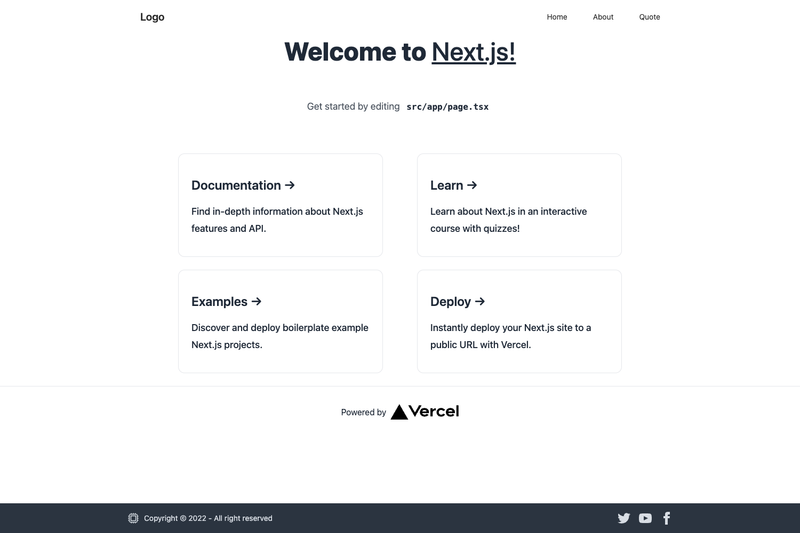
The template is a standard Next.js app structure. Install dependencies with npm install or yarn, run npm run dev to start the development server at http://localhost:3000, and edit src/app/page.tsx to change the home page. The page auto-updates on save. For production, run a build and deploy to Vercel via the provided deployment documentation.
Pricing
This project is free to use under the MIT license. There are no paid tiers or subscription requirements; you may use, modify, and distribute it as you wish.
FAQ
Is the Next.js TailwindCSS Template free?
Yes, it is released under the MIT license. You can use it in commercial and personal projects without paying a license fee, and you may modify or redistribute the code.
What does the template include?
It includes a Next.js project with daisyUI, Heroicons, and Next API Handler as production dependencies. Development dependencies add TypeScript, Jest with React Testing Library, ESLint with Airbnb config, Prettier with prettier-plugin-tailwindcss, husky, lint-staged, commitlint, and MSW.
How do I start developing?
Clone or copy the repository, run npm install or yarn to install dependencies, then run npm run dev. Open http://localhost:3000 to see the default page. The site auto-reloads when you edit files under src.
Does the template work with TypeScript?
Yes. The project is written in TypeScript and includes tsconfig files and example modules such as src/app/page.tsx that use TypeScript syntax. ESLint is configured to enforce Airbnb's TypeScript style.
Can I deploy the template to Vercel?
Yes, the README points to the Vercel platform as the easiest deployment option for a Next.js app, and links to the official Next.js deployment documentation for other platforms.