Newsletter
Join the Community
Subscribe to our newsletter for the latest news and updates

Nuxt3 app template for github pages deploy

Open-source Tailwind CSS starter template with a fixed header, ready to customize.
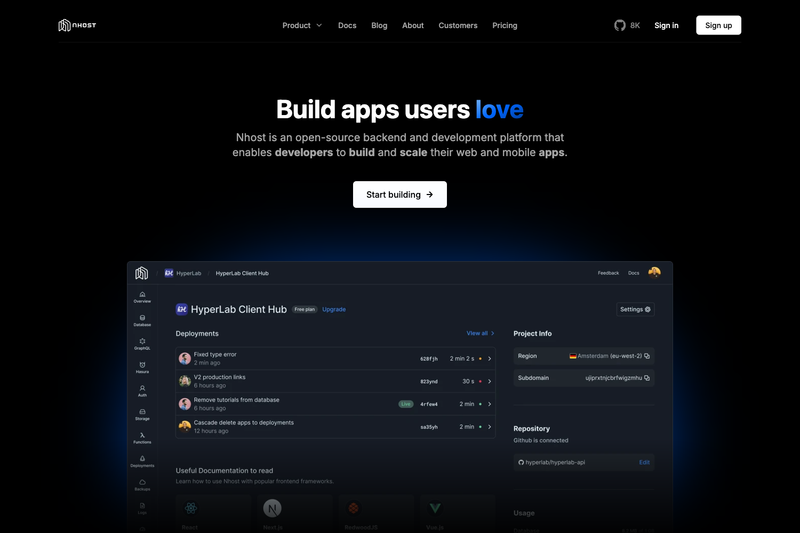
A Nuxt.js boilerplate preconfigured with Nhost's GraphQL, authentication, and Tailwind CSS for rapid full-stack development.

Minimalist Hugo theme with dark/light modes, image banners, and Lunr.js search.
Next.js demo that fetches movies from AWS Aurora PostgreSQL using secure OIDC and RDS IAM authentication.
Nuxt3 Ghpages is a boilerplate template for deploying a Nuxt3 application to GitHub Pages using the gh-pages library. It packages a minimal Nuxt3 app with a single npm run deploy script that static-generates the site and pushes it to the gh-pages branch, so GitHub Pages can serve it without extra CI configuration.
Nuxt3 Ghpages is a starter template by dariotecchia that demonstrates how to publish a Nuxt3 app on GitHub Pages. The input is a standard Nuxt3 project, and the output is a static site hosted under https://dariotecchia.github.io/nuxt3-ghpages/. The template relies on nuxt generate to pre-render pages into .output/public and on the gh-pages library to commit that directory to the gh-pages branch. It runs on any machine with Node.js and npm, and the deployment target is GitHub Pages.
nuxt generate.npm run deploy runs nuxt generate && gh-pages --dotfiles -d .output/public, combining the build and branch push in a single step.nuxt.config.ts includes an app.baseURL option; leave it empty for user pages like username.github.io, or set it to /repo-name/ for project pages like this one.gh-pages library, which creates the gh-pages branch on the first deploy and pushes only the .output/public folder thereafter.--dotfiles flag ensures hidden files in the build output are included in the published branch.nuxt generate for pre-rendered output and need a simple, no-frills hosting path via GitHub Pages.gh-pages branch, supporting both user and project page URLs.username.github.io repository, set baseURL to an empty string and the site appears at the root of your GitHub Pages domain.baseURL to the repository name, and the site lives at https://username.github.io/repo-name/.npm run deploy creates the gh-pages branch, you can repeat the same command to publish site updates.The workflow starts by editing app.baseURL in nuxt.config.ts to match your target GitHub Pages location. You install dependencies with npm install, verify locally with npm run dev, then run npm run deploy. That command builds the static site into .output/public and uses gh-pages to push that directory to the gh-pages branch. Finally, in the repository Settings > Pages menu, you select the gh-pages branch as the publishing source, and GitHub Pages serves the site.
Set app.baseURL to the appropriate value (empty for user pages, the repo name with slashes for project pages), run npm install, then run npm run deploy. Once the script pushes to the gh-pages branch, go to Settings > Pages and choose that branch as the source.
npm run deploy actually do?It executes nuxt generate && gh-pages --dotfiles -d .output/public. First it generates a static version of the app into .output/public, then the gh-pages library commits and pushes that folder to the gh-pages branch, preserving dotfiles via the --dotfiles flag.
Yes. If your repository is not named username.github.io, you must set app.baseURL to the repository name, such as /nuxt3-ghpages/. Otherwise asset and route paths may break on the hosted site.
Yes. For a user or organization page hosted in a username.github.io repository, you can delete the app.baseURL property or leave it as an empty string, and the site will be served from the root.
The template is public on GitHub and uses free building blocks: Nuxt3 is open source, the gh-pages npm library is free, and GitHub Pages offers free static hosting. No paid services are required unless you add a custom domain.