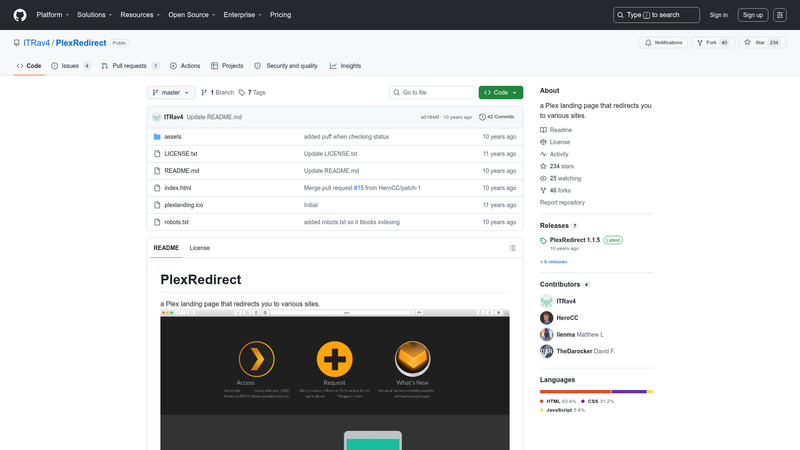
PlexRedirect is a self-hosted HTML landing page that gives Plex server owners a single hub for opening Plex.tv, PlexRequests, and PlexEmail while displaying whether their server is online or offline.
What is PlexRedirect?
PlexRedirect is a lightweight, single-page HTML template that serves as a central landing page for a Plex media server. It accepts your server name and links to external Plex services as input, and produces a styled page with clickable redirects and an automated status indicator. The template runs on any static web server or web root folder because it consists only of HTML, CSS, and JavaScript, with no build step or dependencies beyond the included ping.js library. The project is distributed under the MIT License and the Plex logo and name remain copyright of Plex Inc.
Key Features
- Server status indicator — Uses ping.js to automatically show whether your Plex server is online or offline on the landing page.
- One-click redirects — Links to Plex.tv, PlexRequests, and PlexEmail, letting users jump to each service from a single page.
- Customizable server name — Blank spaces in the template are where your server name goes; you can replace them with anything if you don't have a server name.
- Simple static deployment — Works by adding the files to your webserver root folder and accessing it via your IP address; no database or server-side code is required.
- Editable domain and port — The document.domain and port can be changed in index.html so the status check works with your network setup.
- MIT licensed — The template is free to use and modify, with the Plex trademark remaining with Plex Inc.
Who is it for?
Plex server owners who want a simple, branded entry point to their Plex ecosystem. It's also useful for small households or shared servers that use companion tools like PlexRequests and PlexEmail, giving everyone a single link to start from. The lightweight static design suits any user who prefers a no-database, no-build setup on their existing web space.
What can you do with PlexRedirect?
- Plex server admins: Create a custom landing page on your IP address that lets users open Plex.tv, PlexRequests, and PlexEmail without remembering multiple URLs.
- Household users: Check whether the Plex server is online at a glance before trying to stream.
- Self-hosters: Deploy the page to any web root folder, and use domain masking to make it accessible through a friendly subdomain like requests.example.com.
How does PlexRedirect work?
Installation is straightforward: copy the files to your webserver root folder, optionally rename them to your server name, and access the page via your IP address. To customize, edit index.html to change your server name and the links, and adjust document.domain and port if automatic detection doesn't work. The author's example setup uses domain forwarding with masking to map a domain like www.example.com to their public IP and port, plus separate subdomains for PlexRequests and PlexEmail.
FAQ
Is PlexRedirect free to use?
Yes, PlexRedirect is licensed under the MIT License, so you can freely use, modify, and distribute it. The Plex logo and name are copyright of Plex Inc., and are not covered by the MIT license.
What do I need to run PlexRedirect?
You need any static web server or a webserver root folder where you can place the HTML file. No database, PHP, or build tools are required — just the HTML and JavaScript files from the repository.
How do I change the server status check?
Edit index.html to set document.domain to your server's IP address or a DNS service name, and adjust the port if it isn't detected automatically. The README also mentions checking semicolons in your changes if the ping isn't working.
Which services does PlexRedirect link to?
By default, it links to Plex.tv, PlexRequests (from lokenx/plexrequests-meteor), and PlexEmail (from jakewaldron/PlexEmail). The links can be edited in index.html to point to your own instances.
Who maintains PlexRedirect?
The repository is a community project with several contributors who added ping.js, fixed Google Fonts protocol selection, fixed a missing semicolon, and cleaned up HTML tags. The original repository description describes it as a Plex landing page that redirects to various sites.