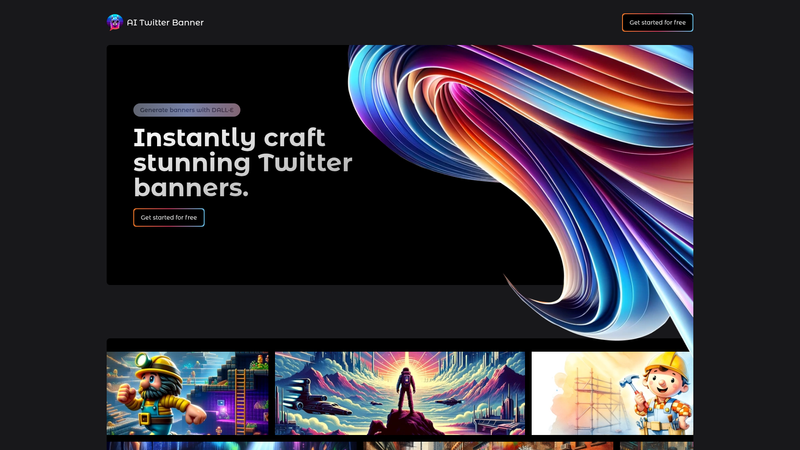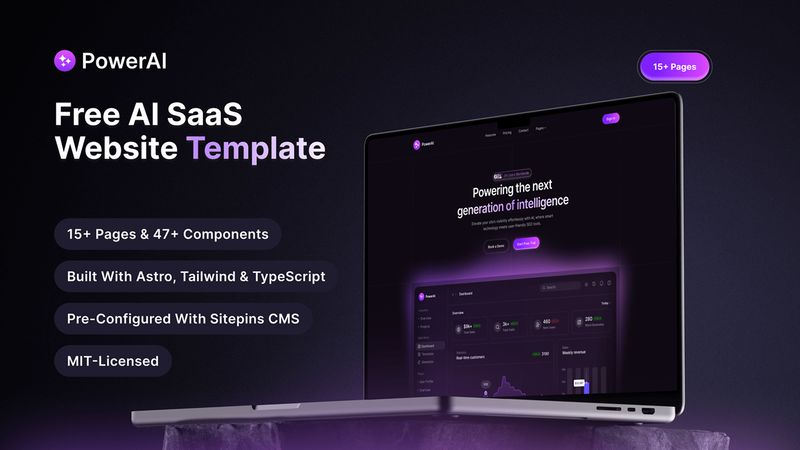
PowerAI Astro is a free, dark-themed AI SaaS website template built on Astro, Tailwind CSS, TypeScript, and React that ships with 16 pre-built pages and 47 components for launching AI product sites.
What is PowerAI Astro?
PowerAI Astro is a free, dark-themed static website template for AI SaaS products, created by Sitepins CMS and released under the MIT license. It accepts Markdown content and JSON configuration files as input, and outputs a static HTML site with blog, case studies, careers, integrations, pricing, and changelog pages. The template runs on Astro 6 with Tailwind CSS 4, React 19, TypeScript, and Framer Motion 12, and can be deployed to Cloudflare Workers, Netlify, Vercel, or Docker.
Key Features
- 16 pre-built pages — The site includes home, pricing, features, changelog, about, contact, blog, blog details, careers, career details, case studies, case study details, integrations, integration details, a 404 page, and regular content pages like privacy policy and terms of service.
- 47 components, partials, and shortcodes — The kit bundles 24 UI components (accordion, animated button, pricing table, video modal), 16 page partials (hero, FAQ, testimonials, trusted clients), and 7 MDX shortcodes (tabs, notices, video player, YouTube player).
- Astro + Tailwind CSS 4 + React 19 stack — Astro 6.0.4 provides static-site generation with minimal JavaScript, Tailwind 4.2.1 handles styling, and React 19.2.4 powers interactive components.
- Framer Motion v12 animations — Scroll-triggered reveals, transitions, and micro-interactions are built into the animation wrappers under src/layouts/components/animations/.
- Sitepins git-based CMS integration — Editors can use the visual Sitepins app to update content and configuration, with changes committed back to the Git repository.
- MDX shortcode library — Content authors can embed accordions, tabs, notices, and video players directly in Markdown files using shortcodes defined in the layout folder.
- Multi-platform deployment — The project includes a Dockerfile, a wrangler configuration for Cloudflare Workers, and build instructions for Netlify, with scripts like yarn deploy:cf-workers.
- JSON-driven configuration — Site metadata, navigation, social links, and theme (colors, fonts, sizing) are controlled by config.json, menu.json, social.json, and theme.json in src/config/.
Who is it for?
- AI product founders and SaaS teams — They can replace placeholder content in src/content/ and configure the theme to launch a full marketing site with product pages, pricing, documentation-ready blog, and careers.
- Agencies and freelancers — The MIT license allows reuse across client projects, while the JSON config and Sitepins CMS handoff make it practical for non-technical clients to manage.
- Developers wanting a full-featured starter — With 24 components and 7 shortcodes already wired, developers can focus on custom features instead of building UI primitives.
- Content teams without coding access — Using Sitepins, editors can publish blog posts, case studies, and job listings through a visual interface without touching the source code.
What can you do with PowerAI Astro?
- Launch an AI product site: Fill in homepage sections, features, pricing, and integrations with your own copy, then deploy to Cloudflare Workers by running yarn deploy:cf-workers.
- Publish a company blog and case studies: Create Markdown files in src/content/blog/ and src/content/case-studies/ with frontmatter for title, description, image, author, category, date, and featured flag.
- Post job openings: Use src/content/careers/ with structured fields like employment type, experience, salary range, location, department, and deadline.
- Customize branding without code: Update theme.json for primary and secondary colors, background, card colors, and font family, then run the theme generator script to rebuild the CSS.
How does PowerAI Astro work?
The workflow is: clone the repository, run yarn install and yarn run dev for local development, then edit src/config/config.json for site name and URL and src/config/theme.json for color and font choices. Content is added as Markdown via Astro Content Collections, and the build command yarn run build produces a static dist folder that can be deployed to Cloudflare Workers, Netlify, Vercel, or Docker.
Pros and cons
- Free and MIT licensed — The template can be used for personal and commercial projects without a license fee.
- Rich out-of-the-box coverage — 16 pages and 47 components cover most sections an AI SaaS site needs, from pricing to case studies.
- Dark theme only — The default design is dark-themed, so a light aesthetic requires custom CSS changes.
Pricing
PowerAI Astro is free to download and use under the MIT license.
FAQ
Is PowerAI Astro free?
Yes. The template is released under the MIT license, so it is free for both personal and commercial use with no restrictions on redistribution or modification. No paid tier or premium unlock is mentioned on the project page.
What are the system requirements?
The README specifies Node.js v22.0 or later, Yarn v1.22 or later, and Astro v5.15 or higher. The installed dependencies in package.json include Astro 6.0.4, Tailwind CSS 4.2.1, React 19.2.4, Vite 8.0.0, and TypeScript 5.9.3.
Can I deploy to Cloudflare Workers?
Yes. The project includes a wrangler configuration and an npm script for Cloudflare Workers deployment. Run yarn deploy:cf-workers after authenticating with the Wrangler CLI, or use yarn preview:cf-workers to simulate the Workers environment locally.
Does it include a CMS?
The template is pre-configured for Sitepins, a Git-based headless CMS. By opening the repository through the Sitepins app, editors can visually modify content and assets, with changes written back to Git. Blog posts, case studies, careers, and integrations are all content collections editable this way.
What content collections are available?
Astro Content Collections provide typed schemas for homepage, blog, case-studies, careers, integrations, sections, and pages. Each entry is a Markdown file with frontmatter fields for metadata like title, description, image, author, date, and featured.