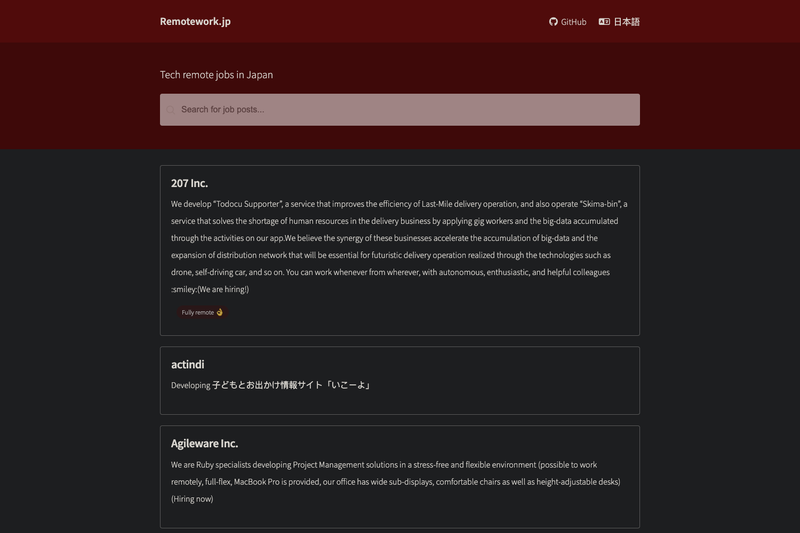
Remote In Japan is a community-curated GitHub directory, built with Jekyll and hosted on GitHub Pages, that lists technology companies in Japan offering remote and full-remote work arrangements. Each entry includes the company name, a description of its business and tech stack, and a flag indicating whether fully remote work is allowed.
What is Remote In Japan?
Remote In Japan is an open-source Markdown table that collects Japanese tech companies open to remote work, with direct links to each company's hiring page, engineering blog, or recruitment portal. The main README is written in Japanese, and an English version is available at README.en.md, making the directory accessible to international job seekers. The repository currently has nearly 2,000 GitHub stars and is maintained by community contributions via pull requests.
Key Features
- Full-remote flag — Each row contains a column marked with a hand emoji (ok_hand) indicating whether the company allows fully remote work, giving job seekers an instant filter.
- Tech-stack transparency — Many descriptions list concrete technologies such as Ruby on Rails, Next.js, TypeScript, Go, AWS, GCP, Flutter, and Vue.js, so engineers can match their preferred tools.
- Direct application links — Every company entry links to its recruiting page or job board (Wantedly, HERP, hrmos, Green, Workable, and company career sites).
- Bilingual README — The Japanese README is paired with an English translation, and some company descriptions include English notes.
- Company diversity — The directory spans early-stage startups (Asobica, mocomoco), mid-size SaaS firms (kickflow, hacomono), and major enterprises (Yahoo! Japan, LINE, NTT Communications, U-NEXT).
- Remote-policy specifics — Entries detail concrete working arrangements, such as "full remote with quarterly office days" (Kaonavi), "choose remote or office per day" (U-NEXT), "full remote and flex" (LayerX, SocialDog), and "no core time super flex" (Kaonavi).
- Jekyll site — The project uses Jekyll, is deployed on GitHub Pages, and the source is versioned in a public GitHub repository.
Who is it for?
- Software engineers in Japan — find companies that allow full remote work and match their preferred stack, then apply directly through the linked hiring pages.
- International developers — use the English README to explore Japanese companies open to remote work and learn about their engineering culture and tech stacks.
- Job seekers comparing benefits — review each company's remote policy details, such as flex time, no core hours, and work-from-anywhere rules, before applying.
- Recruiters and HR teams — monitor which competitors advertise remote work and how they phrase their policies, informing their own employer branding.
What can you do with Remote In Japan?
- Filter for full-remote roles: scan the ok_hand column to shortlist companies where all engineering staff work fully remotely, such as kickflow, LayerX, BoostDraft, Autify, and ZOZO.
- Search by technology: look up specific stacks in the descriptions — for example, Go and Next.js (Canary), Ruby on Rails and Vue.js (kickflow), PHP and Laravel (Greff), or Python and Django (Credit Engine).
- Compare working styles: read each entry's policy — U-NEXT lets employees switch between remote and office daily, while Cluster requires a Wednesday office day and Kaonavi asks for quarterly attendance.
How does Remote In Japan work?
The directory is a single Markdown table in the README file. Each row links the company name to its official website, presents a short description that typically includes the business mission and technical stack, and shows a full-remote emoji when applicable. Readers click through to the company's recruiting page or engineering blog to learn more and apply.
FAQ
Is Remote In Japan free?
Yes, it is an open-source GitHub repository, so browsing the company list is free. Anyone can also contribute new companies by opening a pull request on GitHub.
Does Remote In Japan have an English version?
Yes, the repository includes README.en.md, an English translation of the main Japanese README, making the directory usable for non-Japanese speakers.
What kind of companies are listed?
The list covers Japanese technology companies from small startups to large public enterprises, including SaaS developers, app makers, fintech firms, and IT infrastructure companies. Each entry includes a description and usually states the technology stack and remote-work policy.
Are all listed positions fully remote?
Not necessarily. The ok_hand emoji in the full-remote column indicates companies where at least some roles (often engineering) can be fully remote. Some companies offer hybrid arrangements, such as a few office days per month or quarterly in-person meetings, as described in their individual entries.