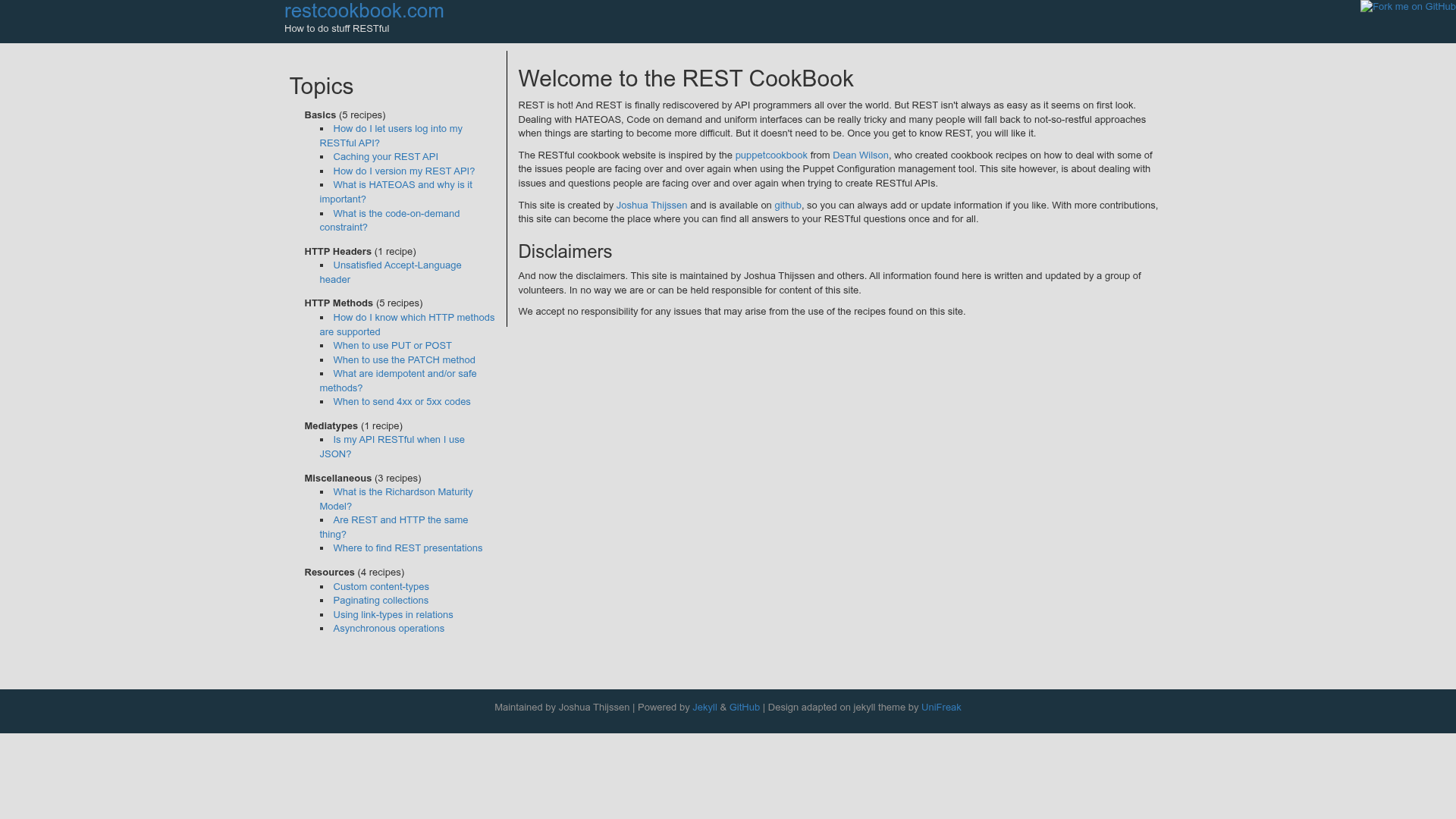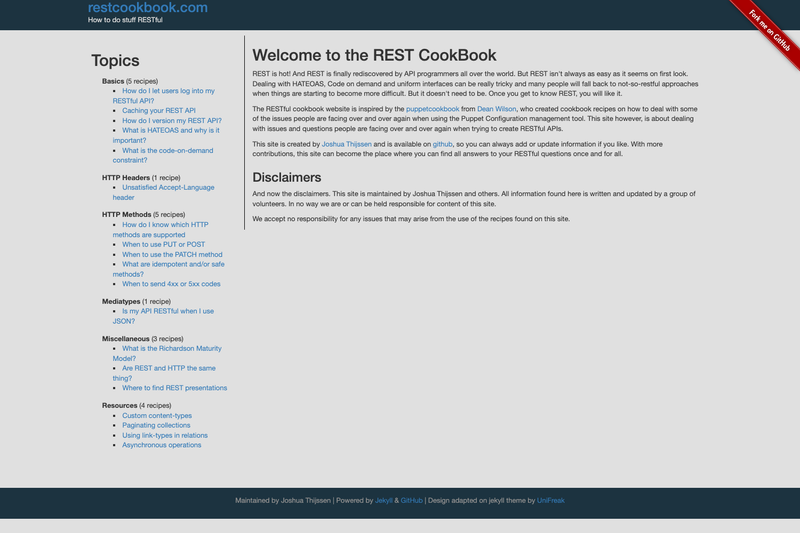
REST Cookbook is a Jekyll-powered, community-contributed website that collects short practical recipes for working with RESTful APIs, and its GitHub repository serves as a ready-made template for launching a similar Jekyll-based recipe or documentation site.
What is REST Cookbook?
REST Cookbook is a Jekyll-based static website that hosts a collection of concise, practical "recipes" for designing, consuming, and troubleshooting RESTful APIs. The site content lives in a GitHub repository that uses Jekyll as its content management system; each recipe is a single HTML post with YAML front matter that defines its title, category, author, and optional author email. The repository itself is a working template: contributors fork it, add posts in the /_posts directory, and submit pull requests to publish new content.
Key Features
- Jekyll static generation — The site is built with Jekyll, the Ruby-based static site generator, producing a plain HTML
_sitefolder ready for deployment on any web server. - Simple post workflow — New recipes are added as files in
/_postswith a strictYEAR-MONTH-DAY-filename.htmlnaming convention; any file not following that pattern is ignored. - YAML front matter metadata — Each post declares a
layout: recipe, atitle, acategory, anauthor, and an optionalauthor_email, which Jekyll uses to organize and display the recipe. - Category-based organization — Posts are grouped by their front-matter category; using an existing category name exactly (case matters) keeps recipes together, while a new name creates a new section.
- Local preview server — Running
jekyll serverat the repository root serves the site at http://localhost:4000 for immediate previewing. - Regeneration command — Simply running
jekyllwithout parameters rebuilds the_siteoutput directory after any content change.
Who is it for?
- REST API developers who want to publish field-tested tips and gotchas for HTTP methods, headers, and status codes in a lightweight community format.
- Technical writers responsible for API documentation who need a low-friction way to manage a collection of short articles with categories and author attribution.
- Jekyll users who want a minimal, CMS-like editing experience based on flat files and GitHub pull requests, without a database.
What can you do with it?
- Share a REST recipe: Fork the repository, create a dated HTML post in
/_postswith the required front matter, and submit a pull request to get your recipe live on restcookbook.com. - Preview edits locally: Use
jekyll serverto view your branch in a browser at port 4000 before pushing changes. - Deploy as a standalone site: Point your web server document root at the generated
_sitedirectory, or serve it directly with Jekyll's built-in server.
How does REST Cookbook work?
Contributors follow a fork-and-pull-request model: fork the repository to their GitHub account, clone it to a new branch, add a post file in the /_posts directory with the required date-prefixed filename, push the branch, and open a pull request. Jekyll then builds the site, converting front matter and HTML into static pages.