Some style please! is an open-source Hugo theme that transforms Markdown content into a fast, minimalist, and responsive static website, building on the nostyleplease design and adding multilingual support, image galleries, captions, and lightweight shortcodes without requiring Node.js or npm.
What is some style please!?
Some style please! is an open-source Hugo theme that turns Markdown content into a fast, minimalist, and responsive static website. It inherits the text-focused design of the nostyleplease theme and adds multilingual support, image galleries, captions, and lightweight shortcodes without requiring Node.js or npm. The theme is developed by jkkNl and released under the MIT License.
Key Features
- Minimalist and responsive interface — A clean layout that works on desktop and mobile with minimal CSS overhead.
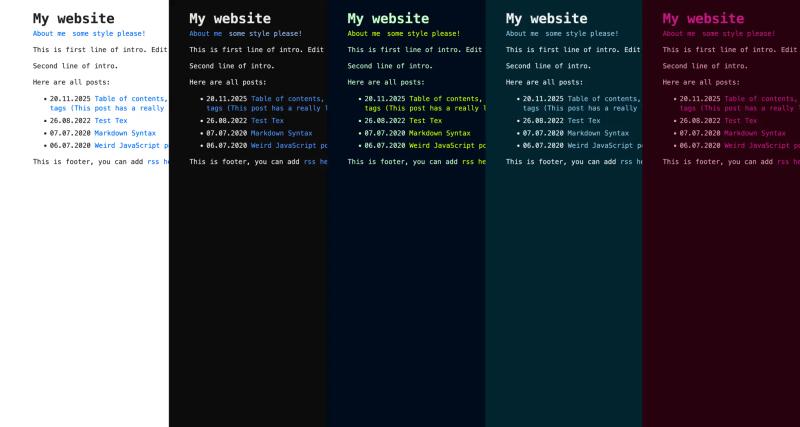
- Six color schemes — Choose from
auto,light,dark,matrix,bear, andtogethervia theappearancesetting inparams.theme_config. - Multilingual support — Create content in multiple languages with language code suffixes (e.g.
my-post.en.md,my-post.pl.md), including per-language taxonomies and RSS feeds. - Language switcher — Displays only available translations of the current page, skipping empty or unnecessary links.
- Categories and tags — Generate taxonomy pages with lowercase term names, configurable with
categories = trueandtags = true. - Responsive image galleries — A
galleryshortcode builds a CSS Grid gallery without JavaScript, with captions and links in captions supported. - Image and video captions — Use the image title syntax to display centered captions; detects video extensions like
webm,mp4,m4v,ogv,ogg, andmov. - MathJax support — Enable math on individual pages with
mathjax = truein front matter and use thetexi/texdshortcodes. - Goldmark footnotes — Native Hugo footnotes work in regular content and are not intercepted inside captions.
- No Node.js build tools — Uses Hugo Pipes, minification, and CSS fingerprinting, so no external dependencies are required.
Who is some style please! for?
- Bloggers who want a fast, minimal blog with straightforward Markdown authoring and no build step beyond Hugo.
- Multilingual content creators who need to publish the same content in several languages and want per-language RSS feeds and taxonomy pages.
- Developers who prefer a Hugo-only workflow without npm or JavaScript tooling and want to customize via Hugo's partial and asset overrides.
- Photographers and visual storytellers who can use the gallery shortcode and image captions to present images in a clean layout.
What can you do with some style please!?
- Set up a personal blog — Write posts with tags, categories, table of contents, and footnotes, and control pagination via
post_limitandshow_more_url. - Create a multilingual site — Define languages in
config.toml, add translation files with language codes, and use the interface translation keys likehomepage.introandgeneral.tags. - Publish image and video stories — Embed videos with Markdown-like syntax, add captions with links, and build responsive galleries using the
galleryshortcode. - Build a documentation-style site — Use pages, a bordered table of contents, highlighted content, and native footnotes to structure articles.
How does some style please! work?
Clone or add the repository as a submodule under themes/somestyleplease, then set theme = "somestyleplease" in your Hugo configuration. Place content files with front matter (like title, date, categories, tags, toc) in content/, run hugo server, and the theme renders them into static pages. Configuration values live under params.theme_config, and project-level files override theme defaults.
Pricing
The theme is free and open source under the MIT License. You can use it for personal and commercial projects without charge.
Alternatives
- nostyleplease — the original theme this one is based on; it lacks multilingual support, galleries, and some shortcodes.
- wooseopkim/hugo-theme-nostyleplease — another variant that contributes code to this theme.
FAQ
Does some style please! require Node.js?
No. The theme uses Hugo Pipes for CSS processing, minification, and fingerprinting, so only a Hugo installation is needed.
How do I create multilingual content?
Create content files with language code suffixes, such as my-post.en.md and my-post.pl.md, and define the languages in your Hugo configuration under languages. The theme's language switcher automatically shows available translations.
What video formats are supported?
The Markdown video syntax detects webm, mp4, m4v, ogv, ogg, and mov extensions, and adds native controls with preload="metadata".
Can I use the theme without a colorscheme configuration?
Yes. The default appearance is auto, which follows the system preference, and you can switch to light, dark, matrix, bear, or together via the appearance parameter.