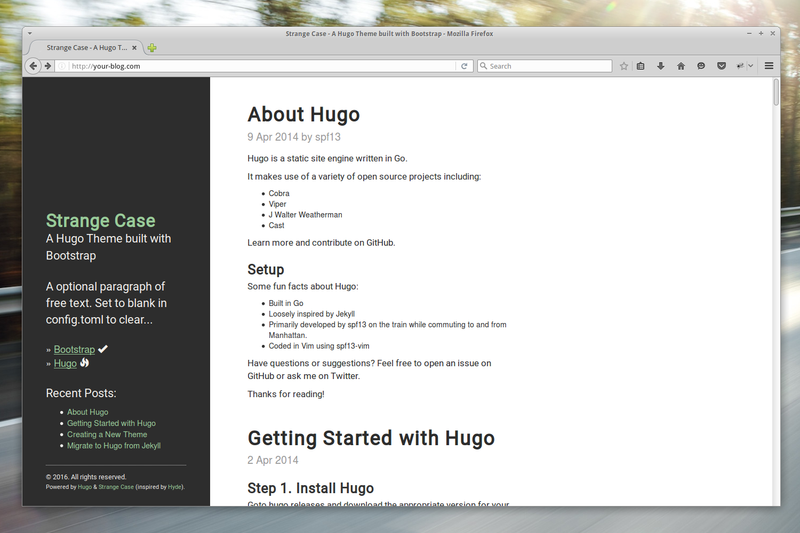
Strange Case is a Hugo theme that recreates the classic Hyde Jekyll theme's two-column design using Bootstrap 3, giving Hugo users a configurable, mobile-responsive alternative to the original.
What is Strange Case?
Strange Case is a Hugo theme built as a Bootstrap 3 clone of the Hyde theme originally created for Jekyll by Mark Otto. It renders Hugo site content in a two-column responsive layout with a customizable sidebar, and it was developed by ExchangeRate-API.com. The theme ships with Bootstrap version 3.3.7 and a single stylesheet, and it is released under the MIT License.
Key Features
- Bootstrap 3.3.7 foundation — Built from an empty Bootstrap 3 template with a single
strange-case.cssstylesheet, keeping the code simple and easy to modify. - Two-column responsive design — The layout uses a sidebar plus a main content column, adapting to screen sizes with Bootstrap's grid.
- Six configurable color schemes — Includes Dark Brown, Light Brown, Green, Orange, Slate (all based on Base16 palettes), plus a bonus Gulf Racing scheme, all switched via the
colorSchemeparameter inconfig.toml. - Custom sidebar content —
sidebarFreeTextlets you add a paragraph of free text, andcontact_emailadds a mailto: link in the sidebar. - Menu support —
menu.mainentries create sidebar links, with an optionalpostvariable to append HTML (e.g. Bootstrap glyphicons) after each link. - Social icons via menu —
menu.iconsentries create clickable icon links, and each can use thepostvariable to inject custom icon HTML. - Analytics integrations — Supports Hugo's native Google Analytics (
googleAnalyticssetting) plus Piwik tracking viapiwikSiteIDandpiwikURLparameters. - Custom color scheme creation — Users can edit a template at the end of
strange-case.cssto make their own schemes, and pull requests for quality schemes are welcome.
Who is it for?
- Hugo users who already like Hyde — They can get the same sidebar-and-content design without switching away from Hugo or from Bootstrap.
- Developers who want a minimal, hackable theme — The code is intentionally simple (clearly formatted HTML and one stylesheet), making it easy to alter or extend.
- Bloggers wanting a config-driven setup — Everything from description text to color scheme to menu links is controlled from
config.toml.
What can you do with Strange Case?
- Bloggers: Publish a personal blog with a sidebar that shows a description, optional free-text paragraph, contact link, and menu links, all without editing HTML.
- Developers: Create a custom color scheme by editing the template at the end of the stylesheet, then submit it as a pull request.
- Site owners: Integrate either Google Analytics or Piwik tracking by setting the corresponding parameters in
config.toml.
How does Strange Case work?
Installation is a two-step process: clone the repository into the themes/ folder of your Hugo site, then set the theme value in config.toml to strange-case. After that, configure the [params] section to choose a color scheme, add sidebar text, and set up menu links. The theme renders pages using Hugo's template engine with Bootstrap 3.3.7 for styling.
FAQ
Is Strange Case free to use?
Yes, the theme is released under the MIT License.
Can I create my own color scheme?
Yes, the stylesheet includes a template at the end of strange-case.css where you can add custom schemes, and pull requests for quality color schemes are accepted.
Does Strange Case support analytics?
Yes, it supports both Google Analytics (via the googleAnalytics setting) and Piwik (via piwikSiteID and piwikURL parameters in config.toml).
Does Strange Case use the latest Bootstrap?
No, it currently includes Bootstrap version 3.3.7, so it predates Bootstrap 4 and 5 and lacks their newer components and utilities.
Who made Strange Case?
It was created by ExchangeRate-API.com, and it is inspired by the Hyde Jekyll theme by Mark Otto and the original Hugo port by Steve Francia.